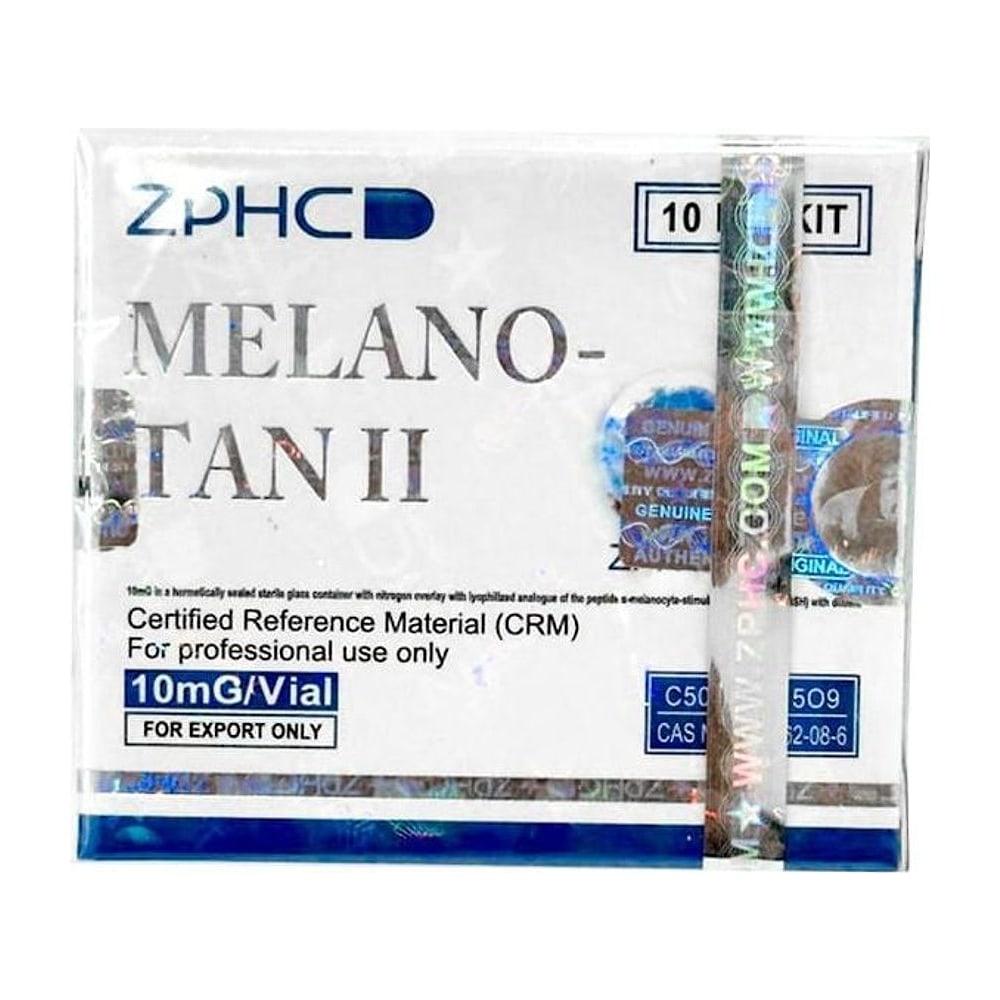
Research Disclaimer: Melanotan II is sold exclusively for in-vitro and laboratory research use. Not for unsupervised use. This content does not constitute medical advice.
Melanotan II (MT-II; Ac-Nle⁴-cyclo[Asp⁵, D-Phe⁷, Lys¹⁰]-α-MSH(4-10)-NH₂) is a synthetic cyclic heptapeptide analogue of α-melanocyte-stimulating hormone (α-MSH). Developed at the University of Arizona (Hadley group, 1980s) as a photoprotective agent, MT-II activates MC1R in melanocytes to stimulate eumelanin production — providing photoprotection independent of UV exposure. MT-II also activates MC3R, MC4R, and MC5R, giving it broader pharmacology than selective MC1R agonists. Research applications span melanogenesis, photoprotection, sexual behavior (MC4R), appetite (MC4R), and inflammation.
Table of Contents#
- Structure: α-MSH Analogue Design
- Melanocortin Receptors: MT-II Binding Profile
- MC1R and Melanogenesis Mechanism
- Photoprotection Research
- Non-Melanogenic Effects: MC4R, MC3R
- Pharmacokinetics
- MT-II vs. Afamelanotide (Scenesse)
- Research Protocols
- Key References
Structure: α-MSH Analogue Design#
MT-II = Ac-Nle⁴-cyclo[Asp⁵, D-Phe⁷, Lys¹⁰]-α-MSH(4-10)-NH₂:
- Core: HFRWG tetrapeptide (His-Phe-Arg-Trp-Gly → His-D-Phe-Arg-Trp core is the pharmacophore)
- Nle⁴ substitution: Norleucine replaces Met⁴ → prevents methionine oxidation → improved stability
- D-Phe⁷: D-phenylalanine → increased metabolic stability, higher receptor affinity
- Cyclization (Asp⁵-Lys¹⁰ side-chain amide bridge): constrains conformation → markedly increased receptor binding and duration of action vs. linear α-MSH
- MW ~1024 Da
Design principle: natural α-MSH (13 amino acids, linear) has t½ ~minutes. MT-II's cyclization and D-amino acid substitutions extend t½ to hours and increase MC1R affinity by orders of magnitude.
Melanocortin Receptors: MT-II Binding Profile#
MT-II is relatively non-selective among MCR subtypes:
| Receptor | Tissue | MT-II Ki | Primary function |
|---|---|---|---|
| MC1R | Melanocytes, skin | ~1–5 nM | Melanogenesis (eumelanin) |
| MC2R (ACTH receptor) | Adrenal cortex | Very low (no significant binding) | Cortisol synthesis |
| MC3R | Hypothalamus, gut | ~5–10 nM | Energy balance, appetite |
| MC4R | Hypothalamus, CNS | ~5–10 nM | Appetite, sexual behavior, BP |
| MC5R | Exocrine glands, immune | ~10–20 nM | Exocrine secretion, immune modulation |
Research implication: MT-II's non-selective MCR profile means researchers cannot attribute effects to a single receptor. For pure MC1R research: use α-MSH (MC1R > others) or afamelanotide (MC1R-selective analog). For MC4R research: use PT-141 (more selective for MC3R/MC4R).
MC1R and Melanogenesis Mechanism#
MC1R signaling cascade:
- MT-II → MC1R (Gs-coupled) → adenylyl cyclase → cAMP ↑ → PKA activation
- PKA → MITF (microphthalmia-associated transcription factor) phosphorylation/stabilization
- MITF → activates promoters of melanogenic enzymes:
- Tyrosinase (TYR): rate-limiting step; converts tyrosine → DOPA → dopaquinone
- TYRP1 (tyrosinase-related protein 1): converts dopachrome → DHICA melanin
- DCT/TYRP2: stabilizes TYRP1
- Melanosomes: mature melanosomes produced, transferred to keratinocytes via dendrite contacts
- Keratinocytes: melanosomes distributed in supra-nuclear cap → UV protection
Eumelanin vs. phaeomelanin switch:
- MC1R activation → PKA → shifts melanocytes from phaeomelanin (yellow/red, UV-generating) to eumelanin (brown/black, UV-absorbing, photoprotective)
- This switch is the fundamental pharmacological action of MT-II and α-MSH agonists
Photoprotection Research#
UV-independent tanning:
- MT-II stimulates melanogenesis without UV exposure
- This is significant for photoprotection research: UV-induced tanning (phaeomelanin first, eumelanin later) causes DNA damage on the way to protection
- MT-II-induced eumelanin synthesis before UV exposure provides photoprotection without the initial UV-damage phase
EPP model (erythropoietic protoporphyria):
- MT-II/afamelanotide increase skin melanin → reduced photosensitivity in light-sensitive porphyria patients
- Research model: Fech(m1Pas) mice (EPP mouse model) → afamelanotide/MT-II → reduced phototoxicity, improved sun exposure tolerance
Skin cancer prevention hypothesis:
- MC1R variants (red hair phenotype, fair skin, low MC1R signaling) → higher melanoma risk
- MC1R agonism hypothesis: restoring MC1R signaling → shift to eumelanin → reduced UV-induced DNA damage → theoretical cancer prevention
- Research status: preclinical support; human RCT data insufficient to establish prevention
Non-Melanogenic Effects: MC4R, MC3R#
MT-II's MC4R activity produces effects beyond pigmentation:
Appetite/energy balance (MC3R + MC4R):
- MT-II injection → acutely reduces food intake in rodents (MC4R pathway)
- Agouti-yellow mice (constitutive MC4R antagonism by agouti protein): obese, impaired MT-II appetite suppression → MC4R required for this effect
Sexual behavior (MC4R):
- MT-II produces ex copula penile erections in rats at doses lower than its melanogenic doses
- This was the initial observation that led to PT-141 development — researchers testing MT-II for tanning in a human volunteer observed unexpected erections
- Research interest: separating MC1R (melanogenic) from MC4R (sexual/appetite) effects requires selective compounds
Blood pressure (MC4R in brainstem):
- Acute MT-II injection → blood pressure and heart rate increase
- Mediated by MC4R in nucleus tractus solitarius and rostral ventrolateral medulla
- Research consideration: include blood pressure monitoring in MT-II rodent studies
Pharmacokinetics#
| Parameter | Value |
|---|---|
| Route | SC injection (standard research route) |
| t½ | ~1–2 hours (humans); ~20–40 min (rats) |
| Cmax | Dose-dependent |
| Onset of melanogenic effect | 24–72h after first injection |
| Peak pigmentation | 7–14 days of daily dosing |
| Offset | Weeks (new keratinocytes replace pigmented ones) |
| Formulation | Lyophilized powder, reconstituted in BAC water or saline |
MT-II vs. Afamelanotide (Scenesse)#
Afamelanotide (NDP-α-MSH, Scenesse by Clinuvel) is the only FDA/EMA-approved melanocortin for clinical use (EPP indication):
| Property | MT-II | Afamelanotide |
|---|---|---|
| Structure | Cyclic 7 aa, SC injection | Linear 13 aa + Nle⁴/D-Phe⁷, PLGA implant |
| Delivery | SC injection, daily | Subcutaneous implant, monthly |
| t½ | ~1–2h | ~22 days (controlled release from implant) |
| MC1R selectivity | Low (MC1-5) | Moderate (slight MC1R preference) |
| MC4R effects | Yes (sexual, appetite, BP) | Less prominent (lower peak Cmax from implant) |
| Approval | None | EMA/FDA: EPP |
| Research use | More common (injectable) | Standard for regulatory-grade MC1R studies |
Research Protocols#
Melanogenesis dose-response (B16-F10 mouse melanoma cells)#
| Parameter | Specification |
|---|---|
| Cell model | B16-F10 mouse melanoma cells (high MC1R expression) |
| Treatment | MT-II: 0.001–100 nM × 72h |
| Endpoints | Melanin content (NaOH extraction + absorbance at 475 nm); tyrosinase activity (L-DOPA oxidation assay); MITF protein by Western blot; TYR, TYRP1, DCT mRNA by RT-qPCR |
| Controls | α-MSH (reference agonist); SHU9119 (MCR antagonist; receptor specificity control) |
UV-independent tanning in guinea pigs (photoprotection model)#
| Parameter | Specification |
|---|---|
| Model | Hartley guinea pigs (large depigmented areas for melanin measurement) |
| Treatment | MT-II 0.01–0.1 mg/kg SC daily × 14 days |
| Endpoints | Skin melanin (reflectance spectrophotometry at 400 nm), tyrosinase activity (biopsy), UV MED (minimal erythema dose — photoprotection assessment) |
Key References#
-
Hadley ME & Dorr RT. (2006). "Melanocortin peptide therapeutics: historical milestones, clinical studies and commercialization." Peptides, 27(4):921–930.
-
Böhm M, et al. (2005). "Evidence for a direct pro-melanogenic effect of α-MSH on human melanocytes." Journal of Investigative Dermatology, 124(5):1000–1007.
-
Langan EA, et al. (2010). "Melanocortin receptor pharmacology." Current Pharmaceutical Design, 16(9):1002–1019.
Research Use Only: Melanotan II is sold exclusively for in-vitro research and laboratory use. Not for unsupervised use. JuicedPharma does not provide medical advice.
Published by JuicedPharma Research Team · September 2026 · Category: Peptides & Recovery