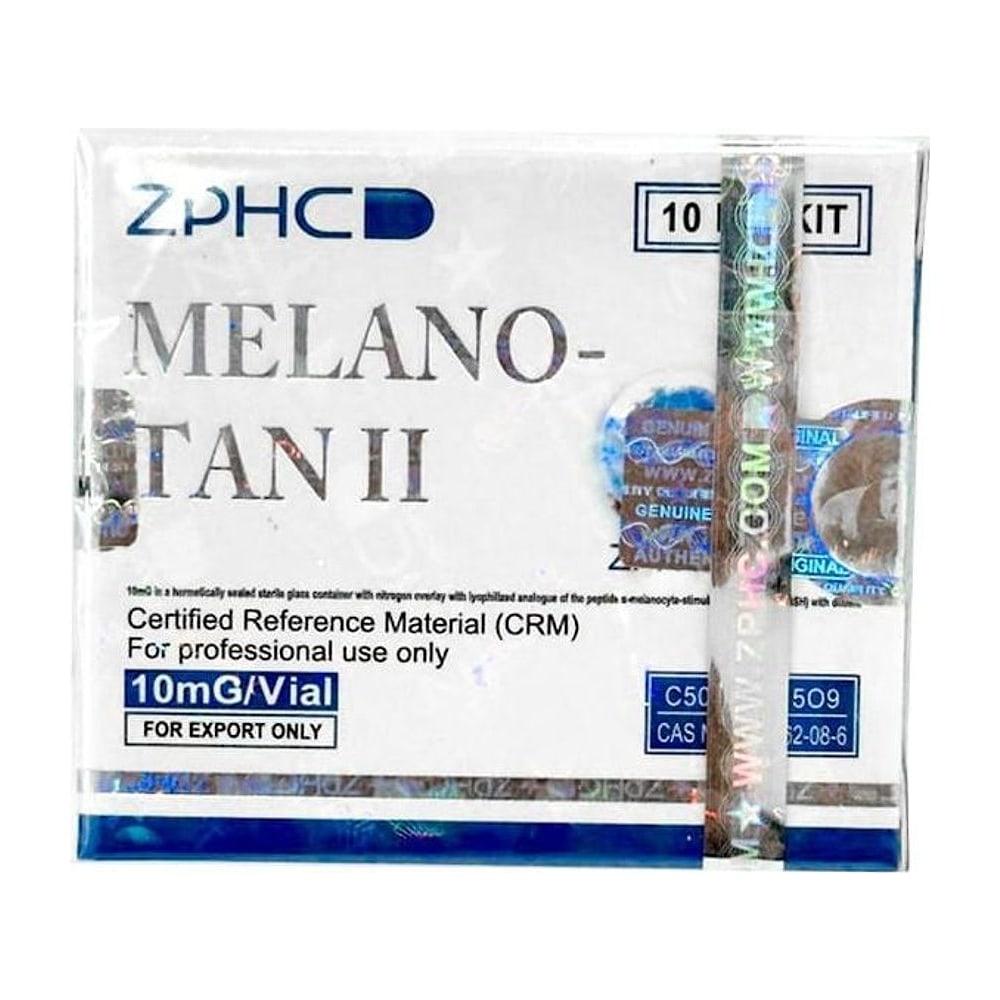
Research Disclaimer: All compounds described are sold exclusively for in-vitro and laboratory research use. Not for unsupervised use. This content does not constitute medical advice.
Melanocortin peptides that stimulate the MC1R-melanogenesis pathway represent a pharmacological approach to UV-independent skin pigmentation. The biological rationale is grounded in sun protection factor research: eumelanin (the brown/black pigment produced by MC1R activation) absorbs UV radiation more efficiently than phaeomelanin (yellow/red) and provides intrinsic photoprotection. Research applications span from mechanistic melanogenesis studies to photoprotection, EPP (erythropoietic protoporphyria), and potential melanoma prevention modeling.
Table of Contents#
- Melanogenesis: Eumelanin vs. Phaeomelanin
- MC1R Variants and Skin Type
- UV-Independent Tanning: Why It Matters for Research
- Melanotan II vs. Afamelanotide: Comparative Pharmacology
- EPP: The Clinical Application of Tanning Peptides
- Melanoma Prevention Hypothesis
- Research Protocols
- Key References
Melanogenesis: Eumelanin vs. Phaeomelanin#
Two types of melanin are produced in melanocytes:
| Property | Eumelanin | Phaeomelanin |
|---|---|---|
| Color | Brown / black | Yellow / red |
| Chemical class | Indole-based polymer (DHICA, DHI) | Benzothiazine-based |
| UV absorption | Very high (320–400 nm especially) | Low |
| Photoprotection | Yes (absorbs and quenches UV-induced ROS) | No — phaeomelanin generates ROS on UV exposure |
| MC1R signal | Stimulated by MC1R → eumelanin | Basal/low MC1R → phaeomelanin (default) |
| Skin cancer association | Associated with lower melanoma risk | High phaeomelanin skin type (red hair, fair) → higher melanoma risk |
The switch: MC1R activation → PKA → MITF → TYR/TYRP1/DCT → eumelanin synthesis. When MC1R is inactive or loss-of-function (variant alleles) → melanocytes default to phaeomelanin.
MC1R Variants and Skin Type#
MC1R is highly polymorphic — over 200 variants identified:
| Variant class | Prevalence | MC1R function | Skin/hair phenotype |
|---|---|---|---|
| Wild-type | ~50% of Europeans | Full cAMP signaling | Dark skin/hair, tans well |
| R alleles (R160W, D294H) | ~15–20% of redheads | Near-complete loss of function | Red hair, fair skin, freckles, very poor tanning |
| r alleles (V60L, V92M, R163Q) | Common in fair-skinned | Partial loss of function | Intermediate phenotype |
| Loss-of-function | Rare homozygotes | Absent MC1R signaling | Extreme sensitivity, cannot tan |
Research relevance: MC1R agonists (MT-II, afamelanotide) can partially rescue MC1R variant phenotypes — even in R/R (red hair) variants, sufficient receptor occupancy by high-affinity agonists can restore some eumelanin production. Quantifying this "rescue" is an active research area.
UV-Independent Tanning: Why It Matters for Research#
The problem with UV-induced tanning: Conventional UV tanning proceeds in two phases:
- Immediate pigment darkening (IPD): oxidation of pre-existing melanin → temporary darkening, no new melanin
- Delayed tanning (hours–days): UV → DNA damage in keratinocytes → p53 → POMC → α-MSH → MC1R → eumelanin synthesis
Phase 2 requires UV-induced DNA damage to trigger melanogenesis — the protection comes after the damage. This is the carcinogenic paradox of tanning.
MC1R agonist tanning bypasses UV:
- MT-II/afamelanotide → directly activates MC1R → eumelanin synthesis without UV
- Eumelanin present before UV exposure → photoprotection before DNA damage
Research implications:
- Cancer prevention models: can pre-loading eumelanin via MC1R agonist reduce UV-induced DNA damage and mutagenesis?
- Carcinogenesis research: UV + phaeomelanin skin type → higher mutation frequency → melanoma initiation
- EPP: non-UV-dependent melanogenesis enables sun exposure in photosensitive patients
Melanotan II vs. Afamelanotide: Comparative Pharmacology#
| Property | Melanotan II | Afamelanotide (Scenesse) |
|---|---|---|
| Structure | Cyclic 7 aa, SC injection | Linear 13 aa + Nle/D-Phe (NDP-α-MSH), PLGA implant |
| Delivery | SC injection, typically daily | Subcutaneous PLGA implant (releases over 30 days) |
| t½ | ~1–2h | ~22 days (from implant) |
| MCR selectivity | MC1-5 (non-selective) | Slightly MC1R-preferring but still broad |
| MC4R side effects | Yes — sexual behavior, nausea, appetite change | Much less (low peak Cmax from slow release) |
| Regulatory status | Research only | FDA/EMA approved (EPP indication only) |
| Pigmentation onset | 24–72h; peak 1–2 weeks | Peak 1–4 weeks |
| Research use | More accessible, injectable format | Gold standard for regulatory-grade studies |
Key pharmacological difference: MT-II's SC injection produces a peak Cmax sufficient to activate MC4R → explains sexual side effects and appetite suppression. Afamelanotide's PLGA implant produces slow, low-peak release → primarily MC1R-effective concentrations; MC4R effects minimized because they require higher concentrations.
Melanotan 2, €30 · 99.0% purityEPP: The Clinical Application of Tanning Peptides#
Erythropoietic protoporphyria (EPP) is the primary approved clinical application:
- EPP: ferrochelatase deficiency → protoporphyrin IX accumulates in red blood cells and skin
- UV exposure → protoporphyrin IX excited state → ROS → severe phototoxic pain (burning, swelling)
- Patients cannot tolerate normal sun exposure
- Afamelanotide → increases skin eumelanin → UV quenched before reaching photosensitizing porphyrin
Clinical evidence (afamelanotide for EPP):
- Phase 3 RCTs: significantly more pain-free sun exposure time (hours/month) vs. placebo
- Quality of life improvement: patients able to participate in outdoor activities
- FDA approved: October 2019
Research model: Fech(m1Pas) mouse (ferrochelatase hypomorphic → EPP phenotype):
- UV exposure → phototoxicity scoring
- MT-II or afamelanotide treatment → reduced phototoxicity score
- Skin melanin quantification (reflectance spectrophotometry) confirms melanogenesis
Melanoma Prevention Hypothesis#
Epidemiological basis:
- Red hair/MC1R R alleles → high phaeomelanin skin → 2–3× higher melanoma risk
- Geographic correlation: UV dose correlates with melanoma incidence for fair-skinned populations
Mechanistic hypothesis:
- MC1R activation → eumelanin replaces phaeomelanin → less UV reaches DNA
- Less UV DNA damage → fewer p53 mutations → reduced melanoma initiation
- MITF pathway: anti-apoptotic signals in melanocytes → possibly pro-survival
Preclinical evidence:
- Tyr-HRas transgenic mice (melanoma-prone): UV irradiation → higher tumor incidence in UV-only vs. MT-II pretreated + UV groups (limited studies)
- Concerns: MITF activation → also drives melanocyte proliferation → double-edged sword in tumor-prone mice
Research status: Active preclinical investigation. No human RCT data on melanoma prevention with MC1R agonists. The carcinogenesis hypothesis remains unproven and controversial — some evidence that MC1R agonism in already-transformed melanoma cells could be pro-proliferative.
Research Protocols#
B16-F10 melanogenesis: MT-II dose-response#
| Parameter | Specification |
|---|---|
| Cell model | B16-F10 (mouse melanoma; MC1R+) |
| Treatment | MT-II: 0.001–100 nM × 48h |
| Endpoints | Melanin content (NaOH lysis + OD at 475 nm), tyrosinase activity (L-DOPA substrate), MITF/TYR Western blot |
Photosensitivity protection in Fech(m1Pas) mice#
| Parameter | Specification |
|---|---|
| Mice | Fech(m1Pas) EPP mice (ferrochelatase hypomorphs) |
| Treatment | MT-II 0.1 mg/kg SC daily × 14 days pre-UV |
| UV protocol | UVA 30 J/cm² (phototoxic dose in EPP mice) |
| Endpoints | Phototoxicity score (erythema, swelling), skin melanin (reflectance 400 nm), histology (dermal inflammation) |
Key References#
-
Hadley ME & Dorr RT. (2006). "Melanocortin peptide therapeutics: historical milestones, clinical studies and commercialization." Peptides, 27(4):921–930.
-
Langan EA, et al. (2010). "Melanocortin receptor pharmacology." Current Pharmaceutical Design, 16(9):1002–1019.
-
Biolcati G, et al. (2015). "Long-term observational study of afamelanotide in 115 patients with erythropoietic protoporphyria." British Journal of Dermatology, 172(6):1601–1612.
Research Use Only: Melanotan II is sold exclusively for in-vitro research and laboratory use. Not for unsupervised use. JuicedPharma does not provide medical advice.
Published by JuicedPharma Research Team · September 2026 · Category: Peptides & Recovery