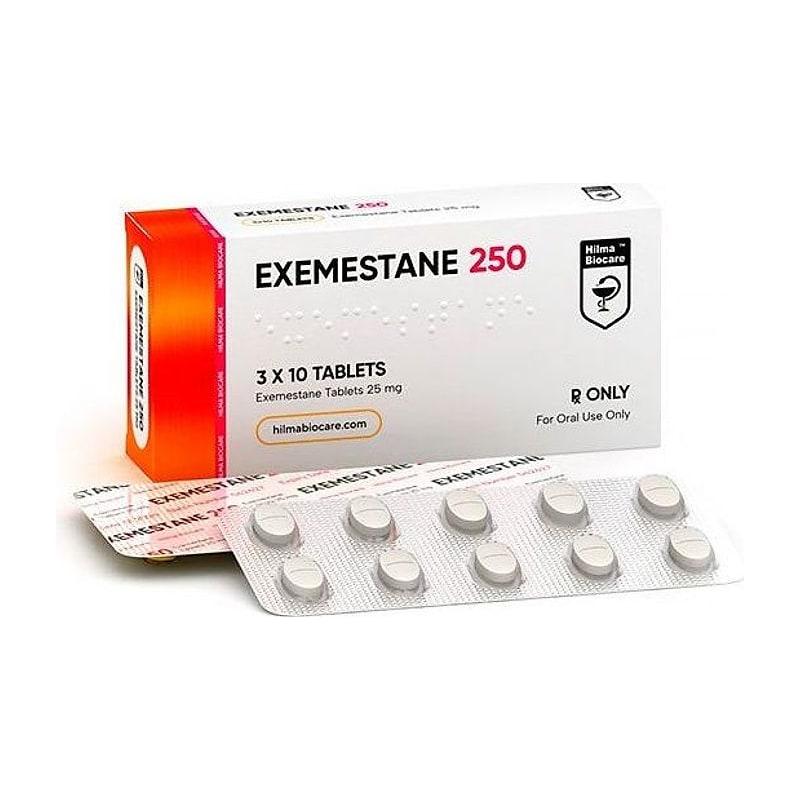
Research Disclaimer: Exemestane is sold exclusively for in-vitro and laboratory research use. Not for unsupervised use. This content does not constitute medical advice.
Exemestane (trade name: Aromasin; Pharmacia/Pfizer, 2000) is a steroidal mechanism-based irreversible aromatase inhibitor — the only steroidal AI among the three third-generation AIs. Unlike the non-steroidal triazole inhibitors anastrozole and letrozole, which competitively and reversibly occupy CYP19A1's active site, exemestane is converted by CYP19A1 itself into a reactive intermediate that forms a covalent bond with the enzyme — permanently inactivating it. This mechanism-based irreversibility produces sustained aromatase suppression even after drug clearance, distinguishing it from the triazoles and making it the compound of choice for research models requiring long-lasting E2 suppression without continuous dosing.
Table of Contents#
- Mechanism: Mechanism-Based Irreversible Inhibition
- Comparison with Non-Steroidal AIs
- Active Metabolite: 17-Hydroexemestane
- Pharmacokinetics
- Bone Effects: A Key Differentiator
- Research Applications
- Research Protocols
- Key References
Mechanism: Mechanism-Based Irreversible Inhibition#
Exemestane is a steroidal androstenedione analogue with an exocyclic methylene group at C6:
Mechanism:
- CYP19A1 recognizes exemestane as an androstenedione-like substrate → begins catalytic aromatization
- During the catalytic cycle, CYP19A1 converts exemestane's C6-methylene into a reactive enone intermediate (6-methylene → 6-oxo)
- This intermediate alkylates the enzyme's active site (irreversible covalent bond)
- CYP19A1 is permanently inactivated — the enzyme is "suicide-inhibited" (mechanism-based inhibition)
- New aromatase activity requires synthesis of new CYP19A1 protein (takes days)
Key consequence: Unlike competitive inhibitors (anastrozole/letrozole), exemestane's inhibition persists for the lifetime of the enzyme. After drug clearance, aromatase suppression continues until new CYP19A1 is synthesized (protein t½ ~2–3 days in most tissues).
Comparison with Non-Steroidal AIs#
| Property | Exemestane | Anastrozole | Letrozole |
|---|---|---|---|
| Class | Steroidal (androstenedione analogue) | Non-steroidal (triazole) | Non-steroidal (bis-triazole) |
| Inhibition type | Irreversible (mechanism-based) | Competitive, reversible | Competitive, reversible |
| After drug clearance | Suppression persists (2–5 days) | Recovers within hours–days | Recovers within hours–days |
| CYP19A1 selectivity | High (steroidal substrate mimic) | Very high | Very high |
| Androgenic metabolites | Yes (17-hydroexemestane — see below) | None | None |
| E2 suppression (clinical) | ~97–98% | ~97% | ~98–99% |
| Bone effects | Neutral or beneficial (androgenic metabolite) | Adverse (bone loss) | Adverse (bone loss) |
| Clinical approval | Adjuvant BC (postmenopausal) | Adjuvant BC | Adjuvant BC, ovulation induction |
Active Metabolite: 17-Hydroexemestane#
When CYP19A1 partially processes exemestane (before the suicidal alkylation step):
- 17β-HSD reduces exemestane at C17 → 17-hydroexemestane
- 17-hydroexemestane has androgen receptor agonist activity (~0.1–0.5× DHT affinity)
- This partial androgenic activity is unique to exemestane among AIs
Research significance of androgenic metabolite:
- In male research models: exemestane may produce a weak AR agonist signal on top of E2 suppression — studies must use AR antagonist (flutamide) to control for this if the endpoint could be affected by weak AR activation
- Bone effects: 17-hydroexemestane → slight anabolic effect at bone (androgenic bone effects) → may explain why exemestane has better bone safety than anastrozole/letrozole
- In female models: androgenic metabolite is more pharmacologically relevant — may cause mild virilization at high doses
Practical implication for androgen research: Do NOT use exemestane as an AI in male androgen studies where AR confounds must be eliminated — use anastrozole or letrozole instead. Exemestane is preferred when: (1) irreversible suppression is the design requirement, (2) bone endpoints are being measured (neutral bone effect advantage), or (3) an androgenic AI effect is deliberately being studied.
Pharmacokinetics#
| Parameter | Value |
|---|---|
| Oral bioavailability | ~42% (improved by fatty meal: ~40% increase in Cmax) |
| t½ (parent drug) | ~24 hours |
| Duration of CYP19A1 inhibition | 2–5 days after last dose (determined by enzyme resynthesis, not drug PK) |
| Protein binding | ~90% |
| Metabolism | Hepatic: CYP3A4 oxidation; 17β-HSD reduction → 17-OH-exemestane |
| Excretion | Urine + feces (~50:50) |
Dosing in research:
- Clinical dose: 25 mg/day oral
- Rodent dose: 0.5–10 mg/kg/day oral gavage
- Administration frequency: once daily adequate despite PK t½ (~24h), due to the multi-day irreversible enzyme suppression
Bone Effects: A Key Differentiator#
This is exemestane's most important clinical differentiation from non-steroidal AIs:
Anastrozole/letrozole + long-term use:
- Complete estrogen suppression → no ER activation in bone → increased osteoclast activity → bone loss
- Adjuvant breast cancer patients: 1–2% annual BMD loss
Exemestane:
- Complete estrogen suppression (same as triazoles) → bone loss expected
- 17-hydroexemestane → weak AR agonism in bone → partially counteracts the bone loss from E2 ablation
- Clinical trials: exemestane produces less BMD loss than letrozole at comparable E2 suppression
- Research model: female rats, exemestane vs. letrozole × 12 months → μCT femur BMD comparison
Research Applications#
1. Long-duration E2 suppression without continuous dosing#
For experiments where daily injections/gavage are impractical:
- Single dose exemestane → aromatase inactivated for 2–5 days
- Twice-weekly dosing maintains sustained suppression
- Useful in chronic rodent studies where reducing dosing frequency reduces animal stress
2. Bone research where E2 effects must be dissociated#
When studying bone endpoints alongside androgen treatment:
- Anastrozole/letrozole: bone loss confound from E2 ablation
- Exemestane: androgenic metabolite partially offsets bone loss → smaller confound → cleaner attribution of effects to the test androgen
3. Comparison with reversible AIs (mechanistic study)#
Study design comparing exemestane (irreversible) vs. anastrozole (reversible) with a 2-week washout period → differential recovery of aromatase activity quantifies the contribution of enzyme turnover to E2 recovery timeline.
Research Protocols#
Aromatase recovery after exemestane vs. anastrozole washout#
| Parameter | Specification |
|---|---|
| Model | Ovariectomized female SD rats + testosterone implant (5 mg/60-day pellet) |
| Groups | 1. Vehicle, 2. Anastrozole 0.5 mg/kg oral daily × 4 weeks then washout, 3. Exemestane 2 mg/kg oral 3×/week × 4 weeks then washout |
| Washout period | 2 weeks (no AI) |
| Measurements | Serum E2 (LC-MS/MS) at week 4 (peak suppression) and days 3, 7, 14 of washout |
| Endpoint | Rate of E2 recovery = rate of aromatase enzyme resynthesis |
Key References#
-
Geisler J, et al. (2002). "Influence of exemestane and anastrozole on serum estrogens and blood lipids in postmenopausal breast cancer patients." Annals of Oncology, 13(12):1862–1866.
-
Santen RJ, et al. (2009). "History of aromatase: saga of an important biological mediator and therapeutic target." Endocrine Reviews, 30(4):343–375.
-
Lonning PE. (2004). "Aromatase inhibitors and inactivators for breast carcinoma treatment." Current Cancer Drug Targets, 4(3):253–264.
Research Use Only: Exemestane is sold exclusively for in-vitro research and laboratory use. Not for unsupervised use. JuicedPharma does not provide medical advice.
Published by JuicedPharma Research Team · September 2026 · Category: Research Protocols & Science