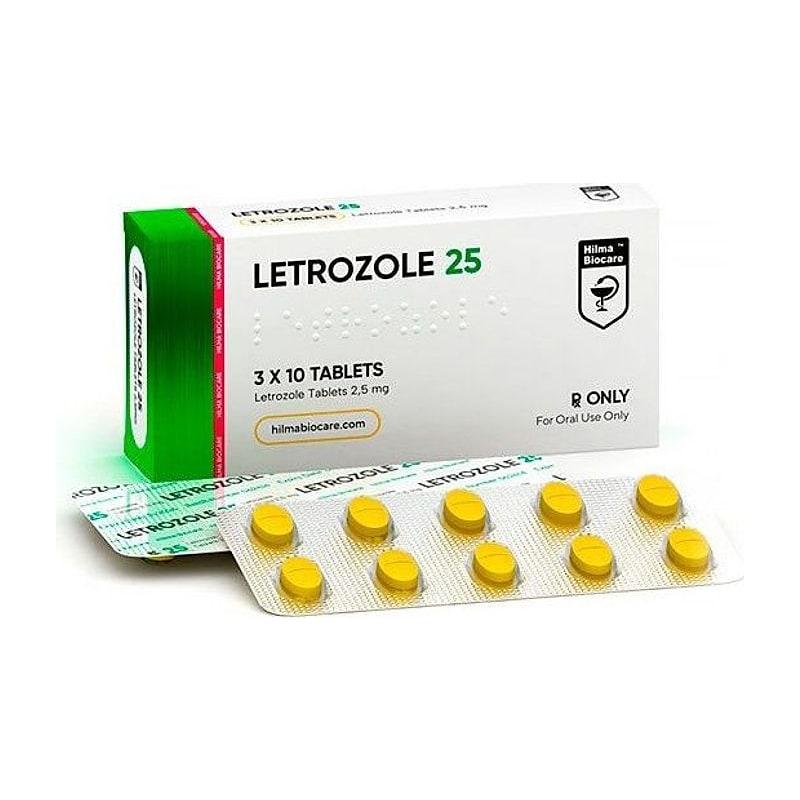
Research Disclaimer: Letrozole is sold exclusively for in-vitro and laboratory research use. Not for unsupervised use. This content does not constitute medical advice.
Letrozole (trade name: Femara; Novartis, 1997) is a third-generation non-steroidal aromatase inhibitor with approximately 10–100× greater CYP19A1 binding affinity than anastrozole. Clinically used for hormone receptor-positive breast cancer in postmenopausal women, letrozole is the tool compound of choice in androgen research when maximum estradiol suppression is required — for example, in studies of pure AR signaling, bone density mechanisms that require complete estrogen ablation, or HPTA research requiring maximal removal of the estrogenic feedback component.
Table of Contents#
- Mechanism: How Letrozole Inhibits Aromatase
- Pharmacokinetics
- Letrozole vs. Anastrozole: When to Use Which
- Effects on the HPTA and Gonadotropins
- Bone and Metabolic Effects of E2 Ablation
- Research Protocols
- Key References
Mechanism: How Letrozole Inhibits Aromatase#
Letrozole is a bis-triazole compound. Both triazole rings coordinate to the iron atom of CYP19A1's heme group:
- The bis-triazole structure gives letrozole higher binding affinity vs. anastrozole's mono-triazole
- Competitive, reversible inhibition (non-steroidal → enzyme is not irreversibly modified)
- Ki ~0.2–2 nM for CYP19A1 (vs. anastrozole Ki ~15 nM)
- High selectivity for aromatase vs. other CYP450 enzymes at relevant concentrations
In vivo E2 suppression:
- Postmenopausal women: letrozole 2.5 mg/day → ~98–99% E2 suppression
- Premenopausal women (ovarian aromatase): incomplete suppression at standard doses (ovarian aromatase is highly expressed and partially escapes inhibition; the pituitary responds with compensatory LH/FSH elevation and ovarian steroidogenesis override)
- Men with exogenous testosterone: letrozole 2.5 mg/day → ~60–85% E2 suppression (dose-dependent)
Pharmacokinetics#
| Parameter | Value |
|---|---|
| Oral bioavailability | ~100% (essentially complete absorption) |
| t½ | ~48 hours |
| Protein binding | ~60% (primarily albumin) |
| Steady-state | ~2–6 weeks (long t½ means slow accumulation) |
| Metabolism | Hepatic: CYP3A4/2A6 → carbinol metabolite (inactive) |
| Excretion | Urine (90%); bile (<10%) |
Rodent PK:
- t½ ~6–12h in rats (faster hepatic clearance)
- Daily dosing required; some studies use twice daily
- Formulation: DMSO-based, oral gavage in methylcellulose, or co-dissolved in ethanol/PEG400
Letrozole vs. Anastrozole: When to Use Which#
| Parameter | Anastrozole | Letrozole |
|---|---|---|
| CYP19A1 Ki | ~15 nM | ~0.2–2 nM |
| Standard clinical dose | 1 mg/day | 2.5 mg/day |
| E2 suppression (clinical) | ~97% | ~98–99% |
| t½ | ~40–50h | ~48h |
| Selectivity vs. other CYPs | High | Slightly higher (bis-triazole) |
| Research use: partial E2 suppression | Yes (lower doses can tune) | Less flexible (very potent) |
| Research use: maximal E2 suppression | Adequate | Preferred |
| Research use: HPTA recovery | Common | Also used |
Rule of thumb for research protocol selection:
- Need to remove E2 completely? → Letrozole
- Need to titrate E2 to a specific level? → Anastrozole (easier dose-response management)
- Studying HPTA feedback where partial E2 suppression aids interpretation? → Anastrozole at sub-maximal doses
Effects on the HPTA and Gonadotropins#
When letrozole removes E2 feedback on the hypothalamus and pituitary:
- GnRH pulse frequency increases (E2 normally slows GnRH pulse frequency)
- LH and FSH increase substantially
- Testosterone rises (in intact men/animals): pituitary drives increased Leydig cell steroidogenesis
- In castrated animals: LH/FSH rises dramatically (no negative feedback at all)
This makes letrozole a useful tool for:
- Studying hypothalamic E2 feedback independently from AR feedback
- Elevating endogenous testosterone in males with intact gonads (for studies requiring supraphysiological endogenous T without exogenous supplementation)
- Ovulation induction research (letrozole is FDA-approved as an ovulation inducer — the primary research application outside oncology)
Bone and Metabolic Effects of E2 Ablation#
Complete E2 removal has consequences beyond HPTA:
Bone#
- E2 is essential for bone mineral density maintenance in both males and females
- Osteoclast activity is suppressed by E2 → letrozole (complete E2 ablation) → increased osteoclastic bone resorption
- In long-term studies (>6 months): letrozole causes measurable bone mineral density loss in humans
- Research implication: if studying skeletal endpoints, letrozole-induced estrogen ablation will confound results unless intentional (studying osteoporosis model or E2-bone relationship)
Cardiovascular/Lipids#
- E2 maintains HDL-C and modulates LDL-C
- Letrozole in postmenopausal women: modest adverse lipid effects (LDL-C +3–10%, HDL-C neutral or slight decrease)
- For short-term acute studies: negligible
- For chronic studies (>4 weeks): measure lipids as safety endpoint
Adipose#
- E2 regulates fat distribution; letrozole → shifts fat distribution in some models (increased central adiposity)
Research Protocols#
Castrated rat model: complete E2 ablation + testosterone replacement#
| Parameter | Specification |
|---|---|
| Model | Adult castrated SD rats |
| Groups | 1. Vehicle, 2. TE (3 mg/kg SC q3d), 3. TE + Letrozole (0.4 mg/kg SC daily) |
| Letrozole formulation | 0.4 mg/kg in 10% DMSO/corn oil SC |
| Duration | 4–8 weeks |
| Endpoints | Serum E2 (LC-MS/MS: target <2 pg/mL), testosterone, LH/FSH, bone density (μCT), levator ani, ventral prostate |
Ovulation induction / follicle development research (intact female rats)#
| Parameter | Specification |
|---|---|
| Model | Intact adult female SD rats, natural estrous cycle tracked by vaginal smear |
| Treatment | Letrozole 1 mg/kg/day oral gavage (days 1–5 of estrous cycle) |
| Endpoints | Ovarian follicle count and morphology (histology), serum E2, LH surge, pregnancy rate if bred |
Key References#
-
Geisler J, et al. (1998). "Letrozole suppresses plasma estradiol and estrone sulphate more completely than anastrozole." Cancer Research, 58(20):4507–4510.
-
Santen RJ, et al. (2009). "History of aromatase: saga of an important biological mediator and therapeutic target." Endocrine Reviews, 30(4):343–375.
-
Taxel P, et al. (2001). "The effect of aromatase inhibition on sex steroids, gonadotropins, and markers of bone turnover in older men." Journal of Clinical Endocrinology and Metabolism, 86(6):2869–2874.
Research Use Only: Letrozole is sold exclusively for in-vitro research and laboratory use. Not for unsupervised use. JuicedPharma does not provide medical advice.
Published by JuicedPharma Research Team · September 2026 · Category: Research Protocols & Science