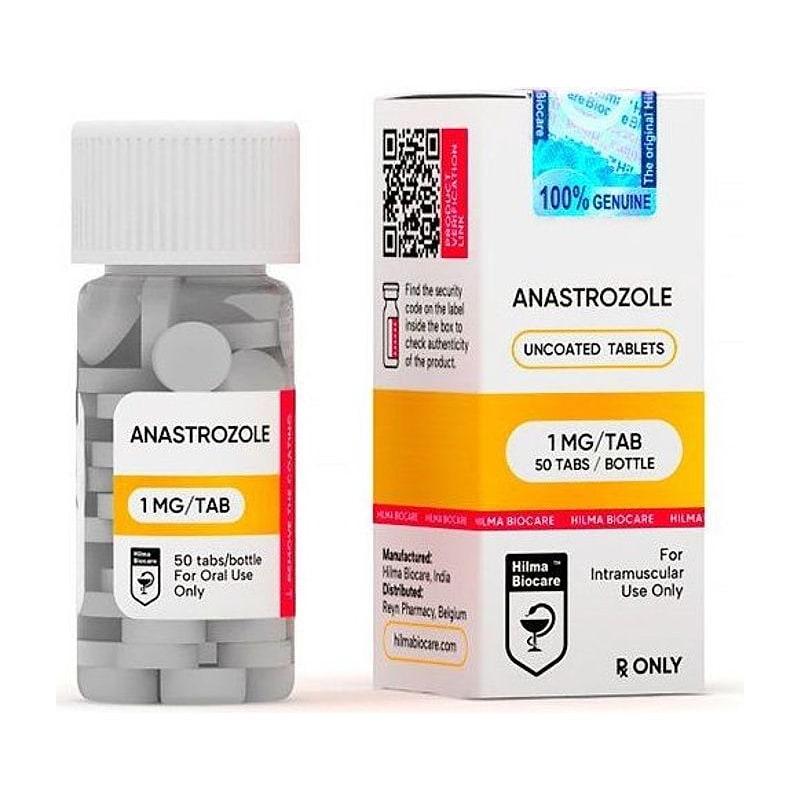
Research Disclaimer: Anastrozole is sold exclusively for in-vitro and laboratory research use. Not for unsupervised use. This content does not constitute medical advice.
Anastrozole (trade name: Arimidex; AstraZeneca, 1995) is a third-generation non-steroidal aromatase inhibitor used clinically for hormone receptor-positive breast cancer in postmenopausal women. In androgen research, anastrozole is the most commonly used tool compound for suppressing estradiol (E2) formation from testosterone, enabling researchers to dissect AR-mediated vs. ER-mediated effects of androgens, study HPTA estrogen feedback, and design post-cycle recovery protocols.
Table of Contents#
- CYP19A1: The Aromatase Enzyme
- Anastrozole Mechanism: Non-Steroidal Competitive Inhibition
- Pharmacokinetics
- Potency vs. Letrozole
- Research Applications
- Rodent Protocols
- Key References
CYP19A1: The Aromatase Enzyme#
Aromatase (CYP19A1) is a P450 enzyme that converts C19 androgens to C18 estrogens via a three-step oxidative aromatization of ring A:
- Testosterone → Estradiol (E2)
- Androstenedione → Estrone (E1)
- DHEA → weak estrogens
Primary tissue sites of aromatization:
- Ovaries/testes: major endocrine source
- Adipose tissue: quantitatively important at high body fat
- Liver: significant first-pass
- Brain: local neurosteroid production (important for sexual behavior and GnRH pulse regulation)
- Bone: E2 required for closure of growth plates and bone density maintenance
Anastrozole Mechanism: Non-Steroidal Competitive Inhibition#
Anastrozole is a non-steroidal triazole compound:
- Triazole group → coordinates the heme iron of CYP19A1 → prevents androgen substrate binding
- Competitive inhibition: dose-dependent, reversible
- Does not modify the aromatase protein or cause long-lasting enzyme suppression after washout (contrast with exemestane, a steroidal irreversible inhibitor)
Selectivity:
- Anastrozole is highly selective for CYP19A1 — at research doses it does not significantly inhibit other CYP450 enzymes (CYP3A4, CYP1A2) at relevant concentrations
- Compare: ketoconazole (non-selective CYP inhibitor, used as cortisol/testosterone synthesis blocker) has major off-target CYP effects
E2 suppression achieved:
- Postmenopausal women (breast cancer): 1 mg/day anastrozole → ~97% suppression of serum E2
- In men (with exogenous testosterone): anastrozole dose-dependently suppresses E2; 0.5–1 mg/day achieves ~50–80% E2 suppression without driving E2 to zero
Pharmacokinetics#
| Parameter | Value |
|---|---|
| Oral bioavailability | ~83% |
| t½ | ~40–50 hours (long t½ = once-daily dosing) |
| Protein binding | ~40% (low — mostly unbound) |
| Metabolism | Hepatic: N-dealkylation, hydroxylation, glucuronidation |
| Steady-state | ~7 days with daily dosing |
| Excretion | Urine and bile |
In rodents:
- t½ shorter (~10–15h in rats)
- Typically dosed every 12–24h in rodent studies
- Common formulation: dissolved in DMSO then diluted with corn oil for SC injection, or in ethanol/water for oral gavage
Potency vs. Letrozole#
Both are third-generation triazole non-steroidal AIs, but letrozole is approximately 10–100× more potent in head-to-head enzyme inhibition assays:
| Property | Anastrozole | Letrozole |
|---|---|---|
| Ki (CYP19A1) | ~15 nM | ~0.2–2 nM |
| E2 suppression (postmenopausal) | ~97% | ~98–99% |
| t½ | ~40–50h | ~48h |
| Clinical use | Adjuvant BC, first-line | Adjuvant BC, more potent |
| Research use | Standard AI for testosterone protocols | When maximum aromatase blockade needed |
Both achieve near-complete E2 suppression at appropriate doses in vivo despite the enzyme potency difference — the in vitro IC50/Ki difference translates to slightly different human doses (1 mg/day anastrozole vs. 2.5 mg/day letrozole for equivalent suppression) rather than a clinically dramatic difference.
Research Applications#
1. Dissecting AR vs. ER contributions in testosterone studies#
Without AI: testosterone → E2 (via aromatase) → ER signaling in addition to AR With anastrozole: testosterone → minimal E2 conversion → predominantly AR signal
This is essential when the research question is "what does testosterone do via AR only?" — e.g., bone density mechanisms (testosterone has both AR-direct and E2-dependent bone effects), lipid metabolism, or neuroprotection.
2. HPTA estrogen feedback studies#
Anastrozole removes the estrogen component of negative feedback on the hypothalamus-pituitary:
- Without AI: testosterone suppresses GnRH/LH/FSH via both AR (direct) and E2 (from aromatization) at the hypothalamus
- With anastrozole: only the direct AR component of HPTA suppression remains
- This allows quantification of the E2 feedback contribution to GnRH suppression
3. Estrogen-dependent endpoint controls#
In musculoskeletal and cardiovascular studies, E2 has important independent effects. Including an AI group allows attribution of outcomes to AR vs. ER pathways.
Anastrozole, €28 · 99.3% purityRodent Protocols#
Standard anastrozole dosing in castrated rats with testosterone replacement#
| Parameter | Specification |
|---|---|
| Model | Adult castrated SD rats |
| Groups | 1. Vehicle, 2. TE (3 mg/kg SC q3d), 3. TE + Anastrozole (0.5 mg/kg SC daily) |
| Anastrozole formulation | 0.5 mg/kg in 10% DMSO / 90% corn oil, SC injection |
| Duration | 4–8 weeks |
| Endpoints | Serum E2 (LC-MS/MS), serum testosterone, LH/FSH (ELISA), bone density (μCT), levator ani mass |
In vitro aromatase inhibition assay#
| Parameter | Specification |
|---|---|
| System | Microsomal fraction from human placenta or MCF-7 cell aromatase assay |
| Substrate | ³H-testosterone or androstenedione (Km concentration) |
| Inhibitor | Anastrozole dose-response: 0.001–100 nM |
| Readout | ³H-water release (aromatization proxy) or E2 by ELISA |
| Analysis | IC50 determination, Ki via Cheng-Prusoff |
Key References#
-
Geisler J, et al. (1996). "Influence of anastrozole on intratumoral estrogen levels and proliferation markers in patients with locally advanced breast cancer." Clinical Cancer Research, 2(8):1339–1345.
-
Mauras N, et al. (2000). "Estrogen suppression in males: metabolic effects." Journal of Clinical Endocrinology and Metabolism, 85(7):2370–2377.
-
Taxel P, et al. (2001). "The effect of aromatase inhibition on sex steroids, gonadotropins, and markers of bone turnover in older men." Journal of Clinical Endocrinology and Metabolism, 86(6):2869–2874.
Research Use Only: Anastrozole is sold exclusively for in-vitro research and laboratory use. Not for unsupervised use. JuicedPharma does not provide medical advice.
Published by JuicedPharma Research Team · September 2026 · Category: Research Protocols & Science