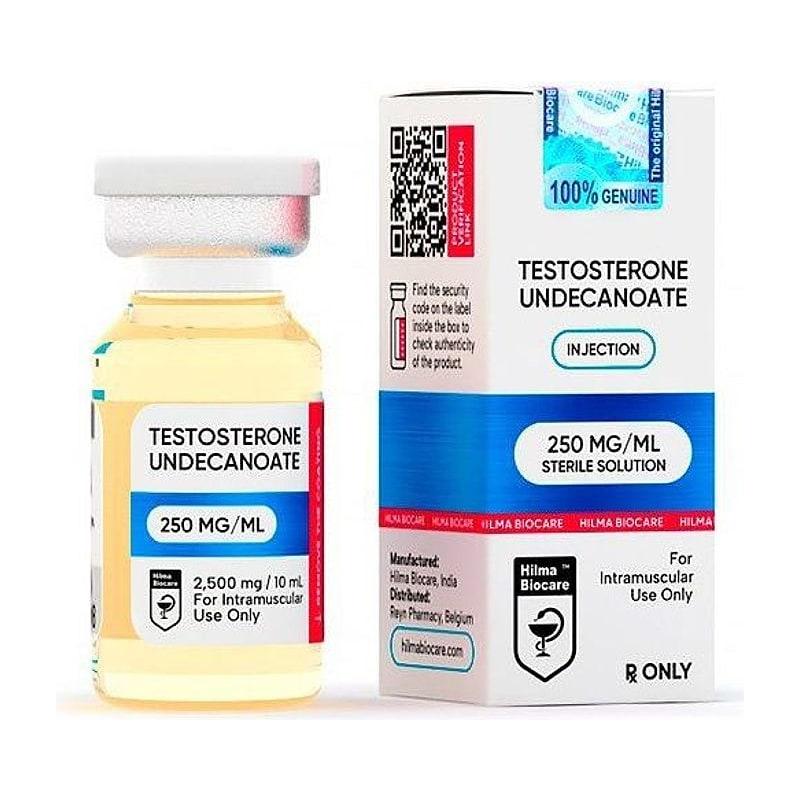
Research Disclaimer: Testosterone undecanoate is sold exclusively for in-vitro and laboratory research use. Not for unsupervised use. This content does not constitute medical advice.
Testosterone undecanoate (TU) injectable (brand names: Nebido in Europe, Aveed in the US) is the longest-acting injectable testosterone ester currently in clinical use. With an 11-carbon undecanoate ester, it achieves an effective half-life of approximately 33–34 days, enabling dosing intervals of 10–14 weeks after loading. This depot pharmacokinetics profile makes it relevant for long-term androgen research, hypogonadism models, and studies requiring stable androgen levels over extended periods.
Table of Contents#
- Undecanoate Ester: Why Such Long Duration?
- Pharmacokinetics: The 10-Week Dosing Interval
- Castor Oil Vehicle: Role in Depot Formation
- Loading Dose and Steady-State Considerations
- Research Applications of Long-Acting TU
- Comparison to Other Testosterone Esters
- Research Protocols
- Key References
Undecanoate Ester: Why Such Long Duration?#
11-carbon undecanoate ester at the 17β-OH position:
- Longest ester chain of commonly used testosterone esters
- Very high lipophilicity (log P ~5.0) → partitions strongly into the oil depot
- Very slow ester hydrolysis rate → sustained testosterone release
Key pharmacokinetic mechanism: Unlike shorter esters (propionate, enanthate) where the ester hydrolyzes relatively quickly from the oil depot, testosterone undecanoate's 11-carbon chain is long enough to behave differently:
- After deep IM injection into castor oil vehicle → depot forms in muscle
- The highly lipophilic TU partitions into lymphatics and tissue fat rather than entering the bloodstream directly
- Gradual release from lymphatics and adipose → prolonged, low-peak sustained testosterone delivery
Pharmacokinetics: The 10-Week Dosing Interval#
Human PK (1000 mg IM, Nebido formulation)#
| Parameter | Value |
|---|---|
| Injection volume | 4 mL (castor oil) |
| Dose | 1000 mg testosterone undecanoate = 631 mg testosterone |
| Tmax | ~7–10 days after injection |
| Cmax | ~700–900 ng/dL |
| Trough (week 10) | ~250–400 ng/dL |
| t½ | ~33–34 days |
| Dosing interval (steady-state) | 10–14 weeks |
Loading dose protocol#
Initial therapy requires:
- First injection: 1000 mg
- Second injection: 1000 mg at 6 weeks (loading)
- Subsequent injections: every 10–14 weeks (maintenance)
This loading ensures that steady-state levels are reached faster than the natural accumulation timeline would allow.
Castor Oil Vehicle: Role in Depot Formation#
The castor oil vehicle is critical to TU's pharmacokinetics — this is not just a delivery vehicle:
Castor oil properties:
- High viscosity (kinematic viscosity ~930 cSt at 25°C vs. ~40 cSt for sesame oil)
- Ricinoleic acid (main castor oil fatty acid) has unique surface-active properties
- Forms a very viscous, semi-immobile depot after IM injection
Why the vehicle matters: The high viscosity of castor oil:
- Slows oil spread from injection site → concentrated depot
- Slows drug diffusion out of depot → prolonged release
- Interacts with lymphatic absorption pathway
When testosterone undecanoate is formulated in castor oil, the resulting pharmacokinetic profile (33-day t½) is a property of the oil-ester combination — not just the ester chain alone. Testosterone undecanoate in a different (lower viscosity) oil would have faster absorption.
For research: this means that PK studies of TU must use the castor oil formulation (or at minimum specify vehicle) to be reproducible.
Loading Dose and Steady-State Considerations#
In rodent models (theoretical)#
TU is rarely used in standard short-term rodent studies because:
- Rodents clear testosterone much faster than humans (~10× higher metabolic rate per body weight)
- The castor oil vehicle (4 mL per human injection) is impractical in rodents (maximum 0.2 mL for mice, 1 mL for rats)
- The volume required for a castor oil depot would need to be scaled in ways that affect absorption
For rodent chronic testosterone studies: enanthate or cypionate are preferred. TU is more relevant for:
- Human pharmacokinetic modeling (in silico PBPK studies)
- Primate (non-human primate) studies where human-relevant dosing is required
- In vitro esterase kinetics studies
Testosterone Undecanoate, €31 · 98.8% purity
Research Applications of Long-Acting TU#
Long-term hypogonadism models in primates/humans#
TU's primary research advantage: stable androgen levels over extended periods with infrequent dosing:
- No large peak-trough fluctuation (unlike weekly enanthate/cypionate injections)
- Minimizes injection stress in long-term animal welfare studies
- Allows studying chronic androgen effects without the confound of fluctuating hormone levels
Comparing stable vs. fluctuating testosterone#
A unique research application: compare TU (stable) vs. enanthate (fluctuating weekly) on:
- Cardiovascular function (does testosterone variability matter for cardiac remodeling?)
- Mood/behavioral endpoints (in rodents that tolerate castor oil volume)
- Bone density and turnover
PK/PD modeling#
TU's unusual PK (lymphatic route, depot kinetics) is a valuable model for studying depot injection pharmacokinetics — how lipophilicity, viscosity, and lymphatic absorption affect drug distribution. This is relevant for any long-acting injectable drug development.
Comparison to Other Testosterone Esters#
| Ester | Carbon chain | t½ | Vehicle | Injection interval | Peak-trough ratio |
|---|---|---|---|---|---|
| Propionate | 3C | 1–3 days | Sesame | Every 1–3 days | High |
| Enanthate | 7C | 4.5 days | Sesame | Weekly | Moderate |
| Cypionate | 8C | 5–8 days | Cottonseed | Weekly | Moderate |
| Undecanoate (Nebido) | 11C | 33 days | Castor oil | Quarterly | Low (most stable) |
TU has the most stable testosterone delivery — the flattest pharmacokinetic profile over time after loading is complete. This stability comes at the cost of a 4 mL injection volume and the requirement for castor oil (which has rare reports of pulmonary oil microembolism if inadvertently injected intravascularly — standard deep IM technique is critical).
Research Protocols#
Human TRT reference pharmacokinetic study#
| Parameter | Specification |
|---|---|
| Compound | Testosterone undecanoate 1000 mg in 4 mL castor oil (Nebido formulation) |
| Route | Deep IM injection (gluteal) |
| Loading | Week 0 and week 6 |
| Maintenance | Every 12 weeks |
| Blood sampling | Days 0, 7, 14, 28, 42 (loading); then every 2 weeks during maintenance |
| Endpoints | Total testosterone, free testosterone, LH, FSH, SHBG, E2, hematocrit |
In vitro esterase kinetics study#
| Parameter | Specification |
|---|---|
| Enzyme source | Rat or human plasma (esterase activity) |
| Substrates | TP, TE, TC, TU (equal molar concentrations) |
| pH | 7.4 (physiological) |
| Temperature | 37°C |
| Endpoints | Testosterone released over time (HPLC-MS/MS), ester hydrolysis rate constants, Km/Vmax |
Key References#
-
Nieschlag E, et al. (2003). "Repeated intramuscular injections of testosterone undecanoate for substitution therapy in hypogonadal men." Clinical Endocrinology, 58(6):589–595.
-
Schubert M, et al. (2004). "Pharmacokinetics of testosterone undecanoate injections in hypogonadal men." European Journal of Endocrinology, 151(4):453–460.
-
Behre HM, et al. (2004). "Long-term efficacy and safety of injections of testosterone undecanoate for male hypogonadism." Journal of Andrology, 25(5):728–735.
Research Use Only: Testosterone undecanoate is sold exclusively for in-vitro research and laboratory use. Not for unsupervised use. JuicedPharma does not provide medical advice.
Published by JuicedPharma Research Team · September 2026 · Category: Research Protocols & Science