Research Disclaimer: All compounds described are sold exclusively for in-vitro and laboratory research use. Not for unsupervised use. This content does not constitute medical advice.
The 19-nor class of androgens is defined by a single structural modification: deletion of the C19 methyl group (the angular methyl at the C10–C19 junction of the androgen skeleton). This seemingly minor change — removal of one carbon atom — produces a class of steroids with distinct tissue-selective pharmacology compared to testosterone, making them valuable tools for studying androgen receptor biology, tissue selectivity, and the development of selective androgen receptor modulators (SARMs).
Table of Contents#
- The C19 Position: Why It Matters
- Key 19-Nor Androgens in Research
- 5α-Reductase and the DHT/DHN Divergence
- Progestogenic Activity of 19-Nor Steroids
- HPTA Suppression: AR + PR Combined Effect
- Aromatization in the 19-Nor Class
- Research Applications of 19-Nor Tissue Selectivity
- 19-Nor vs. SARM: What Research Taught Us
- Key References
The C19 Position: Why It Matters#
In the androgen steroid skeleton (androstane backbone), the C19 methyl group sits at the angular position bridging rings A and B:
- C19 is the methyl group from which the "19" in "19-nortestosterone" (nandrolone) gets its name
- This carbon is the same one that aromatase removes during conversion of androgens to estrogens (aromatization of ring A involves C19 oxidative demethylation)
- When C19 is pre-deleted → the aromatase reaction is altered, as aromatase finds a different substrate
- The C19 group also affects the geometry of 5α-reductase binding
Removing C19:
- Slows aromatization (different substrate geometry for CYP19A1)
- Dramatically changes 5α-reductase products (produces DHN or Δ1-DHT instead of DHT)
- Allows progestogen receptor binding (C19 absence seems to widen receptor selectivity toward PR)
- Does not significantly affect AR binding affinity at the parent compound level
Key 19-Nor Androgens in Research#
| Compound | Class | Key modifications vs. testosterone | Main research use |
|---|---|---|---|
| Nandrolone (19-NT) | 19-nor C17β-OH (no A ring modification) | C19 deletion only | Anabolic selectivity, collagen, bone, anemia |
| Trenbolone | 19-nor + Δ9,10 + Δ11,12 (conjugated double bonds) | C19 deletion + 2 extra double bonds | Very high AR affinity, no aromatization |
| Norethisterone (NET) | 19-nor progestin | C19 deletion + C17α-ethynyl group | Oral progestin, male contraception |
| Levonorgestrel | 19-nor progestin | C19 deletion + 13β-ethyl + C17α-ethynyl | Oral contraceptive |
| Gestrinone | 19-nor with Δ9,10 | C19 deletion + ethynyl + Δ9,10 | Endometriosis research |
| MENT (trestolone) | 7α-methyl-19-nortestosterone | C19 deletion + C7α methyl | SARM-like, potent male contraception |
5α-Reductase and the DHT/DHN Divergence#
The most pharmacologically significant consequence of C19 deletion is the altered 5α-reductase product:
The amplification/attenuation switch#
Testosterone: 5α-reductase → DHT (C19-intact)
- DHT: AR Kd ~0.5 nM (very high affinity, ~3–5× testosterone)
- Effect: amplified androgenic signal in 5α-reductase-rich tissues
Nandrolone: 5α-reductase → DHN (5α-dihydronandrolone, C19-absent)
- DHN: AR affinity ~0.1–0.3× testosterone
- Effect: attenuated (reduced) androgenic signal in 5α-reductase-rich tissues
This is opposite to what happens with testosterone:
- In testosterone: 5α-reductase = amplifier
- In nandrolone: 5α-reductase = attenuator
Why C19 deletion changes 5α-reductase product potency#
The C19 methyl group in testosterone (and its absence in nandrolone) affects the electron density and steric profile around C3 (ketone) and C5 (where 5α-reduction occurs). DHT's high AR affinity depends partly on the C19-containing A ring geometry for optimal AR binding. DHN, without C19, adopts a slightly different conformation at the AR ligand-binding pocket → lower affinity.
Tissue selectivity table#
| Tissue | 5α-reductase | Testosterone effect | Nandrolone effect |
|---|---|---|---|
| Skeletal muscle | Low | Moderate direct AR activation | Similar direct AR activation |
| Bone | Low | AR activation | Similar AR activation |
| Prostate (type 2) | Very high | Strongly amplified (DHT) | Weakly attenuated (DHN) |
| Scalp (type 2) | High | Amplified (DHT) | Attenuated (DHN) |
| Skin sebaceous glands (type 1) | High | Amplified (DHT) | Attenuated (DHN) |
| Adrenal | Moderate | Moderate | Similar |
The tissue selectivity pattern of nandrolone — more anabolic per unit androgenic effect — emerges directly from this 5α-reductase divergence.
Progestogenic Activity of 19-Nor Steroids#
A second defining feature of the 19-nor class: progestogen receptor (PR) binding.
The progesterone receptor evolved to recognize progesterone (which is also C19-absent — pregnenolone, progesterone, and all progestins are 19-nor or structurally similar at C19). The presence of C19 in testosterone prevents efficient PR binding. Its absence in nandrolone "unveils" a degree of PR affinity.
PR binding data (relative binding affinities, progesterone = 1.0)#
| Compound | PR RBA | PR classification |
|---|---|---|
| Progesterone | 1.0 | Full agonist |
| Nandrolone | 0.15–0.22 | Partial agonist |
| Trenbolone | 0.80–1.0 | Potent agonist |
| Norethisterone | 1.0–2.0 | Full agonist |
| Levonorgestrel | 1.5–2.5 | Potent agonist |
| Testosterone | 0.01–0.03 | Negligible |
The progestogenic potency within the 19-nor class varies:
- Nandrolone: moderate PR binding (~20% of progesterone)
- Trenbolone: potent PR agonist (~80–100% of progesterone)
- 19-nor progestins (levonorgestrel, norethisterone): very potent PR agonists (primary therapeutic action)
HPTA Suppression: AR + PR Combined Effect#
19-nor androgens suppress the HPTA through both AR and PR pathways:
AR pathway (all androgens):
- AR feedback at hypothalamic GnRH neurons and pituitary gonadotrophs
- Reduces GnRH pulse frequency, reduces LH/FSH secretion
PR pathway (19-nor class specifically):
- Progesterone receptors on hypothalamic GnRH interneurons: PR agonism → further GnRH suppression
- PR on pituitary lactotrophs and gonadotrophs: progestogenic suppression of LH/FSH
Result: 19-nor androgens (especially trenbolone) produce more complete HPTA suppression per unit anabolic effect than testosterone:
- Used in male contraception research at sub-replacement doses → sufficient for HPTA suppression → azoospermia
- No need for full replacement doses → reduced androgenic side effects → better therapeutic window for male contraception
Aromatization in the 19-Nor Class#
C19 deletion affects aromatase activity differently depending on additional modifications:
| Compound | Aromatization | Product | Rate vs. testosterone |
|---|---|---|---|
| Nandrolone | Yes | 19-norE2 (estradiol without C19) + estrone | ~0.2× (low) |
| Trenbolone | No | Not substrate for aromatase | 0 |
| Norethisterone | Minimal | Ethinyl-estradiol (traces) | ~0.05× |
Nandrolone aromatizes, but slowly:
- CYP19A1 must still perform the C19-involving aromatization step, but C19 is already absent → the reaction may proceed via a different mechanism → reduced efficiency
- Resulting estrogen: mainly estrone (E1) and trace amounts of 19-norE2 (19-nortestosterone-derived estradiol)
- E1 is a much weaker estrogen than E2
Trenbolone does not aromatize: The Δ9,10 and Δ11,12 double bonds in ring B of trenbolone provide additional steric protection against the aromatase reaction → zero aromatization.
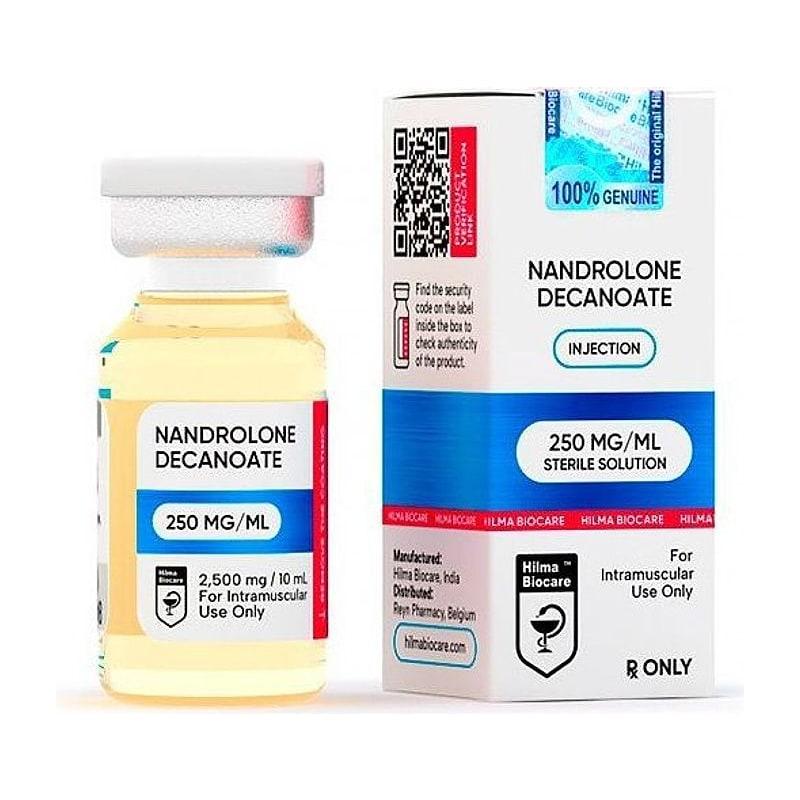
Nandrolone Decanoate, €40 · 99.3% purity
Research Applications of 19-Nor Tissue Selectivity#
The 19-nor class has been fundamental to:
1. Understanding tissue-selective androgen action#
19-nor compounds provided the first clear pharmacological evidence that anabolic (muscle, bone) and androgenic (prostate, skin) effects could be dissociated — important for SARM development rationale.
2. Male contraception research#
The combined AR + PR HPTA suppression of 19-nor steroids enables effective gonadotropin suppression at lower doses → potential for male hormonal contraception without full androgenic replacement dose → fewer side effects.
3. Bone and muscle wasting disease models#
For diseases where anabolic therapy is needed but androgenic effects are undesirable (e.g., female patients, prostate cancer patients): 19-nor compounds or SARMs derived from 19-nor insights are candidates.
4. Mechanistic dissection experiments#
Comparing testosterone + 5α-reductase inhibitor vs. nandrolone (both reduce DHT exposure):
- Finasteride blocks type 2 only
- Nandrolone substitutes DHN for DHT entirely
- Different mechanism → helps dissect which tissue effects are type 1 vs. type 2 5α-reductase dependent
19-Nor vs. SARM: What Research Taught Us#
SARMs (selective androgen receptor modulators) were developed with the explicit goal of achieving the anabolic selectivity of nandrolone without its side effects (progestogenic activity, HPTA suppression, still some androgenicity).
Key insights from 19-nor research that guided SARM development:
- Tissue selectivity is achievable via metabolic differences — nandrolone proved this
- AR itself is tissue-agnostic — the receptor is the same molecule in muscle and prostate; selectivity comes from metabolism (DHT vs. DHN) or coactivator expression
- For gene therapy-based SARM approaches: non-steroidal SARMs exploit differences in coactivator recruitment profiles
- The progestogenic liability of steroidal 19-nors: motivates development of non-steroidal SARMs that don't interact with PR
Key References#
-
Gao W, et al. (2005). "Selective androgen receptor modulators (SARMs): current knowledge and clinical applications." Sexual Medicine Reviews, 3(2):67–82.
-
Kicman AT. (2008). "Pharmacology of anabolic steroids." British Journal of Pharmacology, 154(3):502–521.
-
Loughney DA & Schwender CF. (1992). "A comparison of progestin and androgen receptor binding using the CoMFA technique." Journal of Computer-Aided Molecular Design, 6(6):569–581.
-
Saartok T, et al. (1984). "Relative binding affinity of anabolic-androgenic steroids: comparison of the binding to the androgen receptors in skeletal muscle and in prostate as well as to sex hormone-binding globulin." Endocrinology, 114(6):2100–2106.
Research Use Only: All compounds described are sold exclusively for in-vitro research and laboratory use. Not for unsupervised use. JuicedPharma does not provide medical advice.
Published by JuicedPharma Research Team · September 2026 · Category: Research Protocols & Science