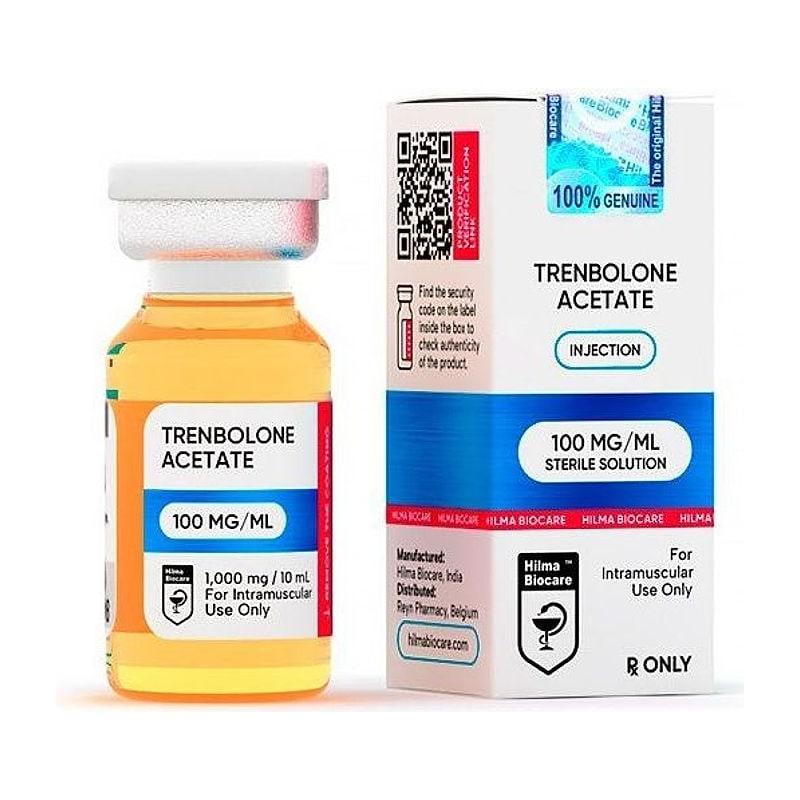
Research Disclaimer: Trenbolone acetate is sold exclusively for in-vitro and laboratory research use. Not for unsupervised use. This content does not constitute medical advice.
Trenbolone is among the most potent anabolic-androgenic steroids in terms of absolute receptor binding and anabolic potency. As a 19-nor steroid with additional Δ9,10 and Δ11,12 double bonds, it possesses a cross-conjugated diene system in ring B that prevents both aromatization and 5α-reduction. This combination — ultra-high AR affinity, potent PR agonism, no conversion to estrogen, and no 5α-reduced metabolite — makes trenbolone a pharmacologically distinct research compound for studying maximal AR activation and glucocorticoid receptor antagonism.
Table of Contents#
- Structural Basis of Trenbolone's Potency
- Pharmacokinetics: Acetate Ester
- AR Binding: Why Trenbolone Is So Potent
- No Aromatization: Mechanism and Implications
- Progestogenic Activity: PR Agonism
- Glucocorticoid Receptor Interactions
- Anabolic Mechanisms and In Vivo Potency
- HPTA Suppression
- Research Protocols
- Key References
Structural Basis of Trenbolone's Potency#
Trenbolone is 17β-hydroxy-estra-4,9,11-trien-3-one: a 19-nor steroid with three double bonds (Δ4,5 in ring A; Δ9,10 and Δ11,12 in ring B).
The Δ9,10 and Δ11,12 double bonds create a cross-conjugated diene system:
- Ring B rigidity: the conjugated diene makes ring B more planar and rigid
- Steric protection: the C9,10 and C11,12 double bonds sterically prevent 5α-reductase (which acts at C4,5) from functioning efficiently
- Aromatase resistance: aromatase requires specific geometry at ring A + C10 bond and C19 methyl → absent (19-nor) + altered ring B geometry → aromatase cannot process trenbolone
- AR binding optimization: ring B rigidity may allow optimal positioning in the AR ligand-binding pocket → high affinity, slow dissociation
Pharmacokinetics: Acetate Ester#
Trenbolone acetate (TrA): 2-carbon acetate ester at C17β
| Parameter | Value |
|---|---|
| Ester chain | 2 carbons (acetate) |
| t½ (human, IM) | ~1–3 days |
| Tmax | ~12–24h |
| Duration above baseline | ~5–7 days |
| Injection interval (research) | Every 1–3 days |
| Oil vehicle | Sesame oil or MCT |
In rodents#
- t½ ~0.5–1 day (faster clearance)
- Daily to every-other-day dosing for stable exposure in rodents
Free trenbolone equivalent: TrA: acetate ester MW = 60 Da; trenbolone MW = 270 Da. TrA 100 mg = ~82 mg trenbolone (78% free base by mass).
AR Binding: Why Trenbolone Is So Potent#
Relative binding affinity (RBA)#
The AR binding affinity of trenbolone varies substantially across assay conditions:
| Compound | AR RBA (various assays range) | Typical physiological assay |
|---|---|---|
| Testosterone | 1.0 (reference) | 1.0 |
| DHT | 2.0–5.0 | 3.0–5.0 |
| Trenbolone | 1.5–100 (wide range) | ~3–5× testosterone |
| Nandrolone | 0.6–1.0 | ~0.8 |
Why such variability in trenbolone RBA? AR binding assays use different:
- Temperature (37°C vs. 4°C — affects off-rate)
- Incubation time (short vs. extended equilibrium)
- AR source (expressed vs. native; different species)
- Competitor (methyltrienolone R1881 vs. testosterone vs. DHT)
The ~100× values (cited in some reviews) come from specific non-equilibrium competition conditions. Under physiological temperature and extended incubation, trenbolone's RBA vs. testosterone is approximately 3–5× — similar to DHT.
Slow AR dissociation rate#
Trenbolone's most important AR kinetic property: slow off-rate (koff)
- Testosterone: AR residence time ~minutes at physiological temperature
- DHT: slower off-rate than testosterone (explains higher affinity)
- Trenbolone: even slower off-rate than DHT → extended nuclear AR residence → prolonged ARE-driven transcriptional activation
Biological consequence: per unit AR occupancy, trenbolone drives more prolonged gene expression than testosterone or DHT — contributing to its high in vivo potency.
No Aromatization: Mechanism and Implications#
Trenbolone's Δ9,10 + Δ11,12 double bonds in ring B, combined with 19-nor (no C19 methyl), makes it a non-substrate for aromatase (CYP19A1):
Aromatization mechanism: requires:
- C19 hydroxylation → removal → ring A double bond rearrangement
- This requires specific molecular geometry around C10 junction
With Δ9,10 in ring B: C10 geometry is altered → aromatase cannot catalyze the ring A aromatization → zero aromatization
Research implications of zero aromatization#
- No estradiol production: trenbolone administration → no E2 increase → estrogen-sensitive endpoints (water retention, bone protective effects) do not change
- Bone: trenbolone's AR activation provides bone anabolism, but without E2, the estrogen-dependent bone resorption suppression pathway is absent → net bone effect differs from testosterone
- Clean androgenic/anabolic signal: for studying pure AR effects without ER confound, trenbolone is useful (as is DHT, stanozolol, oxandrolone)
- No estrogen feedback to HPTA: E2 is normally a major suppressor of HPTA; with trenbolone, HPTA suppression is primarily AR + PR-mediated (no E2 contribution)
Progestogenic Activity: PR Agonism#
Trenbolone has the highest PR binding affinity among the commonly studied 19-nor androgens:
| Compound | PR RBA (progesterone = 1.0) |
|---|---|
| Progesterone | 1.0 |
| Trenbolone | 0.8–1.0 |
| Nandrolone | 0.15–0.22 |
| Levonorgestrel | 1.5–2.5 |
| Testosterone | ~0.01 |
At near-equipotent PR affinity to progesterone, trenbolone is one of the most potent PR agonists among anabolic steroids.
PR agonism contributes:
- HPTA suppression (PR on hypothalamic GnRH interneurons → additional suppression beyond AR effects)
- Lactotroph effects (PR on pituitary lactotrophs — can elevate prolactin in some contexts)
- Mammary gland effects in female models (PR agonism + AR activation)
Glucocorticoid Receptor Interactions#
A unique feature of trenbolone not shared by most androgens: glucocorticoid receptor (GR) binding
Trenbolone binds GR with approximately 30–40% the affinity of dexamethasone (a potent synthetic glucocorticoid). This GR binding produces:
Partial GR agonism/antagonism#
At the GR:
- Low doses: trenbolone may act as a partial GR agonist (weak activation of glucocorticoid-responsive genes)
- High concentrations relative to endogenous cortisol: trenbolone may partially displace cortisol from GR → functional GR antagonism → reduced catabolic signaling
Anti-catabolic mechanism via GR antagonism:
- Cortisol → GR → MAFbx/MuRF1 upregulation → muscle catabolism
- Trenbolone competing with cortisol at GR → reduced GR-driven atrophy gene expression → reduced muscle catabolism
This anti-catabolic mechanism (GR partial antagonism) is proposed to contribute to trenbolone's exceptionally high A:A ratio (~3–5:1 anabolic:androgenic) beyond its direct AR anabolic effects.
Anabolic Mechanisms and In Vivo Potency#
AR pathway (primary anabolic mechanism)#
Same as other androgens: AR-mediated protein synthesis in skeletal muscle (IGF-1, follistatin, PI3K/Akt/mTOR, anti-proteolytic). The difference is potency — trenbolone's slow off-rate from AR drives more prolonged gene expression per receptor-binding event.
A:A ratio comparison#
| Compound | A:A ratio (Hershberger assay) |
|---|---|
| Testosterone propionate | 1.0 (reference) |
| Nandrolone decanoate | 3.0–3.5 |
| Trenbolone acetate | 3.0–5.0 (some labs report up to 10) |
| Oxandrolone | ~10 |
Trenbolone's high anabolic potency is due to:
- High AR affinity (slow off-rate) → maximal ARE-driven gene expression
- GR partial antagonism → reduced cortisol-driven catabolism
- No DHT-mediated androgenic amplification in prostate (no 5α-reduction) → lower relative androgenic score
Trenbolone Enanthate, €68 · 98.7% purity
HPTA Suppression#
Trenbolone produces among the most complete HPTA suppression of any anabolic compound:
Mechanisms#
- AR pathway: hypothalamic and pituitary AR feedback (same as all androgens)
- PR pathway: very potent PR agonism → additional GnRH pulse suppression (hypothalamus) and LH/FSH suppression (pituitary) — trenbolone is as potent as progesterone at PR
- No E2 counterbalance: unlike testosterone, trenbolone doesn't produce E2. E2 paradoxically has some FSH-stimulating effects (via E2-mediated inhibin B reduction) — absence of E2 with trenbolone means this stimulation doesn't occur
- GR effects: some evidence that GR activation in the hypothalamus can also modulate GnRH secretion
At relatively low doses, trenbolone produces near-complete LH/FSH suppression in both intact animals and humans.
Research Protocols#
Trenbolone acetate dose-response in castrated rats#
| Parameter | Specification |
|---|---|
| Model | Adult castrated male SD rats |
| Doses | TrA: 0, 0.1, 0.3, 1, 3 mg/kg SC daily (short ester → daily dosing) |
| Duration | 10 days (Hershberger format) or 4 weeks |
| Endpoints | Levator ani, ventral prostate, seminal vesicles, quadriceps, serum LH, FSH, trenbolone by LC-MS/MS |
| Comparison | Include TP 0.4 mg/kg/day reference for A:A ratio normalization |
GR antagonism study design#
| Parameter | Specification |
|---|---|
| Model | Adult male rats, intact |
| Groups | Vehicle, TrA alone (3 mg/kg SC daily), dexamethasone (0.1 mg/kg SC daily, catabolic model), TrA + dexamethasone |
| Duration | 3 weeks |
| Endpoints | Muscle weight (levator ani, quadriceps), MAFbx/MuRF1 mRNA (RT-qPCR), serum cortisol, GR nuclear translocation (western blot fractional nuclear enrichment) |
Key References#
-
Kicman AT. (2008). "Pharmacology of anabolic steroids." British Journal of Pharmacology, 154(3):502–521.
-
Bauer ER, et al. (2000). "Hormonal activities of trenbolone metabolites and related compounds." Analyst, 125(5):901–905.
-
Saartok T, et al. (1984). "Relative binding affinity of anabolic-androgenic steroids." Endocrinology, 114(6):2100–2106.
-
Gao W, et al. (2005). "Selective androgen receptor modulators (SARMs): current knowledge and clinical applications." Sexual Medicine Reviews, 3(2):67–82.
Research Use Only: Trenbolone acetate is sold exclusively for in-vitro research and laboratory use. Not for unsupervised use. JuicedPharma does not provide medical advice.
Published by JuicedPharma Research Team · September 2026 · Category: Research Protocols & Science