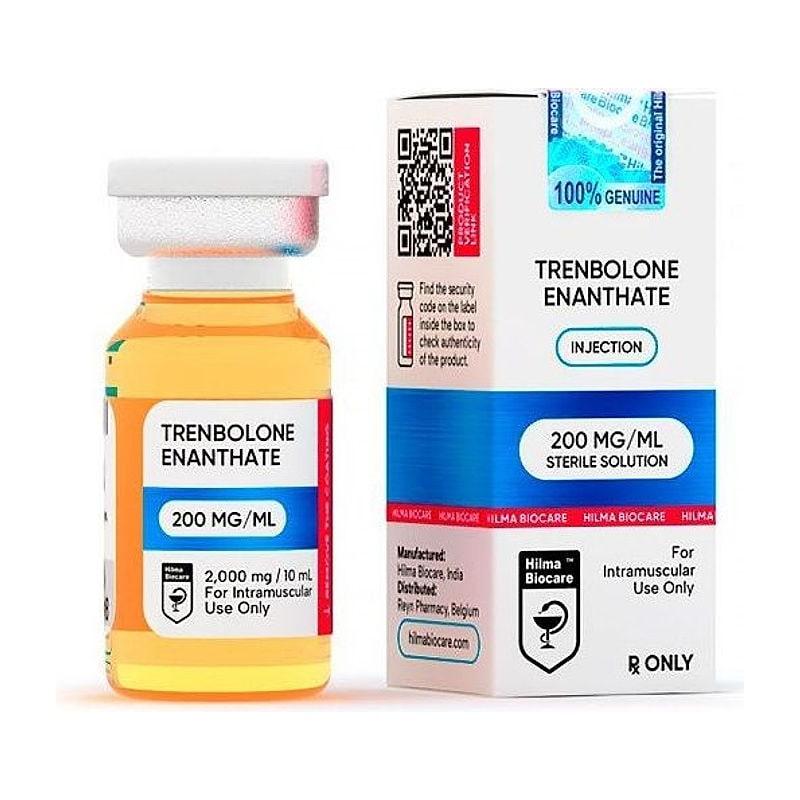
Research Disclaimer: Trenbolone enanthate is sold exclusively for in-vitro and laboratory research use. Not for unsupervised use. This content does not constitute medical advice.
Trenbolone enanthate (TrE) is the 7-carbon heptanoate ester of trenbolone, providing the same pharmacological profile as trenbolone acetate (the short-acting form) with extended pharmacokinetics — approximately 7–10 day half-life after IM injection versus 1–3 days for acetate. This pharmacokinetic difference makes trenbolone enanthate more suitable for longer research protocols, while trenbolone acetate remains the choice for acute studies or protocols requiring rapid dose adjustment.
Table of Contents#
- Enanthate Ester Applied to Trenbolone
- Pharmacokinetics: TrE vs. TrA
- Identical Receptor Pharmacology to Acetate
- When to Use TrE vs. TrA
- Research Protocols with TrE
- Formulation and Storage
- Key References
Enanthate Ester Applied to Trenbolone#
The enanthate (heptanoate) ester:
- 7-carbon chain attached at trenbolone's C17β-OH
- Same ester used in testosterone enanthate → extends t½ from ~0.5h (free trenbolone) to ~7–10 days (TrE)
- Oil depot after IM injection → gradual release → esterase hydrolysis → free trenbolone → biologically active
Compared to trenbolone acetate:
- Acetate (2C): t½ ~1–3 days → requires every 1–3 day injections
- Enanthate (7C): t½ ~7–10 days → weekly injections sufficient
Free trenbolone equivalent: TrE 200 mg = ~148 mg free trenbolone (enanthate MW = 114 Da; trenbolone MW = 270 Da; ~74% free base by mass)
Pharmacokinetics: TrE vs. TrA#
Human PK comparison (100 mg dose)#
| Parameter | Trenbolone Acetate | Trenbolone Enanthate |
|---|---|---|
| Tmax | ~12–24h | ~24–72h |
| Cmax | ~500–800 ng/dL trenbolone | ~400–700 ng/dL |
| t½ | ~1–3 days | ~7–10 days |
| Duration above baseline | ~5–7 days | ~14–21 days |
| Injection interval | Every 1–3 days | Weekly |
| Steady-state reached at | ~4–6 days (multiple injections) | ~4–6 weeks (weekly injections) |
In rodents#
| Parameter | TrA (rat) | TrE (rat) |
|---|---|---|
| t½ | ~0.5–1 day | ~3–5 days |
| Dosing interval for stable exposure | Daily or EOD | Every 3–4 days |
Identical Receptor Pharmacology to Acetate#
Once the enanthate ester is hydrolyzed, the resulting free trenbolone is identical to trenbolone from TrA hydrolysis:
- Same AR affinity (~3–5× testosterone, slow koff)
- Same PR affinity (~80–100% of progesterone)
- Same zero aromatization (Δ9,10 + Δ11,12 prevents CYP19A1)
- Same GR interactions (~30–40% of dexamethasone)
- Same anabolic-androgenic profile (A:A ~3–5:1)
The only difference between TrA and TrE is pharmacokinetics — not pharmacodynamics.
This makes ester selection entirely a protocol design question: how long is the study? How often can injections be administered? What peak-trough ratio is acceptable?
When to Use TrE vs. TrA#
| Criterion | Trenbolone Acetate | Trenbolone Enanthate |
|---|---|---|
| Study duration <4 weeks | ✓ (appropriate t½) | × (still accumulating) |
| Study duration 8–16 weeks | × (very frequent injections) | ✓ |
| Rapid dose adjustment needed | ✓ | × |
| Minimal injection stress for animals | × | ✓ |
| Rapid washout required post-study | ✓ (<2 weeks) | × (3–4 weeks) |
| Human TRT-pattern PK study | × | ✓ (weekly parallel to TE) |
| Acute single-dose timing study | ✓ | × |
Trenbolone Enanthate, €68 · 98.7% purity
Research Protocols with TrE#
Chronic body composition study (8 weeks, castrated rat)#
| Parameter | Specification |
|---|---|
| Model | Adult castrated male SD rats |
| Groups | Vehicle, TrE 3 mg/kg SC q4d, TrE 10 mg/kg SC q4d, TE 5 mg/kg SC q3d (testosterone reference) |
| Duration | 8 weeks |
| Endpoints | Body composition (DEXA), muscle weights, ventral prostate weight, serum LH, FSH, trenbolone by LC-MS/MS, PINP, hematocrit |
| PK note | Blood sampling at trough (4 days post-injection) and peak (24h post-injection) at week 4 to confirm steady-state |
Trenbolone vs. testosterone + aromatase inhibitor comparison#
Rationale: Compare trenbolone (no E2, PR agonist) to testosterone + anastrozole (no E2, no PR agonism) to isolate the PR contribution:
- Both groups have: high serum androgen, zero estrogen
- Trenbolone group adds: potent PR agonism
- Testosterone + anastrozole group: no PR agonism
- Difference in HPTA suppression, HPTA recovery, and progestogenic endpoints = attributable to PR agonism
| Parameter | Specification |
|---|---|
| Groups | 1. Vehicle, 2. TrE 3 mg/kg q4d, 3. TE 5 mg/kg q3d + anastrozole 0.1 mg/kg/day, 4. TE 5 mg/kg q3d alone |
| Duration | 8 weeks |
| Endpoints | LH, FSH, E2, serum trenbolone/testosterone, muscle weights, prostate weight, HPTA recovery (3, 6, 9 weeks post-cessation) |
Formulation and Storage#
Vehicle preparation: Trenbolone enanthate dissolves readily in oil:
- Solubility in sesame oil: up to 100 mg/mL (above this: benzyl benzoate required)
- Standard research formulation: 75 mg/mL in sesame oil (20% benzyl benzoate + 2% benzyl alcohol)
- Stable at room temperature (sealed vial): 18–24 months
- Refrigerated: 36+ months
For high-concentration vials (200 mg/mL):
- Requires 30–40% benzyl benzoate
- Warm to 50°C to dissolve completely
- Filter through 0.22 µm PTFE syringe filter while warm
Key References#
-
Kicman AT. (2008). "Pharmacology of anabolic steroids." British Journal of Pharmacology, 154(3):502–521.
-
Bauer ER, et al. (2000). "Hormonal activities of trenbolone metabolites." Analyst, 125(5):901–905.
-
OECD Test Guideline 441. (2009). "Hershberger Bioassay in Rats."
Research Use Only: Trenbolone enanthate is sold exclusively for in-vitro research and laboratory use. Not for unsupervised use. JuicedPharma does not provide medical advice.
Published by JuicedPharma Research Team · September 2026 · Category: Research Protocols & Science