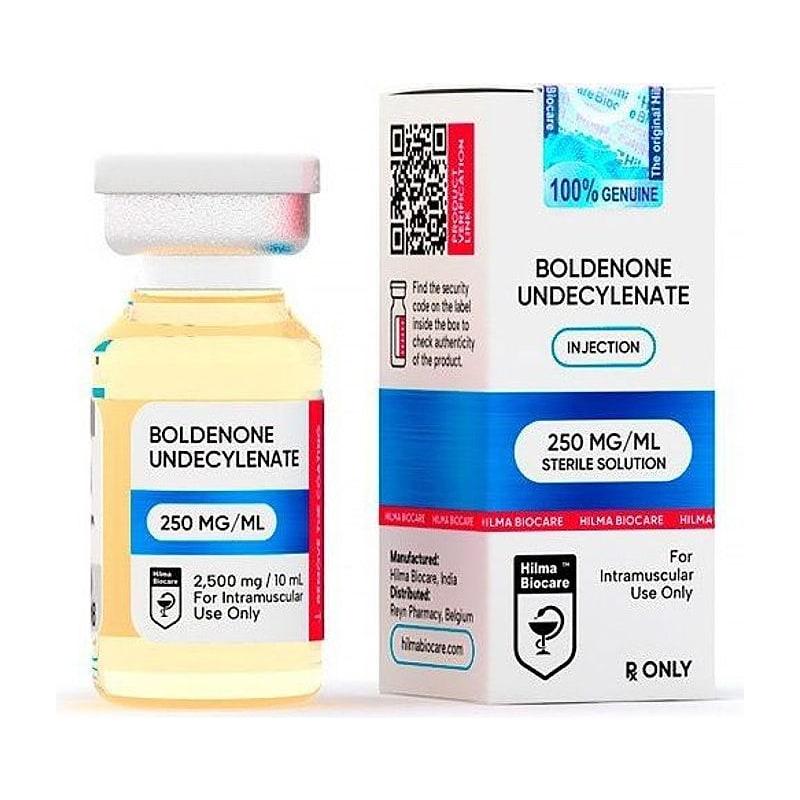
Research Disclaimer: Boldenone undecylenate is sold exclusively for in-vitro and laboratory research use. Not for unsupervised use. This content does not constitute medical advice.
Boldenone undecylenate (BU), marketed for veterinary use as Equipoise, is a Δ1,2-testosterone derivative — testosterone with an additional double bond between C1 and C2 positions. This structural modification produces a compound with distinct pharmacological properties compared to both testosterone and nandrolone: moderate AR affinity, reduced aromatization, low 5α-reduction, and a unique capacity to stimulate erythropoietin (EPO) production that has attracted research interest in anemia and exercise physiology.
Table of Contents#
- Δ1,2-Double Bond: Structural Significance
- Pharmacokinetics: Undecylenate Ester
- Aromatization Profile
- 5α-Reduction and Androgenic Profile
- EPO Stimulation: The Unique Erythropoietic Effect
- Anabolic Mechanisms
- Comparison Table: Boldenone vs. Nandrolone vs. Testosterone
- Research Protocols
- Key References
Δ1,2-Double Bond: Structural Significance#
Boldenone is Δ1-testosterone: testosterone with an additional C1–C2 double bond in ring A.
This modification:
- Reduces aromatase activity: the Δ1,2-double bond interferes with aromatase binding geometry → boldenone aromatizes at ~50% the rate of testosterone (yields estradiol, but at half the rate per unit exposure)
- Reduces 5α-reductase activity: the double bond sterically hinders 5α-reductase → boldenone is a poor substrate → limited 5α-reduced metabolite formation (and when it does form, Δ1-DHT has reduced AR affinity)
- Does NOT significantly alter AR binding: boldenone itself binds AR with ~0.5–0.8× the affinity of testosterone
- Produces a distinct metabolite: boldenone → (minor) 5α-reduction → Δ1-DHT (less potent than DHT; unlike testosterone's amplification, boldenone's 5α-reduction does not increase androgenic potency)
Pharmacokinetics: Undecylenate Ester#
The undecylenate ester is structurally almost identical to the undecanoate ester (11 carbons) but contains a terminal double bond:
| Parameter | Boldenone Undecylenate | Testosterone Undecanoate (Nebido) |
|---|---|---|
| Ester chain | 11C with terminal double bond | 11C saturated |
| t½ (human, IM) | ~14 days | ~33 days |
| Difference | Undecylenate's terminal double bond slightly reduces lipophilicity vs. undecanoate → faster absorption | More lipophilic → slower absorption |
Boldenone undecylenate PK summary#
| Parameter | Value |
|---|---|
| t½ | ~14 days (human); ~5–7 days (rat) |
| Tmax | ~3–7 days (human) |
| Cmax (200 mg IM) | ~300–600 ng/dL boldenone |
| Duration above baseline | ~4–6 weeks |
| Dosing interval (research) | Weekly to every 2 weeks |
Free boldenone equivalent: 200 mg BU → ~140 mg boldenone (undecylenate = ~30% of MW)
Aromatization Profile#
Boldenone aromatizes to estradiol, but at approximately 50% the rate of testosterone per unit serum level:
Mechanism of reduced aromatization#
Aromatase (CYP19A1) converts the A ring of androgens to the phenolic (aromatic) A ring of estrogens. The reaction requires removal of the C19 methyl group and oxidative aromatization.
For testosterone: the Δ4,5-double bond facilitates this reaction. For boldenone: the Δ1,2-double bond alters the geometry of ring A, making aromatase binding less efficient. The Δ1,2-bond and Δ4,5-bond together create a different electron density pattern that reduces CYP19A1 turnover rate.
Research implication: boldenone is useful for studying androgen effects with an intermediate estrogenic signal — more estrogen than a non-aromatizable androgen (DHT, oxandrolone), less than testosterone. This allows studying how varying estrogen co-production affects endpoints like bone density, cardiovascular function, and mood-related behaviors.
5α-Reduction and Androgenic Profile#
Boldenone is a poor substrate for 5α-reductase:
- Limited conversion to Δ1-DHT (the 5α-reduced metabolite)
- Δ1-DHT: AR affinity ~0.5× testosterone (less potent than DHT, unlike testosterone's 3–5× amplification)
- Result: boldenone's androgenic profile in 5α-reductase-rich tissues is not amplified
Anabolic:androgenic ratio (Hershberger assay):
- Boldenone: approximately 1.5–2.0:1 (modestly higher than testosterone at 1.0:1)
- Less selectivity than nandrolone (~3–3.5:1) but more than testosterone
Versus nandrolone's selective mechanism:
- Nandrolone is selective because DHN is weak
- Boldenone is moderately selective because 5α-reduction barely occurs (limited metabolite formation)
EPO Stimulation: The Unique Erythropoietic Effect#
The most distinct pharmacological property of boldenone: stronger EPO-stimulating effects than testosterone or nandrolone at equivalent AR-activating doses.
Mechanism#
AR activation in renal peritubular fibroblasts → increased HIF-1α (hypoxia-inducible factor 1α) pathway activity → EPO gene upregulation → increased EPO secretion → erythroid progenitor stimulation → increased RBC production
Why boldenone > testosterone for EPO stimulation: The precise reason for boldenone's preferential EPO stimulation is not fully elucidated, but proposed mechanisms include:
- Boldenone's Δ1,2-double bond may allow better renal tissue penetration (different lipophilicity vs. testosterone)
- Boldenone may have different coactivator recruitment at HIF-1α/VEGF-responsive elements in the EPO promoter
- Reduced estradiol from boldenone (since E2 has modest EPO-suppressing effects at the pituitary level) → net more EPO
Research evidence#
- Boldenone in rodent studies: hematocrit increase ~10–15% above baseline (vs. ~5–10% with testosterone at equimolar doses)
- Reticulocyte count (indicator of active erythropoiesis) rises more steeply with boldenone than testosterone
- Serum EPO levels: measurably elevated with boldenone treatment in intact rodents
Research applications#
- Anemia models: test boldenone's erythropoietic efficacy vs. recombinant EPO (rEPO)
- Exercise performance research: boldenone-induced erythrocytosis as model for altitude acclimatization
- Anti-doping research: boldenone urinary metabolite detection (boldenone → 5α-androst-1-en-17β-ol-3-one as urine metabolite — WADA target)
Anabolic Mechanisms#
Skeletal muscle#
Boldenone activates AR in skeletal muscle similarly to testosterone:
- ARE-driven gene expression (IGF-1, follistatin)
- PI3K/Akt/mTOR non-genomic activation
- Anti-proteolytic: reduced MAFbx/MuRF1
At equivalent doses, boldenone produces lean mass gains in castrated rodents comparable to testosterone decanoate.
Collagen and connective tissue#
Boldenone shares nandrolone's property of stimulating collagen synthesis in fibroblasts and tenocytes (AR-mediated COL1A1/COL3A1 upregulation). This has been proposed as useful for joint research, though the evidence base is less extensive than for nandrolone.
Bone#
- Osteoanabolic: AR activation in osteoblasts → bone formation stimulation
- Less studied than testosterone or nandrolone for bone endpoints specifically
Nandrolone Decanoate, €40 · 99.3% purity
Comparison Table: Boldenone vs. Nandrolone vs. Testosterone#
| Property | Testosterone | Nandrolone | Boldenone |
|---|---|---|---|
| AR affinity | 1.0 | 0.6–1.0 | 0.5–0.8 |
| Anabolic:androgenic ratio | 1.0 | 3.0–3.5 | 1.5–2.0 |
| Aromatization rate | High | Low (→estrone) | Moderate (~50% T) |
| 5α-reduction product | DHT (potent) | DHN (weak) | Δ1-DHT (moderate) |
| Progestogenic activity | Low | High (~20% P4) | Low |
| EPO stimulation | Moderate | Moderate | Highest among androgens |
| Androgenic in prostate | High (DHT) | Low (DHN) | Moderate (Δ1-DHT) |
| t½ (decanoate/undecylenate) | — | 12–15 days | 14 days |
| Collagen synthesis | Yes | Yes (potent) | Yes (moderate) |
Research Protocols#
EPO and erythropoiesis study#
| Parameter | Specification |
|---|---|
| Model | Adult intact male SD rats (uremic CKD model: 5/6 nephrectomy for EPO deficiency OR intact animals for baseline EPO stimulation) |
| Groups | Vehicle, Boldenone undecylenate 5 mg/kg SC weekly, TE 5 mg/kg SC weekly, rEPO 50 U/kg SC 3×/week |
| Duration | 6 weeks |
| Endpoints | Hematocrit, hemoglobin (CBC), reticulocyte count, serum EPO (ELISA — rat-specific kit), BFU-E colony assay from bone marrow, renal EPO mRNA (RT-qPCR) |
Anabolic comparison: boldenone vs. nandrolone vs. testosterone (castrated rat)#
| Parameter | Specification |
|---|---|
| Model | Adult castrated male SD rats |
| Treatment | BU 5 mg/kg SC weekly, ND 5 mg/kg SC weekly, TE 5 mg/kg SC q3d |
| Duration | 8 weeks |
| Endpoints | Levator ani, ventral prostate, quadriceps, DEXA, serum hormone levels by LC-MS/MS, hematocrit, collagen content (hydroxyproline, Achilles tendon) |
Key References#
-
Kicman AT. (2008). "Pharmacology of anabolic steroids." British Journal of Pharmacology, 154(3):502–521.
-
Shahidi NT. (2001). "A review of the chemistry, biological action, and clinical applications of anabolic-androgenic steroids." Clinical Therapeutics, 23(9):1355–1390.
-
Casavant MJ, et al. (2007). "Factitious hyperbolism in a collegiate athlete." Pediatrics, 119(5):e1259–e1263.
-
Hartgens F & Kuipers H. (2004). "Effects of androgenic-anabolic steroids in athletes." Sports Medicine, 34(8):513–554.
Research Use Only: Boldenone undecylenate is sold exclusively for in-vitro research and laboratory use. Not for unsupervised use. JuicedPharma does not provide medical advice.
Published by JuicedPharma Research Team · September 2026 · Category: Research Protocols & Science