Research Disclaimer: All compounds described are sold exclusively for in-vitro and laboratory research use. Not for unsupervised use. This content does not constitute medical advice.
The glucocorticoid receptor (GR) is the primary mediator of cortisol's catabolic effects on muscle. Several anabolic steroids, most notably trenbolone, interact with GR in ways that produce functional antagonism of cortisol's muscle-wasting effects. Understanding GR-androgen cross-reactivity is important for interpreting anabolic steroid pharmacology, designing anti-catabolic research protocols, and dissecting the mechanisms underlying certain anabolic steroids' exceptional muscle-preserving potency.
Table of Contents#
- The Glucocorticoid Receptor: Catabolic Mediator
- Which Androgens Interact with GR?
- Trenbolone-GR Interaction: Mechanism
- Functional GR Antagonism: Anti-Catabolic Pathway
- Distinguishing AR vs. GR Contributions
- Research Protocols: Dissecting GR Interactions
- GR Agonism Risk: When GR Activation Has Adverse Effects
- Key References
The Glucocorticoid Receptor: Catabolic Mediator#
The glucocorticoid receptor (GR, NR3C1) is a member of the nuclear receptor superfamily — same family as the androgen receptor (NR3C4):
GR structure:
- Ligand-binding domain (LBD): binds cortisol, dexamethasone, prednisolone
- DNA-binding domain (DBD): binds glucocorticoid response elements (GREs)
- Similar domain architecture to AR → explains cross-reactivity potential
GR-driven muscle catabolism: Cortisol → GR → nucleus → GRE-driven gene expression:
- MAFbx (muscle atrophy F-box, atrogin-1) upregulation → E3 ubiquitin ligase → targets myofibrillar proteins for proteasomal degradation
- MuRF1 (muscle RING finger protein 1) upregulation → another E3 ubiquitin ligase → targets myosin heavy chain specifically
- FoxO1/FoxO3a nuclear translocation (GR-driven) → transcribes atrophy program
- Reduced mTOR/S6K activity (cortisol suppresses mTORC1)
Net: elevated cortisol (stress, illness, caloric restriction, overtraining) → GR activation → muscle wasting.
Which Androgens Interact with GR?#
Not all anabolic steroids interact with GR. The key factors are structural similarity to glucocorticoids and the steroid's geometry at the LBD:
| Compound | GR binding affinity | GR action | Notes |
|---|---|---|---|
| Cortisol | 1.0 (reference) | Full agonist | Endogenous glucocorticoid |
| Dexamethasone | ~7–10× cortisol | Full agonist | Synthetic; research reference |
| Trenbolone | ~0.3–0.4× cortisol | Partial agonist/antagonist | Most potent GR-interacting androgen |
| Testosterone | ~0.01× cortisol | Negligible | Minimal GR interaction |
| Nandrolone | ~0.05× cortisol | Negligible | Low GR interaction |
| Stanozolol | ~0.03× cortisol | Negligible | Minimal |
| DHT | ~0.05× cortisol | Negligible | Minimal |
| Boldenone | ~0.1× cortisol | Very low partial agonist | Some evidence for slight GR interaction |
Trenbolone is the primary GR-interacting anabolic steroid in common research use, with approximately 30–40% the GR binding affinity of cortisol.
Trenbolone-GR Interaction: Mechanism#
GR binding#
Trenbolone's conjugated diene ring system (Δ9,10 + Δ11,12 in ring B, combined with 19-nor) produces a ring geometry that:
- Fits the GR LBD binding pocket (similar volume and shape to dexamethasone)
- Does not fully activate GR (partial agonist kinetics — recruits some but not all GR coactivators)
- Competes with endogenous cortisol for GR binding → competitive displacement
Partial agonist profile at GR: At GR, trenbolone:
- Activates a subset of GR-driven genes (partial agonism at some GREs)
- Blocks cortisol's full activation at other GREs (competitive antagonism)
- Net effect depends on concentration and the ratio of trenbolone to cortisol
At therapeutic research concentrations of trenbolone (comparable to androgenic doses producing muscle anabolism), the cortisol:trenbolone molar ratio typically favors cortisol → trenbolone acts primarily as a competitive partial antagonist at GR in muscle.
Functional GR Antagonism: Anti-Catabolic Pathway#
In the muscle: competitive cortisol displacement#
When trenbolone occupies GR:
- Cortisol → GR binding site occupied by trenbolone → cortisol cannot fully activate GR
- MAFbx and MuRF1 upregulation is blunted (less GR-driven atrogene transcription)
- FoxO nuclear translocation reduced
- mTOR pathway less suppressed (cortisol's anti-mTOR signal is blocked)
Net: trenbolone reduces cortisol-driven muscle protein breakdown → anti-catabolic effect
This GR antagonism operates INDEPENDENTLY of trenbolone's AR-mediated anabolic effects:
- AR activation → increased protein synthesis (anabolic)
- GR antagonism → decreased protein breakdown (anti-catabolic)
- Combined: net protein balance improved from both sides
This dual mechanism (AR agonism + GR antagonism) likely explains why trenbolone achieves higher anabolic efficacy per unit androgen dose than testosterone (which has minimal GR interaction).
Distinguishing AR vs. GR Contributions#
Research challenge: trenbolone activates AR and interacts with GR simultaneously. To dissect which contribution drives which outcome:
Experimental approach 1: AR antagonist + trenbolone#
- Co-administer flutamide (AR antagonist) + trenbolone
- Any remaining effect is GR-mediated (AR blocked)
- Any trenbolone-specific effect lost = AR-mediated
- This separates AR anabolic from GR anti-catabolic
Experimental approach 2: GR antagonist + trenbolone#
- Co-administer mifepristone (RU486 — GR antagonist, also PR antagonist) + trenbolone
- Any remaining effect is AR-mediated (GR/PR blocked)
- Note: mifepristone also blocks PR → cannot distinguish GR vs. PR contribution alone
Experimental approach 3: Catabolic stress model#
- Dexamethasone-induced muscle wasting model: give dexamethasone to catabolic control group
- Compare: Dexamethasone alone vs. Dexamethasone + Trenbolone
- In the combined group: trenbolone competes with dexamethasone at GR → rescued muscle mass = GR antagonism contribution
- Separate group: Dexamethasone + Testosterone (no GR interaction) → less protection
- Difference between trenbolone-rescued and testosterone-rescued groups = GR antagonism contribution
Research Protocols: Dissecting GR Interactions#
Dexamethasone-catabolic model with trenbolone rescue#
| Parameter | Specification |
|---|---|
| Model | Adult male SD rats, intact |
| Groups | 1. Vehicle (corn oil SC + saline SC), 2. Dexamethasone 1 mg/kg SC daily, 3. Dexamethasone + Trenbolone acetate 3 mg/kg SC daily, 4. Dexamethasone + Testosterone enanthate 5 mg/kg SC q3d, 5. Trenbolone acetate alone 3 mg/kg SC daily |
| Duration | 14 days |
| Endpoints | Body weight, quadriceps and gastrocnemius mass, MAFbx and MuRF1 mRNA (RT-qPCR), puromycin incorporation (protein synthesis SUnSET), plasma trenbolone/testosterone by LC-MS/MS, serum cortisol |
| Key comparison | Group 3 vs. 4: isolates GR antagonism effect (both have equal AR activation, but trenbolone adds GR block) |
GR competition binding assay (in vitro)#
| Parameter | Specification |
|---|---|
| Receptor | Recombinant human GR-LBD (commercially available) |
| Radioligand | [³H]-dexamethasone (specific activity 15–20 Ci/mmol) |
| Competitor | Trenbolone, testosterone, nandrolone, dexamethasone (dose-response) |
| Buffer | 10 mM Tris-HCl pH 7.4, 0.5 mM EDTA, 20 mM molybdate (stabilizes GR) |
| Incubation | 4h at 4°C (equilibrium) |
| Separation | DCC |
| Analysis | IC50 → Ki via Cheng-Prusoff; compare RBA values across compounds |
GR Agonism Risk: When GR Activation Has Adverse Effects#
Trenbolone's partial GR agonism also carries potential adverse signals:
At GR partial agonism (not pure antagonism):
- Some GR-responsive genes ARE activated by trenbolone (the partial agonist fraction)
- Potential for metabolic GR effects (insulin resistance, glucose dysregulation) if GR agonism fraction is significant
- In adipose tissue: GR agonism → increased fat deposition → trenbolone's partial GR agonism in fat may explain some observations of lipid redistribution
Research design implication: Studies using trenbolone as a "GR antagonist" must verify that the dose range does NOT produce partial agonist effects at the genes of interest. This requires gene expression profiling, not just muscle weight endpoints.
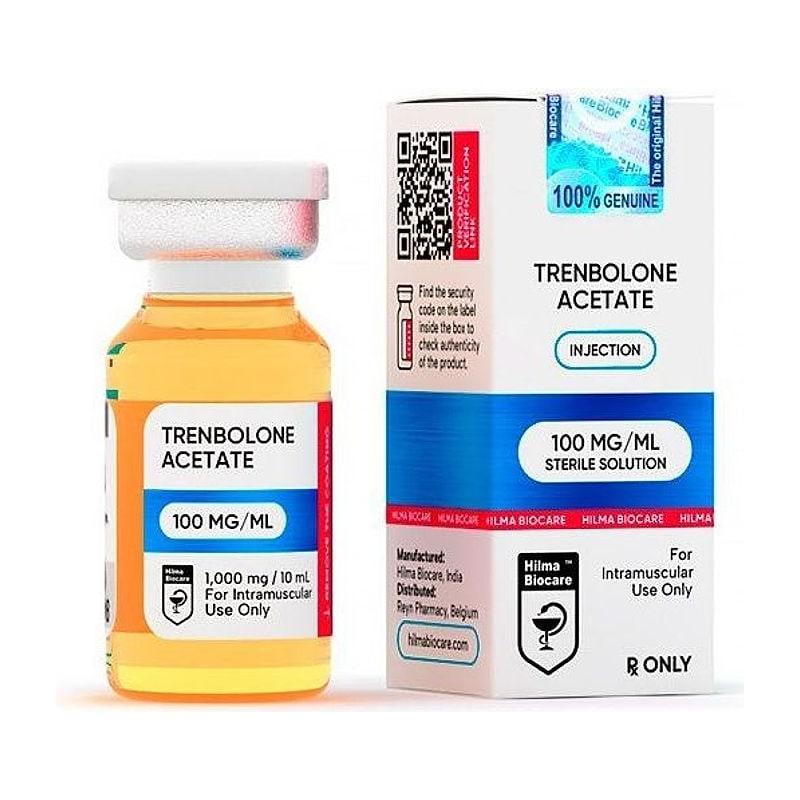
Trenbolone Acetate, €52 · 98.9% purityKey References#
-
Bauer ER, et al. (2000). "Hormonal activities of trenbolone metabolites and related compounds." Analyst, 125(5):901–905.
-
Saartok T, et al. (1984). "Relative binding affinity of anabolic-androgenic steroids." Endocrinology, 114(6):2100–2106.
-
Kicman AT. (2008). "Pharmacology of anabolic steroids." British Journal of Pharmacology, 154(3):502–521.
-
Schakman O, et al. (2013). "Mechanisms of glucocorticoid-induced myopathy." Journal of Endocrinology, 197(1):1–10.
Research Use Only: All compounds described are sold exclusively for in-vitro research and laboratory use. Not for unsupervised use. JuicedPharma does not provide medical advice.
Published by JuicedPharma Research Team · September 2026 · Category: Research Protocols & Science