Research Disclaimer: All compounds described are sold exclusively for in-vitro and laboratory research use. Not for unsupervised use. This content does not constitute medical advice.
Anastrozole and exemestane are both third-generation aromatase inhibitors (AIs) approved for breast cancer treatment and used in clinical endocrinology. Both target CYP19A1 (aromatase) — the enzyme that converts androgens to estrogens — but they do so through entirely different biochemical mechanisms. This mechanistic difference has important implications for research design, particularly for studies investigating aromatase biology, estrogen suppression kinetics, or the androgenic metabolites of exemestane.
Mechanism of Action Comparison#
Anastrozole: Reversible Competitive Inhibition (Type II AI)#
Class: Non-steroidal triazole Mechanism: Anastrozole's triazole nitrogen coordinates with the heme iron of the CYP19A1 active site → competes with androstenedione substrate for binding → reversible enzyme inhibition
Key properties:
- Reversible: when anastrozole is cleared, aromatase activity returns to normal
- Competitive: higher androgen substrate concentrations reduce inhibition efficiency
- Enzyme remains intact: aromatase protein is not damaged
- Off-target CYP inhibition: anastrozole inhibits CYP1A2 and CYP3A4 at higher concentrations → relevant for drug-drug interaction research
Selectivity: Non-steroidal → no androgenic or estrogenic off-target activity
Exemestane: Irreversible Mechanism-Based Inactivation (Type I AI)#
Class: Steroidal (6-methyleneandrosta-1,4-diene-3,17-dione) Mechanism: Exemestane is a substrate for aromatase (structurally resembles androstenedione). CYP19A1 begins metabolizing it → during catalysis, a reactive intermediate forms → covalently binds to the active site → permanent inactivation of that enzyme molecule
Key properties:
- Irreversible (mechanism-based, "suicide inhibitor"): once inactivated, that aromatase molecule is permanently non-functional
- New aromatase synthesis (over 3–5 days) restores enzyme activity — not drug clearance
- Substrate-based: competes with androgen substrate at the active site; higher androgen doesn't overcome it once inactivated
- No wash-out recovery kinetics: estrogen suppression persists beyond drug clearance
Androgenic metabolite: 17-Hydroexemestane (17-OH-exemestane) — the primary metabolite — has androgenic activity at AR (~15–30% of testosterone potency). This is a pharmacologically relevant off-target effect unique to exemestane among approved AIs.
Pharmacokinetic Comparison#
| Parameter | Anastrozole | Exemestane |
|---|---|---|
| Class | Non-steroidal | Steroidal |
| Inhibition type | Reversible competitive | Irreversible (suicide) |
| Oral bioavailability | ~83–85% | ~42% (food-dependent) |
| t½ | ~46h | ~24h |
| Aromatase suppression duration | Returns after drug clearance | 3–5 days (new enzyme synthesis needed) |
| Androgenic metabolite? | No | Yes (17-hydroexemestane) |
| Bone effect | Reduces bone mineral density | Less negative (androgenic metabolite partially compensates) |
Research Application Differences#
Anastrozole:
- Clean estrogen suppression model (no androgenic confound)
- Reversible inhibition useful when studying estrogen recovery kinetics
- CYP1A2/3A4 inhibition research (drug-drug interaction studies at high doses)
- Preferred for: pure estrogen suppression endpoint; competitive inhibition kinetics studies
Exemestane:
- Irreversible kinetics research (suicide inhibition mechanisms)
- Androgenic effects research (via 17-OH-exemestane) — unique among AIs
- Bone protection research: androgenic metabolite partially protects bone while suppressing estrogen → unique bone safety profile vs. other AIs
- Breast cancer estrogen-dependency research: some anastrozole-resistant tumors respond to exemestane (different binding site → no cross-resistance)
Estrogen Suppression: Potency Data#
Clinical estrogen suppression (postmenopausal):
- Anastrozole 1 mg/day: ~97% reduction in plasma E2 in postmenopausal women
- Exemestane 25 mg/day: ~85–90% reduction in plasma E2
Absolute suppression: Anastrozole achieves slightly greater E2 suppression due to reversible mechanism allowing continuous competitive inhibition. Exemestane's irreversible mechanism is limited by rate of new enzyme synthesis (plateau effect).
Residual aromatization: Some CYP19A1 activity always remains (as new enzyme is synthesized); neither agent achieves 100% inhibition in vivo.
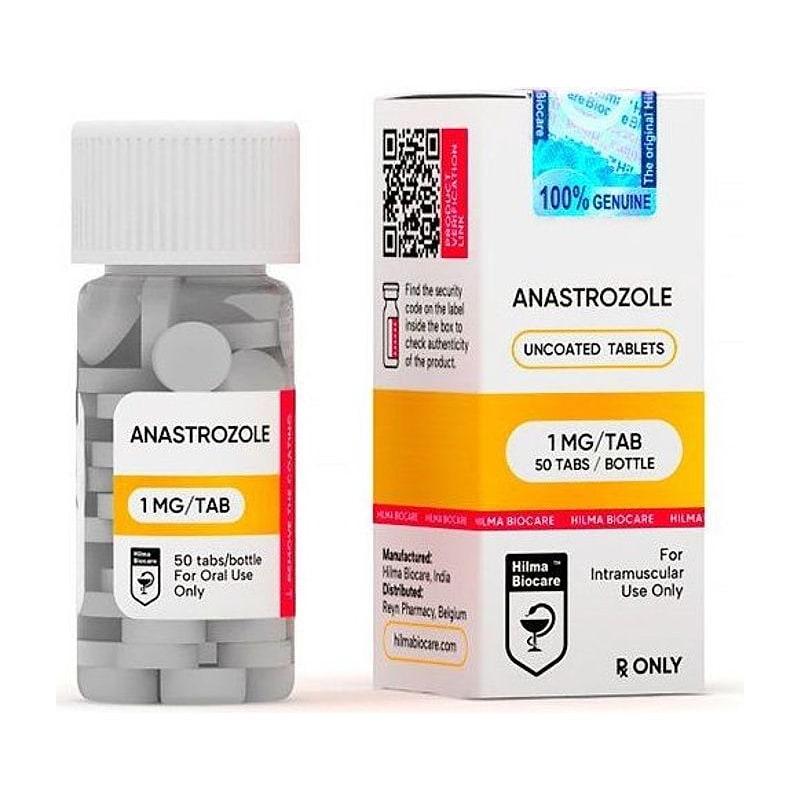
Anastrozole, €28 · 99.3% purityBone Effects: A Key Research Difference#
Anastrozole (non-steroidal):
- E2 suppression → accelerated bone resorption → reduced bone mineral density (BMD)
- ATAC trial (anastrozole vs. tamoxifen): significant BMD reduction over 5 years
- Pure AI effect; no androgenic compensation
Exemestane (steroidal):
- Same E2 suppression but androgenic metabolite (17-OH-exemestane) has mild AR agonism at bone
- TEAM trial (exemestane vs. tamoxifen): smaller BMD loss than anastrozole; some compensation from androgenic metabolite
- Unique position: AI with partial androgen receptor activity at bone → useful for bone/androgen/estrogen interaction research
Practical Research Selection Guide#
Use Anastrozole when:
- Pure, clean E2 suppression endpoint required
- No androgenic off-target effects acceptable
- Reversibility desired (study design requires hormone recovery after washout)
Use Exemestane when:
- Irreversible inhibition kinetics are the research focus
- Studying androgenic AI metabolite effects (androgenic + anti-estrogenic simultaneously)
- Bone safety under estrogen suppression (exemestane's partial androgenic protection)
- Anastrozole-resistant model (estrogen-independent aromatase activity)
Research Use Only. JuicedPharma does not provide medical advice.
Published by JuicedPharma Research Team · September 2026 · Category: Research Protocols & Science