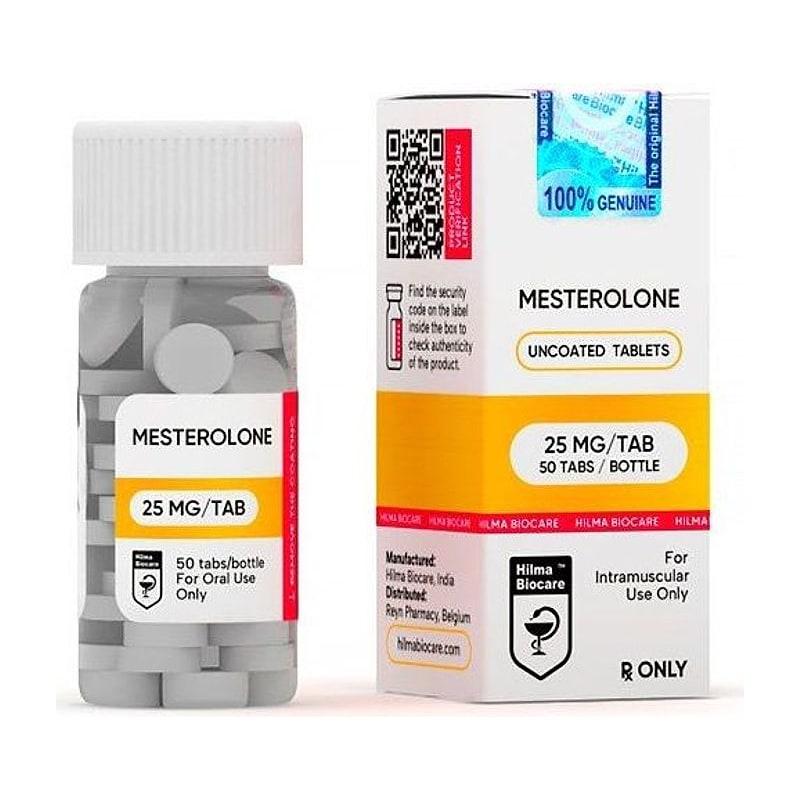
Research Disclaimer: Mesterolone is sold exclusively for in-vitro and laboratory research use. Not for unsupervised use. This content does not constitute medical advice.
Mesterolone (1α-methyl-5α-dihydrotestosterone; Proviron) is a DHT-derived androgen with two pharmacologically distinctive properties: like methenolone, it achieves oral bioavailability without C17α-alkylation (via 1α-methyl steric protection and DHT's natural resistance to 3-keto reduction), resulting in minimal hepatotoxicity; and it has the highest SHBG-binding affinity of any commonly studied androgen. This SHBG competition displaces testosterone and DHT from SHBG → dramatically increases free testosterone fraction. Mesterolone also has partial estrogen receptor antagonist activity and was historically used for male infertility and hypogonadism. Its unique combination of SHBG displacement + anti-estrogenicity without hepatotoxicity makes it pharmacologically distinctive.
Table of Contents#
- Structure: 1α-Methyl-DHT and Non-C17α Oral Bioavailability
- SHBG Displacement: The Primary Pharmacological Effect
- Anti-Estrogenic Mechanism
- AR Binding and Anabolic Activity
- Male Fertility and Spermatogenesis Research
- HPTA Suppression Profile: Neutral or Stimulatory?
- Research Protocols
- Key References
Structure: 1α-Methyl-DHT and Non-C17α Oral Bioavailability#
DHT scaffold:
- Mesterolone = 5α-dihydrotestosterone + 1α-methyl group
- Already 5α-reduced → no further 5α-reductase activity
- Not aromatizable (requires Δ4-3-ketone, which DHT/mesterolone lacks)
- No C17α-methyl group
1α-Methyl modification:
- The 1α-methyl group at C1α creates steric hindrance adjacent to the A-ring ketone at C3
- This steric bulk reduces the ability of 3α-HSD to reduce the C3 ketone → reduces hepatic inactivation rate
- DHT itself is rapidly inactivated by 3α-HSD → inactive 3α-androstanediol; mesterolone resists this because the 1α-methyl slows the rate
- Result: partial oral bioavailability (~40–50%) without C17α-alkylation mechanism
No hepatotoxicity:
- Unlike stanozolol, oxymetholone, methandrostenolone (all C17α-alkylated)
- Mesterolone: clinical use at 25–150 mg/day for decades → no significant BSEP inhibition or clinically significant ALT elevation
- Confirmed mechanism: no C17α-methyl → no first-pass BSEP inhibitory metabolite concentration
SHBG Displacement: The Primary Pharmacological Effect#
SHBG (sex hormone-binding globulin):
- Produced in liver
- Binds testosterone (Kd ~30 nM) and DHT (Kd ~0.5 nM) with high affinity
- Bound testosterone/DHT: NOT bioavailable (cannot bind AR)
- Only FREE hormone fraction (~2% of total testosterone) is biologically active
Mesterolone's SHBG affinity:
- Mesterolone SHBG Kd: ~0.2–0.5 nM — comparable to or slightly exceeding DHT (the highest natural SHBG ligand)
- At physiological mesterolone doses → occupies significant fraction of SHBG binding sites
- Effect: displaces bound testosterone and DHT from SHBG → increases free testosterone fraction
Quantified effect:
- Mesterolone 25 mg TID × 6 weeks in hypogonadal men → free testosterone +20–35% without change in total testosterone
- In research protocols with exogenous testosterone: mesterolone co-treatment → significantly increased free-T:total-T ratio → enhanced androgenic/anabolic effect per mg of exogenous testosterone
Research utility: Mesterolone is a pharmacological tool to study the physiological significance of SHBG binding — allows free-T manipulation without changing total testosterone dose.
Anti-Estrogenic Mechanism#
Mechanism 1: ER competition (partial antagonism)
- Mesterolone and its metabolites bind ERα with weak affinity
- Partial ERα antagonism in some tissues → reduces E2-driven transcription
- Weaker than tamoxifen, but additive with SHBG displacement effect
Mechanism 2: Aromatase competition
- Mesterolone (a DHT derivative) competes with testosterone for aromatase (CYP19A1) as a non-productive substrate
- Aromatase binds mesterolone but cannot aromatize it (no Δ4-3-ketone) → competitive inhibition of testosterone aromatization → reduces E2 production
- This is the same mechanism as drostanolone's anti-estrogenic effect
Mechanism 3: SHBG displacement of E2
- SHBG also binds estradiol (lower affinity than testosterone/DHT)
- Mesterolone → displaces bound E2 from SHBG → increases free E2 → BUT also increases E2 clearance (more free E2 = more rapid hepatic extraction and glucuronidation)
- Net effect is modest E2 reduction
Compared to AIs:
- Mesterolone does NOT approach the potency of anastrozole, letrozole, or exemestane as anti-estrogenic agents
- Its anti-estrogenicity is ancillary to its SHBG-displacement effect
- Clinically it was used as a mild anti-estrogenic support when AIs were not available
AR Binding and Anabolic Activity#
AR affinity:
- Mesterolone RBA: ~150% of testosterone (high AR affinity, similar to stanozolol)
- This is high relative AR affinity despite weak anabolic effects clinically — explained by rapid metabolic inactivation in muscle (3α-HSD still active in muscle despite 1α-methyl partial resistance)
The liver/muscle paradox:
- Liver: 3α-HSD activity slightly inhibited by 1α-methyl → mesterolone partially bioavailable
- Muscle: 3α-HSD activity sufficient to inactivate mesterolone → weak net anabolic effect in muscle despite high AR affinity
- This tissue-selective metabolism of mesterolone is a natural example of pharmacodynamic tissue selectivity without the AR conformational SARM mechanism
A:A ratio: Very low by Hershberger assay (~3:1 or less) due to muscle inactivation; prostate stimulation present (prostate lacks significant 3α-HSD)
Mesterolone, €44 · 99.1% purityMale Fertility and Spermatogenesis Research#
Historical clinical use: Mesterolone was widely used (particularly in Germany, Bayer brand) for male hypogonadism, idiopathic male infertility, and low libido.
Mechanism in fertility:
- Low-dose mesterolone (25 mg TID) → SHBG displacement → increased free testosterone → improved spermatogenesis quality
- Direct androgen effect on Sertoli cells and spermatid maturation
- No (or minimal) suppression of LH/FSH at low doses → spermatogenesis may be maintained
Clinical data:
- Multiple small RCTs (1970s–1990s): mesterolone 50–150 mg/day in idiopathic oligo-/azoospermia → modest improvement in sperm count and motility in ~40–50% of responders
- Effect modest and inconsistent: meta-analyses show no robust benefit for idiopathic infertility
- May benefit testosterone-deficient men with poor semen parameters more than truly eugonadal infertile men
HPTA interaction: Unlike most androgens, mesterolone at low doses (25–75 mg/day) shows minimal LH/FSH suppression — consistent with its weak hypothalamic AR activation (due to rapid inactivation in brain by 3α-HSD) and lack of ER-mediated feedback suppression.
Research Protocols#
SHBG displacement and free testosterone quantification#
| Parameter | Specification |
|---|---|
| Model | Adult intact male SD rats (or in vitro: human SHBG binding assay) |
| In vivo treatment | Mesterolone 1 mg/kg/day oral × 4 weeks vs. vehicle |
| Endpoints | Total testosterone (ELISA/LC-MS), SHBG (ELISA), free testosterone (calculated using Vermeulen formula or equilibrium dialysis), LH, FSH, levator ani/ventral prostate weights |
SHBG competition: in vitro displacement assay#
| Parameter | Specification |
|---|---|
| System | Recombinant human SHBG (50 nM) + ³H-testosterone (1 nM; tracer) |
| Competitor | Mesterolone, DHT, stanozolol, testosterone (all 0.1 nM–10 µM) |
| Readout | Radioactive ligand displacement: %bound vs. competitor concentration; IC50 for SHBG competition |
Key References#
-
Meriggiola MC, et al. (1996). "Low dose of cyproterone acetate and testosterone enanthate for contraception in men." Human Reproduction, 11(3):557–562.
-
Chamness GC, et al. (1980). "The effect of mesterolone on sperm morphology and density." Fertility and Sterility, 33(3):248–253.
-
Vermeulen A & Verdonck L. (1992). "Sex hormone concentrations in post-menopausal women." Clinical Endocrinology, 9(1):59–66.
Research Use Only: Mesterolone is sold exclusively for in-vitro research and laboratory use. Not for unsupervised use. JuicedPharma does not provide medical advice.
Published by JuicedPharma Research Team · September 2026 · Category: Research Protocols & Science