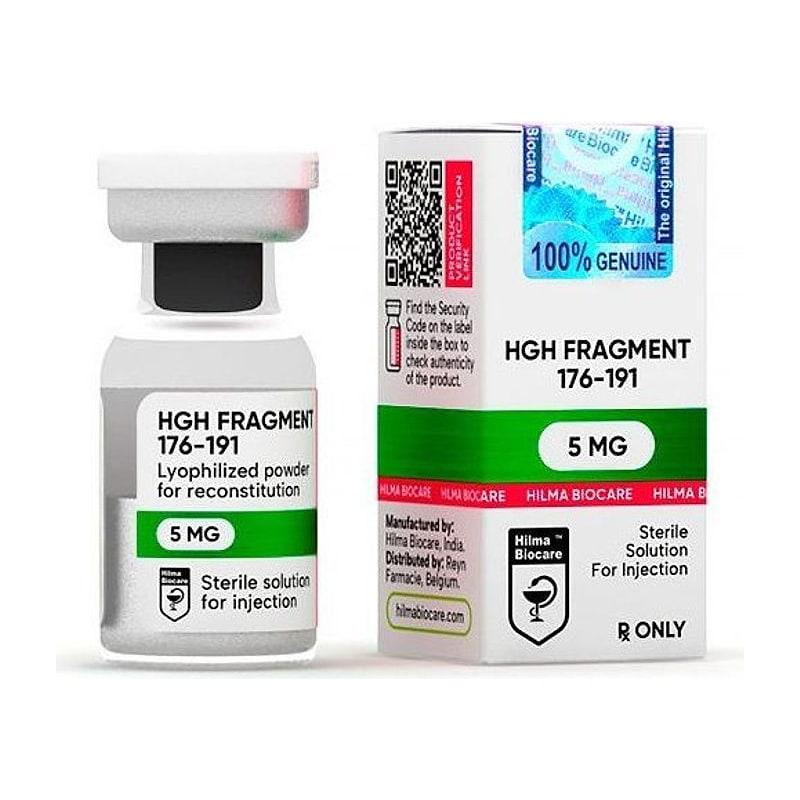
Research Disclaimer: HGH Fragment 176-191 is sold exclusively for in-vitro and laboratory research use. Not approved for clinical use. This content does not constitute medical advice.
HGH Fragment 176-191 (also called AOD-9604, anti-obesity drug 9604) is a synthetic peptide corresponding to the C-terminal region of human growth hormone — specifically residues 176 through 191 — that has been identified as the portion responsible for growth hormone's lipolytic (fat-burning) activity. Unlike full-length HGH, Fragment 176-191 does not stimulate IGF-1 production, does not cause growth promotion, and does not affect glucose metabolism. This selectivity makes it a useful research tool for studying fat mobilization mechanisms.
Table of Contents#
- HGH's Lipolytic Domain: Why a Fragment?
- Fragment 176-191 Structure and Modifications
- Lipolytic Mechanism: HSL and Beta-3 Adrenergic Signaling
- What Fragment 176-191 Does NOT Do
- Animal Research Data: Fat Mass Reduction
- AOD-9604: The Oral Development Attempt
- Comparison to Full HGH for Fat Loss Research
- Research Protocols
- Key References
HGH's Lipolytic Domain: Why a Fragment?#
Full-length human growth hormone (22 kDa, 191 amino acids) has multiple physiological effects:
- Growth-promoting: via IGF-1 upregulation (JAK2/STAT5 → hepatic IGF-1)
- Lipolytic: direct activation of adipose hormone-sensitive lipase (HSL)
- Anabolic: protein synthesis, satellite cell activation
- Diabetogenic: at pharmacological doses → insulin resistance
Researchers identified early that these effects are separable — different structural domains of HGH mediate different functions. The C-terminal region (residues 176–191) was found to contain the lipolytic domain:
- Fragment 176-191: contains the lipolytic signal
- Does not contain the GHR binding domains required for IGF-1 stimulation
- Does not cause insulin resistance (no diabetogenic effect)
This domain separation makes Fragment 176-191 a selective research tool for studying fat mobilization without confounding growth or metabolic effects.
Fragment 176-191 Structure and Modifications#
Native HGH(176-191) sequence: Tyr176-Leu-Arg-Ile-Val-Gln-Cys-Arg-Ser-Val-Glu-Gly-Ser-Cys-Gly-Phe191
Key features:
- Contains a disulfide bond between Cys182 and Cys189 (positions 7 and 14 of the fragment) — this intramolecular disulfide is required for lipolytic activity
- Tyrosine at position 176 (Tyr176): important for receptor interaction
- Phenylalanine at position 191 (Phe191, C-terminus): amidated in native HGH; affects potency
AOD-9604 modification:
- AOD = Anti-Obesity Drug
- Modified by adding D-Ser at the N-terminus: Tyr-D-Ser(CH₂OH)-Ala-Ile-Phe-Thr-Asn-Ser-Tyr-Arg-Lys-Val-Leu-Gly-Gln-Leu-Ser-Ala-Arg-Lys-Leu-Leu-His-Asp-Ile
- Actually a modified form of AOD-9604 used in clinical development had different modifications
- The commonly used research compound is the raw fragment 176-191 or Tyr-176 to Phe-191 sequence with disulfide
Lipolytic Mechanism: HSL and Beta-3 Adrenergic Signaling#
How does Fragment 176-191 activate lipolysis?#
The receptor target and signaling pathway of Fragment 176-191 has been partially characterized:
-
Beta-3 adrenergic receptor (β3-AR) pathway: In vitro evidence suggests Fragment 176-191 activates β3-AR (the beta-3 adrenergic receptor, expressed primarily in white and brown adipose tissue). β3-AR → Gs → cAMP → PKA → phosphorylation and activation of hormone-sensitive lipase (HSL).
-
Direct adipocyte effect: In isolated adipocyte studies, Fragment 176-191 stimulates lipolysis (glycerol and FFA release) in a concentration-dependent manner.
-
β3-AR mechanism evidence: The lipolytic effect of Fragment 176-191 is blocked by selective β3-AR antagonists (SR59230A) in adipocyte assays — supporting the β3-AR hypothesis.
HSL (hormone-sensitive lipase): HSL is the rate-limiting enzyme for stored triglyceride mobilization in white adipose tissue. PKA → phosphorylation of HSL at Ser563 → HSL activation → triglyceride hydrolysis → fatty acids and glycerol released into circulation → taken up by muscle for β-oxidation.
Perilipin: PKA also phosphorylates perilipin (lipid droplet coating protein) → perilipin moves away from lipid droplet surface → HSL access to triglycerides facilitated.
What Fragment 176-191 Does NOT Do#
This selectivity profile is the key research advantage:
No IGF-1 stimulation: Unlike full HGH which activates the JAK2/STAT5 → IGFBP-3/IGF-1 axis, Fragment 176-191 does not contain the receptor-binding domains (Site 1 and Site 2) required for growth hormone receptor (GHR) dimerization and JAK2 activation. Therefore:
- No hepatic IGF-1 production
- No skeletal/cartilage growth promotion
- No muscle anabolic effect via IGF-1
No insulin resistance: Pharmacological HGH → increased circulating fatty acids → hepatic lipid accumulation → hepatic insulin resistance. Fragment 176-191, by not causing hyperIGFemia and by activating HSL differently, does not produce the insulin-desensitizing cascade of full HGH.
No glucose elevation: Full HGH at pharmacological doses causes transient hyperglycemia (anti-insulin effect via GHR/post-receptor signaling). Fragment 176-191 does not affect glucose metabolism in rodent studies.
Animal Research Data: Fat Mass Reduction#
Obese rodent models#
Heffernan et al. (2001) — the primary original characterization:
- Fragment 176-191 SC in ob/ob mice (genetic obesity) and diet-induced obese mice
- 2 weeks treatment → significant reduction in fat mass (DXA confirmed) vs. vehicle
- Body weight reduction: ~10–15% from baseline in responsive obese models
- Lean mass preserved (no significant change)
- IGF-1: unchanged vs. vehicle (confirmed no IGF-1 stimulation)
- Glucose tolerance: unchanged or improved (vs. full HGH which worsens)
Mechanism confirmation in vivo#
- HSL activity: increased in fat depots of Fragment 176-191 treated animals vs. vehicle
- Plasma FFA: elevated after Fragment 176-191 injection (lipolysis product)
- β3-AR antagonist pretreatment: abolished the lipolytic response in vivo
Visceral vs. subcutaneous fat selectivity#
Some data suggests Fragment 176-191 preferentially reduces visceral fat vs. subcutaneous fat — clinically important as visceral fat is more strongly associated with metabolic disease. This is being investigated in ongoing research with GH secretagogue combinations.
AOD-9604: The Oral Development Attempt#
Monash University and Metabolic Pharmaceuticals (Australia) developed AOD-9604 as an oral anti-obesity drug in the early 2000s:
- Modified peptide with improved oral stability vs. native Fragment 176-191
- Phase 1/2 clinical trials in obese subjects
- Results: modest body fat reduction in some studies; did not reach statistical significance in pivotal Phase 3 trial
- Development was discontinued
The failure of AOD-9604 in Phase 3 was attributed to:
- Insufficient oral bioavailability even with modifications
- Modest effect size not meeting clinical significance thresholds at tested doses
- Competition from more potent agents (emerging GLP-1 agonist class)
Research relevance: The AOD-9604 experience provides important negative data for oral peptide lipolytic research. The subcutaneous route remains the most reliable for research-grade Fragment 176-191.
Comparison to Full HGH for Fat Loss Research#
For researchers studying fat loss specifically, Fragment 176-191 offers a cleaner experimental system than full HGH:
| Parameter | Full HGH | Fragment 176-191 |
|---|---|---|
| IGF-1 elevation | Yes (major confounder) | No |
| Anabolic effect | Yes (growth, lean mass) | Minimal |
| Insulin resistance | At pharmacological doses | No |
| Glucose effects | Transient hyperglycemia | Neutral |
| Lipolysis | Yes (plus many other effects) | Selective lipolysis |
| Bone growth | Yes | No |
| Experimental clarity | Confounded (multiple effects) | More selective (fat loss model) |
For adipocyte biology, adipose tissue physiology, and lipolysis mechanism studies, Fragment 176-191 is the cleaner tool. For studies requiring the full GH axis (IGF-1, GHR signaling, growth), full HGH or GH secretagogues are required.
Research Protocols#
Adipose tissue lipolysis (in vitro)#
| Parameter | Specification |
|---|---|
| Cells | 3T3-L1 differentiated adipocytes (days 8–12 post-differentiation) or primary adipocytes |
| Fragment 176-191 dose | 10 nM – 1 µM |
| Incubation | 2–4 hours at 37°C |
| Endpoint | Glycerol release (free glycerol assay kit), FFA release, HSL phosphorylation (western blot, pS563 antibody) |
| Control | β3-AR antagonist (SR59230A, 1 µM) to confirm β3-AR-dependent mechanism |
In vivo fat reduction protocol (DIO rodents)#
| Parameter | Specification |
|---|---|
| Model | HFD-obese mice (12+ weeks) |
| Dose | 100–500 µg/kg SC |
| Frequency | Once daily |
| Duration | 4–8 weeks |
| Endpoints | Body weight, food intake (unaffected), DXA body composition, plasma FFA and glycerol, epididymal fat pad weight, adipocyte size (histology), HSL activity |
| Comparators | Vehicle, full HGH (positive control), combined with semaglutide |
Key References#
-
Heffernan M, et al. (2001). "The effects of human GH and its lipolytic fragment (AOD9604) on lipid metabolism following chronic treatment in obese mice and beta(3)-AR knock-out mice." Endocrinology, 142(12):5182–5189.
-
Ng FM, et al. (1990). "Metabolic studies of a growth hormone-releasing peptide." Journal of Endocrinology, 124(1):R3–R5.
-
Svensson J, et al. (2001). "Safety of GH replacement therapy in adults: a study of the Swedish National Register." Clinical Endocrinology, 55(5):581–588.
Research Use Only: HGH Fragment 176-191 is sold exclusively for in-vitro research and laboratory use. Not for human consumption. JuicedPharma does not provide medical advice.
Published by JuicedPharma Research Team · September 2026 · Category: Peptides & Recovery