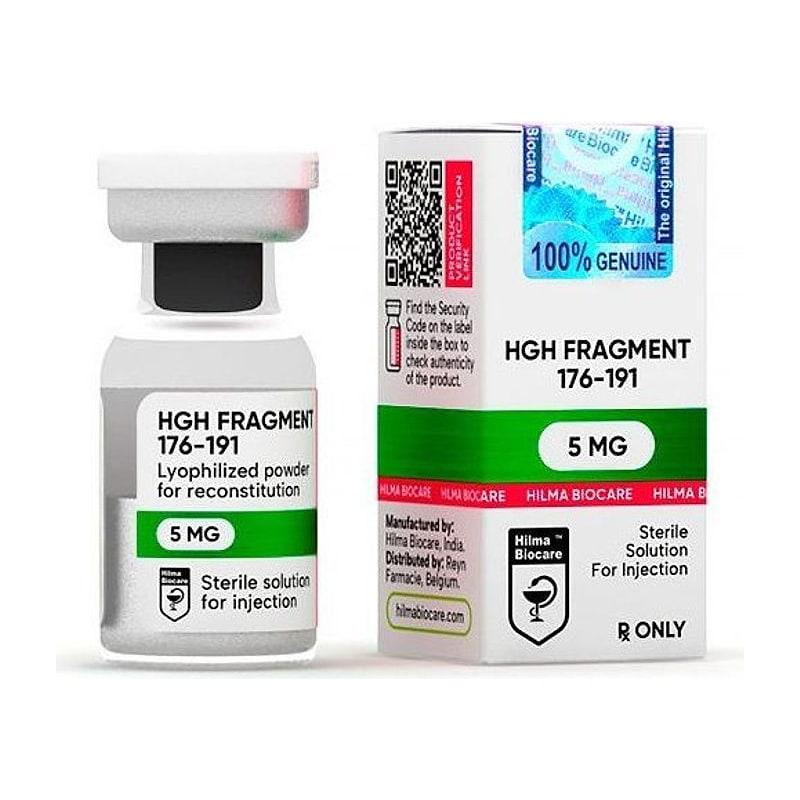
Research Disclaimer: HGH Fragment 176-191 is sold exclusively for in-vitro and laboratory research use. Not approved for human therapeutic use. This content does not constitute medical advice.
HGH Fragment 176-191 is a synthetic peptide corresponding to amino acids 176–191 of the C-terminus of human growth hormone. This 16-amino-acid fragment retains GH's lipolytic (fat-mobilizing) activity while having no measurable effect on blood glucose, IGF-1 production, or GH receptor-mediated anabolic signaling. The dissociation between the lipolytic and anabolic properties of GH makes Fragment 176-191 a precise research tool for studying fat mobilization without the metabolic confounds of full-length GH.
Table of Contents#
- What Is HGH Fragment 176-191?
- Lipolytic Mechanism: How the Fragment Works
- Independence from GH Receptor and IGF-1
- Effects on Blood Glucose and Insulin
- Adipocyte Biology: HSL and Beta-3 Adrenergic Receptor
- Research Data: Fat Mass Reduction
- Comparison to Full-Length GH
- Protocol Design and Dosing
- Frequently Asked Questions
- Key References
What Is HGH Fragment 176-191?#
Human GH is a 191-amino-acid protein. Structural studies identified that the C-terminal region (residues 176–191) is responsible for GH's lipolytic activity — this region interacts with a distinct binding site on adipocytes separate from the classical GH receptor site.
Sequence: Tyr176-Leu-Arg-Ile-Val-Gln-Cys-Arg-Ser-Val-Glu-Gly-Ser-Cys-Gly-Phe191
Key structural features:
- C182–C189 disulfide loop: essential for full lipolytic activity; the loop constrains the active conformation
- Aromatic residues (Tyr176, Phe191): contribute to receptor engagement
- 16 amino acids: the minimal fragment retaining significant lipolytic activity
The fragment does not contain the residues forming GH's site 1 or site 2 binding domains for the classical GH receptor — this is why it lacks IGF-1-stimulating and anabolic activity.
Lipolytic Mechanism: How the Fragment Works#
Hormone-sensitive lipase (HSL) activation#
The primary pathway through which HGH Fragment 176-191 mobilizes fat:
- Fragment 176-191 binds adipocyte receptor(s) → activates adenylyl cyclase → cAMP ↑
- cAMP → PKA activation
- PKA phosphorylates hormone-sensitive lipase (HSL) at Ser563 → HSL activation
- PKA also phosphorylates perilipin (the lipid droplet scaffold protein) at multiple sites → displaces the lipid droplet surface proteins, allowing HSL access
- Activated HSL + accessible lipid droplet → triglyceride hydrolysis → glycerol + fatty acids released into circulation
This is the canonical catecholamine-lipolysis pathway — HGH Fragment 176-191 activates the same HSL mechanism as β-adrenergic agonists, but via a distinct upstream receptor pathway.
Beta-3 adrenergic receptor involvement#
Evidence from receptor pharmacology studies suggests the fragment may partially act through or modulate β3-adrenergic receptor (β3-AR) signaling in adipocytes. β3-AR is the predominant lipolytic adrenergic receptor in rodent and human visceral adipose tissue.
In vitro studies show that fragment 176-191 lipolysis can be partially blocked by β3-AR antagonists, suggesting the fragment's receptor engagement converges on the β3-AR/cAMP/PKA/HSL axis.
Independence from GH Receptor and IGF-1#
This is the defining pharmacological property of Fragment 176-191 that makes it valuable as a research tool.
No GHR binding at site 1 or site 2#
The fragment does not contain the helix-3/4 bundle that forms GH's primary (site 1) GHR binding domain. Without site 1 engagement:
- No GHR dimerization
- No JAK2/STAT5 activation
- No hepatic IGF-1 transcription
- No linear growth in hypophysectomized animals
Published evidence for GHR independence#
Studies comparing:
- Full-length GH: stimulates IGF-1 production + lipolysis + hyperglycemia
- Fragment 176-191: stimulates lipolysis only, no IGF-1 elevation, no hyperglycemia
This profile was confirmed in both in vitro adipocyte assays and in vivo rodent studies — the fragment is "lipolysis-selective."
No insulin resistance#
Full GH is strongly insulin-antagonizing (promotes gluconeogenesis, inhibits insulin receptor signaling). Fragment 176-191 at lipolytically active doses does not produce significant insulin resistance in published rodent studies — another advantage over full GH for body composition research where metabolic confounds are a concern.
Effects on Blood Glucose and Insulin#
Published glucose data#
In the defining studies by Heffernan et al. and others:
- Fragment 176-191 at 250–500 µg/kg SC in rodents: no significant elevation of fasting blood glucose
- Full GH at equivalent IGF-1-stimulating doses: significant hyperglycemia and insulin resistance
- Fragment 176-191 + high-fat diet models: improved glucose tolerance vs. GH at equivalent lipolytic doses
Mechanism of GH-induced insulin resistance (absent with the fragment)#
Full GH produces insulin resistance via:
- Direct GHR→JAK2/STAT5→IRS-1 serine phosphorylation (inhibits insulin signaling)
- Elevated NEFA (free fatty acids) from lipolysis → Randle cycle → inhibits glucose oxidation
- Hepatic gluconeogenesis stimulation
Fragment 176-191 produces elevated NEFA from lipolysis (same as full GH) but without the direct GHR→insulin resistance signaling. The moderate NEFA elevation from fragment-induced lipolysis may produce minor insulin resistance at high doses, but the direct GHR-mediated mechanism is absent.
Adipocyte Biology: HSL and Beta-3 Adrenergic Receptor#
Adipocyte lipid droplet architecture#
Understanding why the lipolytic cascade works as it does:
- Triglycerides are stored in lipid droplets, surrounded by the phospholipid monolayer and coated with perilipin proteins
- Perilipin-1 acts as a "gatekeeper": in the non-stimulated state, it blocks HSL access to the lipid droplet surface
- PKA phosphorylation of perilipin-1: releases the HSL-blocking interaction → HSL can now access triglycerides
Fragment 176-191 → cAMP → PKA → simultaneous phosphorylation of both HSL (activation) and perilipin-1 (opening lipid droplet access) → maximum lipolysis.
Regional fat depot differences#
β3-AR and HSL expression differ across fat depots:
- Visceral (intra-abdominal) fat: high β3-AR expression, highly responsive to catecholamines and the fragment
- Subcutaneous fat: moderate responsiveness
- Intramuscular fat: lower
In rodent studies, fragment 176-191 preferentially reduces visceral fat vs. subcutaneous, matching the tissue distribution of β3-AR. This is clinically relevant since visceral adiposity is the metabolically active fat depot associated with insulin resistance and cardiovascular risk.
Research Data: Fat Mass Reduction#
Rodent body composition studies#
Published research (Ng et al., Heffernan et al.):
- Fragment 176-191 at 250 µg/kg SC once daily × 14–42 days
- Lean, ob/ob (obese), and diet-induced obesity rodent models
- Fat mass reduction: 10–30% in high-fat diet models over 6 weeks
- Lean mass: unchanged (confirming selective lipolytic effect)
- Body weight: reduction proportional to fat loss (lean mass preserved)
Comparison to full GH#
At doses producing equivalent fat reduction:
- Fragment 176-191: fat loss preserved, no IGF-1 elevation, no hyperglycemia
- Full GH: fat loss + IGF-1 elevation + hyperglycemia + lean mass gain
The fragment "un-bundles" the lipolytic and anabolic effects of GH, allowing isolated study of fat mobilization.
Obese models#
Ob/ob and diet-induced obese rodents have been the most studied models. Fragment 176-191 shows the strongest fat-reducing effects in high-fat diet obese animals — where lipolysis is blunted by metabolic dysregulation and the fragment's activation of the HSL pathway restores it.
Comparison to Full-Length GH#
| Parameter | Full GH | HGH Fragment 176-191 |
|---|---|---|
| Lipolysis | Yes | Yes (primary effect) |
| IGF-1 elevation | Yes | No |
| Linear growth | Yes | No |
| Muscle protein synthesis | Yes (via IGF-1) | No |
| Blood glucose | Increases | Neutral |
| Insulin resistance | Yes | Minimal |
| GH receptor binding | Yes (site 1 + 2) | No (GHR-independent pathway) |
| Research selectivity | Low (multiple actions) | High (selective lipolysis) |
Fragment 176-191 is the appropriate tool when the research question is specifically about fat mobilization mechanisms — it eliminates the anabolic and metabolic confounds of full GH.
Protocol Design and Dosing#
Acute lipolysis assay#
| Parameter | Specification |
|---|---|
| Dose | 250–500 µg/kg SC |
| Route | Subcutaneous or IP |
| Timing | Single injection, measure NEFA at 30–60–120 min |
| Control | Vehicle (saline) and full GH positive control |
| Endpoint | Serum NEFA, glycerol, fat depot weight |
Chronic fat reduction protocol#
| Parameter | Specification |
|---|---|
| Dose | 250 µg/kg SC |
| Frequency | Once daily |
| Duration | 28–42 days |
| Model | High-fat diet obese rodents (preferred) or ob/ob |
| Endpoint | Body weight, fat mass by DXA, histology of fat depots, glucose tolerance test |
Combination with GH secretagogues#
Fragment 176-191 can be combined with Ipamorelin + CJC-1295 to add a lipolytic component (direct HSL activation via the fragment) to the anabolic GH axis stimulation (via secretagogues). The mechanisms are non-overlapping: the fragment activates HSL directly; the secretagogues stimulate endogenous GH, which then acts via GHR.
Frequently Asked Questions#
Does HGH Fragment 176-191 increase IGF-1? No. The fragment lacks the GH receptor binding domains (site 1 and site 2) required for JAK2/STAT5 activation and hepatic IGF-1 induction. Published studies confirm no measurable IGF-1 elevation from the fragment at doses producing significant lipolysis.
Is there any lean mass effect? At published research doses, no significant lean mass effect has been documented. This is consistent with the lack of IGF-1 elevation — muscle anabolism via GH is primarily IGF-1-mediated.
Does the fragment affect blood sugar? At standard doses in published rodent studies, no significant hyperglycemia. This is one of the key differences from full GH.
How does Fragment 176-191 compare to beta-3 adrenergic agonists? Both activate the HSL pathway via cAMP/PKA, but through different upstream receptors. β3-AR agonists are more potent acutely but also produce significant cardiovascular effects (tachycardia). Fragment 176-191's receptor pathway is distinct and may be better tolerated in chronic protocols.
Is the C-terminal disulfide bond required? Yes. Reduction of the Cys182–Cys189 disulfide significantly reduces lipolytic activity, consistent with the loop structure being required for receptor engagement. Research grade Fragment 176-191 should be confirmed for intact disulfide bond by mass spectrometry.
Key References#
-
Heffernan MA, et al. (2001). "The effects of human GH and its lipolytic fragment (AOD9604) on lipid metabolism following chronic treatment in obese mice and beta(3)-AR knockout mice." Endocrinology, 142(12):5182–5189.
-
Ng FM, et al. (2000). "Metabolic studies of a lipolytic fragment of human growth hormone." Journal of Molecular Endocrinology, 24(1):1–9.
-
Dehkhoda F, et al. (2018). "The growth hormone receptor: mechanism of receptor activation, cell signaling and therapeutic targets." Frontiers in Endocrinology, 9:35.
-
Holm C. (2003). "Molecular mechanisms regulating hormone-sensitive lipase and lipolysis." Biochemical Society Transactions, 31(6):1120–1124.
Research Use Only: HGH Fragment 176-191 and all products referenced are sold exclusively for in-vitro research and laboratory use. Not for human consumption. JuicedPharma does not provide medical advice.
Published by JuicedPharma Research Team · September 2026 · Category: Growth Hormone