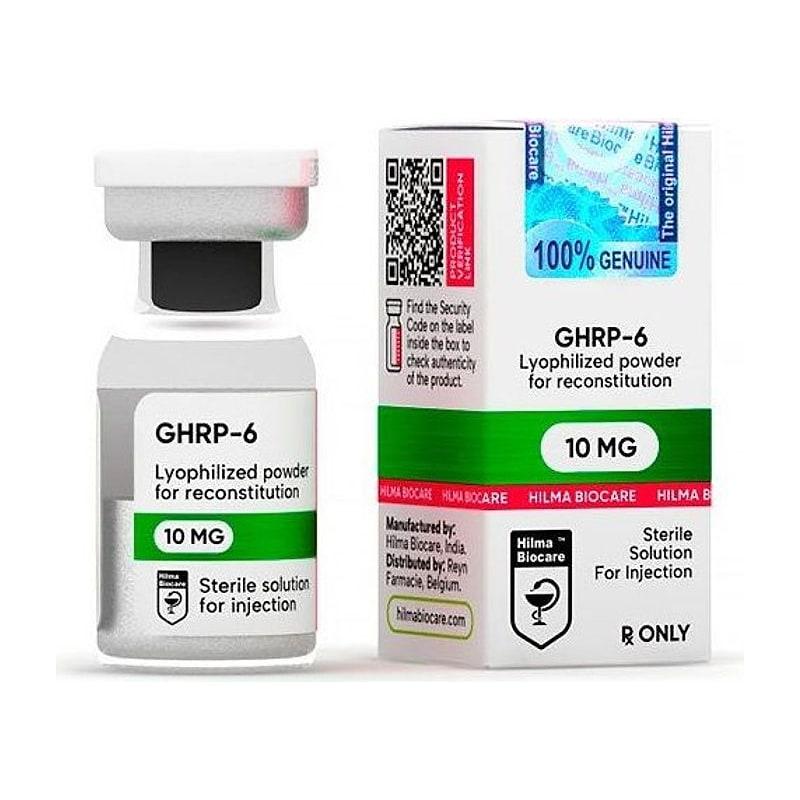
Research Disclaimer: GHRP-6 is sold exclusively for in-vitro and laboratory research use. Not approved for human therapeutic use. This content does not constitute medical advice.
GHRP-6 (Growth Hormone Releasing Peptide-6) was one of the first synthetic GHRPs to be extensively characterized and remains an important research tool — not primarily for its GH-releasing potency (which is intermediate among GHRPs), but for its uniquely strong appetite-stimulating (orexigenic) properties. GHRP-6 engages the ghrelin axis in a way that most newer GHRPs deliberately avoid, making it the appropriate compound for research specifically targeting the hunger/satiety dimension of GHS-R1a biology.
Table of Contents#
- GHRP-6 History and Structure
- GHS-R1a and the Ghrelin Axis
- GH Release: Magnitude and Profile
- The Appetite Mechanism: Why GHRP-6 Is Uniquely Orexigenic
- Body Weight Research Models
- GH, IGF-1, and Anabolic Effects
- Cortisol and Hormonal Side Effects
- When to Use GHRP-6 vs. Other GHRPs
- Dosage Reference
- Frequently Asked Questions
- Key References
GHRP-6 History and Structure#
GHRP-6 was first described in 1984 by Cyril Bowers, who identified it while investigating enkephalin analogs with unexpected GH-releasing activity. This discovery launched the entire GHRP research field and ultimately led to the identification of the ghrelin receptor.
Sequence: His-D-Trp-Ala-Trp-D-Phe-Lys-NH₂ (6 amino acids)
Key features:
- His (histidine) at position 1: important for receptor interaction and partially preserved against proteolysis
- D-Trp: D-amino acid configuration, protease-resistant
- Trp at position 4: aromatic residue critical for GHS-R1a binding
- D-Phe: D-amino acid, contributes to proteolytic stability
- C-terminal amide: stabilizes against exopeptidase cleavage
GHRP-6 was the predecessor to GHRP-2 and Ipamorelin — both were developed as improved, more selective versions. GHRP-6 retains the highest appetite-stimulating activity of the three, because subsequent optimization removed this "off-target" effect from the newer compounds.
GHS-R1a and the Ghrelin Axis#
Like all GHRPs, GHRP-6 acts as a GHS-R1a agonist. The ghrelin receptor (GHS-R1a) mediates:
- Pituitary GH release (the intended research target)
- Hypothalamic orexigenic signaling (hunger stimulation via NPY/AgRP neurons)
- Gastric GI motility (via GHS-R1a in the enteric nervous system)
- Cardiovascular effects (GHS-R1a expressed in heart; ghrelin promotes cardioprotection)
- Reward/dopamine axis (GHS-R1a in the VTA; ghrelin activates dopaminergic reward pathways)
GHRP-6 engages all of these pathways more broadly than Ipamorelin or GHRP-2 — it behaves more like an endogenous ghrelin agonist than a selective pituitary GH secretagogue.
This broad engagement is a liability for research where only GH axis effects are of interest. It is an asset for research specifically investigating ghrelin axis biology.
GH Release: Magnitude and Profile#
GH pulse in rodents#
At equivalent weight-based doses (100 µg/kg SC in rats), GHRP-6 produces a GH pulse that is:
- Smaller in peak amplitude than GHRP-2 (by approximately 20–30%)
- Comparable or slightly smaller than Ipamorelin at the same dose
- Duration: peak at 15–30 minutes, baseline by 90–120 minutes
GHRP-6 is not the most potent GHRP for GH release — this is a deliberate tradeoff in its selectivity profile. The receptor engages additional non-pituitary pathways, meaning some of the receptor occupancy is "spent" on hypothalamic and other extrapituitary effects.
Combination with GHRH analogs#
Like GHRP-2 and Ipamorelin, GHRP-6 synergizes with GHRH (CJC-1295). The combination produces a GH pulse 3–8× larger than GHRP-6 alone. For GH amplitude research, adding CJC-1295 to GHRP-6 is the appropriate amplification strategy.
The Appetite Mechanism: Why GHRP-6 Is Uniquely Orexigenic#
The orexigenic (appetite-stimulating) property of GHRP-6 is the most distinctive characteristic separating it from GHRP-2 and Ipamorelin.
NPY/AgRP pathway#
GHS-R1a activation in the arcuate nucleus of the hypothalamus stimulates NPY (Neuropeptide Y) and AgRP (Agouti-related protein) neurons — two of the most potent orexigenic signals in the hypothalamus. This stimulation:
- Increases appetite and food intake within 30–60 minutes of administration
- Reduces metabolic rate (AgRP opposes α-MSH/MC4R satiety signaling)
- Promotes energy storage (fat deposition) via hypothalamic metabolic regulation
Why GHRP-6 is more orexigenic than GHRP-2 or Ipamorelin#
The selectivity engineering of Ipamorelin and (to a lesser extent) GHRP-2 specifically reduced hypothalamic GHS-R1a engagement relative to pituitary engagement. GHRP-6's original structure does not make this discrimination — it activates both pituitary and hypothalamic GHS-R1a equally.
Appetite research models#
GHRP-6 is the appropriate compound for:
- Ghrelin axis research: modeling ghrelin's orexigenic effects without using the full-length acylated ghrelin peptide
- Food intake studies: measuring dose-dependent effects on food intake and meal size
- GH + appetite co-regulation: investigating whether GH release and appetite stimulation can be pharmacologically dissociated (using Ipamorelin as the comparison)
- Obesity and energy balance research: studying hypothalamic mechanisms of hyperphagia
Body Weight Research Models#
The combination of GH release and appetite stimulation makes GHRP-6 a useful tool for body weight and body composition research:
Lean mass models#
Chronic GHRP-6 (100–200 µg/kg twice daily × 4–8 weeks):
- Increases lean body mass via GH→IGF-1 pathway
- Stimulates food intake, which contributes independently to anabolic effects
- Challenge: difficult to distinguish GH-mediated anabolism from caloric intake effects
This confound is the reason Ipamorelin is preferred for pure GH-effect body composition studies — but GHRP-6 is appropriate when studying the interaction of GH signaling + increased caloric intake (a relevant physiological state during recovery from illness or surgical stress).
Weight gain models#
In rodent models of cachexia (cancer-induced weight loss, chemotherapy-induced anorexia), GHRP-6 shows particular promise because it simultaneously:
- Stimulates appetite (combating anorexia)
- Elevates GH/IGF-1 (combating muscle catabolism)
- Has direct cytoprotective effects in some cardiac and hepatic models
This dual action (appetite + GH) makes GHRP-6 a more complete anti-cachexia tool than a pure GH secretagogue.
GH, IGF-1, and Anabolic Effects#
IGF-1 elevation#
Chronic GHRP-6 produces IGF-1 elevation comparable to GHRP-2 at equivalent doses — the GH AUC is similar despite GHRP-6's lower peak (broader pulse profile somewhat compensates). Published data shows:
- 20–45% IGF-1 elevation above baseline after 2–4 weeks of 2× daily GHRP-6 SC in rats
- Similar magnitude to Ipamorelin
Protein synthesis#
GH→IGF-1 axis activation drives muscle protein synthesis via mTOR signaling. GHRP-6's contribution to food intake (more amino acids available) makes muscle protein accretion in chronic GHRP-6 studies hard to attribute to GH alone — an important caveat for experimental interpretation.
Cortisol and Hormonal Side Effects#
GHRP-6's cortisol and ACTH co-release profile is intermediate between Ipamorelin (none) and GHRP-2 (significant):
| Hormone | GHRP-6 Response |
|---|---|
| GH | Significant ↑ |
| Cortisol | Moderate ↑ (less than GHRP-2, more than Ipamorelin) |
| ACTH | Moderate ↑ |
| Prolactin | Slight ↑ |
| Appetite | Strong ↑ (unique to GHRP-6) |
For research where HPA axis co-activation is a confound, GHRP-6 is intermediate in severity — better than GHRP-2, worse than Ipamorelin. For most chronic research applications requiring selectivity, Ipamorelin remains the better choice.
When to Use GHRP-6 vs. Other GHRPs#
| Research Goal | Best GHRP Choice |
|---|---|
| Ghrelin axis / appetite research | GHRP-6 |
| Cachexia / anorexia models | GHRP-6 |
| Maximum GH pulse amplitude | GHRP-2 |
| Clean GH-only stimulation | Ipamorelin |
| Body composition (GH isolated) | Ipamorelin |
| Long-term chronic protocols | Ipamorelin |
| GI motility research | GHRP-6 or GHRP-2 |
| Combination with CJC-1295 | Ipamorelin (cleaner) or GHRP-2 (larger pulse) |
Dosage Reference#
| Model | Dose | Route | Frequency | Duration |
|---|---|---|---|---|
| Acute GH release | 100–200 µg/kg | SC or IV | Single | — |
| Appetite stimulation | 100 µg/kg | SC | Once (measure 30–120 min food intake) | — |
| IGF-1 elevation | 200 µg/kg | SC | 2× daily | 14–28 days |
| Cachexia model | 100–200 µg/kg | SC | 2× daily | 4–8 weeks |
| Combination with GHRH | 100 µg/kg each | SC | 2–3× daily | 4+ weeks |
Frequently Asked Questions#
How much does GHRP-6 increase food intake? In rodent studies, a single GHRP-6 injection at 100 µg/kg SC increases 30-minute food intake by approximately 40–80% compared to vehicle-injected controls. This effect is dose-dependent and peaks within 30 minutes of administration.
Can GHRP-6 be used to study GH without appetite confounds? Not cleanly. The appetite stimulation is inseparable from GH release with GHRP-6. For research where appetite is a confound, use Ipamorelin.
Is GHRP-6 the original GHRP? GHRP-6 is the first hexapeptide GHRP characterized (Bowers 1984), though earlier work on GHRP involved longer peptides. GHRP-6 is considered the starting point for the modern GHRP research field.
What is GHRP-6's relationship to ghrelin? GHRP-6 is a synthetic agonist at the ghrelin receptor (GHS-R1a). Ghrelin (endogenous, acylated 28-mer peptide) is the natural ligand. GHRP-6 was discovered before ghrelin was identified — ironically, the discovery of GHRPs led to the identification of the receptor, which then led to the identification of the endogenous ligand (ghrelin).
Can GHRP-6 and GHRP-2 be combined? Technically yes, but there is no published research supporting a rational combination. Both act on GHS-R1a — combining them would likely produce diminishing returns as they compete for the same receptor rather than accessing independent pathways.
Key References#
-
Bowers CY, et al. (1984). "On the in vitro and in vivo activity of a new synthetic hexapeptide that acts on the pituitary to specifically release growth hormone." Endocrinology, 114(5):1537–1545.
-
Raun K, et al. (1998). "Ipamorelin, the first selective growth hormone secretagogue." European Journal of Endocrinology, 139(5):552–561.
-
Kojima M, et al. (1999). "Ghrelin is a growth-hormone-releasing acylated peptide from stomach." Nature, 402(6762):656–660.
-
Wren AM, et al. (2001). "Ghrelin enhances appetite and increases food intake in humans." Journal of Clinical Endocrinology & Metabolism, 86(12):5992–5995.
-
Ghigo E, et al. (1999). "Growth hormone-releasing peptides." European Journal of Endocrinology, 136(5):445–460.
Research Use Only: GHRP-6 and all products referenced are sold exclusively for in-vitro research and laboratory use. Not for human consumption. JuicedPharma does not provide medical advice.
Published by JuicedPharma Research Team · September 2026 · Category: Growth Hormone