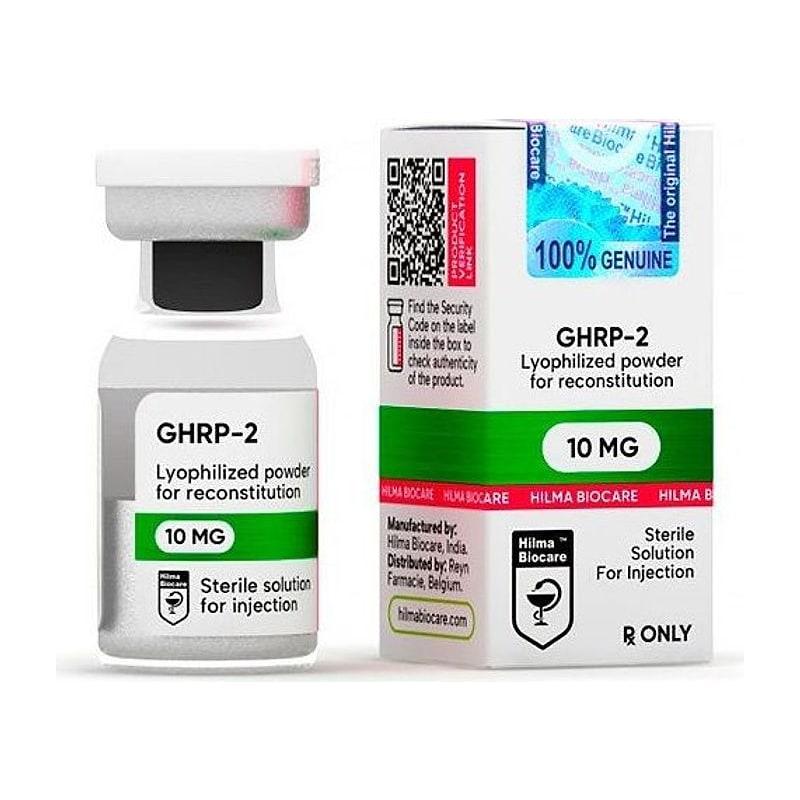
Research Disclaimer: GHRP-2 is sold exclusively for in-vitro and laboratory research use. Not approved for human therapeutic use. This content does not constitute medical advice.
GHRP-2 (Growth Hormone Releasing Peptide-2) is one of the most potent synthetic GHS-R1a agonists studied. It produces the largest GH pulse amplitude of the commonly studied GHRPs, making it the reference compound for maximum GH-stimulation research. The tradeoff is a less selective hormonal profile — GHRP-2 co-releases cortisol and ACTH alongside GH, which must be accounted for in research design.
This article covers GHRP-2's receptor pharmacology, the evidence for its GH-releasing effects, the HPA axis co-activation, and how to use GHRP-2 appropriately in research.
Table of Contents#
- GHRP-2 Structure and Discovery
- Receptor Pharmacology
- GH Pulse: Magnitude and Kinetics
- ACTH and Cortisol Co-Release
- IGF-1 Elevation from Chronic Dosing
- Body Composition Research
- Comparison with Other GHRPs
- Dosage Reference from Literature
- Frequently Asked Questions
- Key References
GHRP-2 Structure and Discovery#
GHRP-2 (also called Pralmorelin) was developed through SAR optimization of the original GHRP compounds in the 1990s. It is a 6-amino-acid peptide:
Sequence: D-Ala-D-β-Nal-Ala-Trp-D-Phe-Lys-NH₂
Key structural features:
- D-β-Nal (D-β-naphthylalanine): large aromatic residue providing high-affinity GHS-R1a binding
- Trp (tryptophan): key for receptor selectivity and binding geometry
- D-Phe: D-amino acid, protease-resistant
- C-terminal amide: improves stability vs. free carboxylate
GHRP-2 was clinically developed as a diagnostic test agent for GH deficiency — a single IV injection produces a predictable, large GH pulse that allows assessment of pituitary GH reserve. This clinical background gives GHRP-2 a well-characterized human pharmacokinetic and safety profile unavailable for most research peptides.
Receptor Pharmacology#
GHS-R1a affinity#
GHRP-2 has one of the highest binding affinities for GHS-R1a among synthetic GHRPs:
- Ki at GHS-R1a: approximately 0.05–0.3 nM (high affinity, full agonist)
- This 10–50× higher receptor affinity compared to Ipamorelin (~2 nM) explains GHRP-2's greater GH pulse amplitude at equivalent weight-based doses
Off-target receptor activity#
Unlike Ipamorelin, GHRP-2 is not a selective GHS-R1a agonist. It also shows activity at:
- Corticotropin-releasing factor (CRF) binding protein: may interfere with CRF-mediated stress responses
- Hypothalamic receptors (beyond the pituitary): contributing to the ACTH/cortisol response
- Somatostatin inhibition: GHRP-2 suppresses somatostatin release to a greater degree than Ipamorelin, which accounts partly for the larger GH pulse
GH Pulse: Magnitude and Kinetics#
In vivo rodent data#
GHRP-2 at 100 µg/kg SC in rats:
- Onset: 10–15 minutes
- Peak: 20–30 minutes (GH concentration 15–25× above baseline in some studies)
- Duration: returns to baseline within 90 minutes
- Magnitude: typically 1.5–2× greater peak than Ipamorelin at equivalent doses
In humans (diagnostic use)#
GHRP-2 was studied as a GH-stimulation test agent. In healthy adults:
- IV GHRP-2 (1 µg/kg) produces peak GH of 20–60 ng/ml at 15–30 minutes
- Subnormal response (<10 ng/ml peak) indicates GH deficiency
This human diagnostic data makes GHRP-2 one of the few research peptides with published human dose-response curves.
Combination with GHRH analogs#
When GHRP-2 is combined with GHRH or CJC-1295:
- GH peak amplitude increases 3–10× beyond either compound alone
- The combination engages both GHS-R1a and GHRH-R simultaneously
- This synergistic effect is the mechanistic basis for the GHRP + GHRH combination approach used in research
GHRP-2 + CJC-1295 produces larger GH peaks than Ipamorelin + CJC-1295 due to GHRP-2's higher GHS-R1a affinity. For studies requiring maximal GH pulse amplitude, GHRP-2 + CJC-1295 is the standard combination.
ACTH and Cortisol Co-Release#
The defining pharmacological characteristic that distinguishes GHRP-2 from Ipamorelin is ACTH and cortisol co-release.
Mechanism#
GHRP-2 directly stimulates ACTH secretion from pituitary corticotrophs through a mechanism that is partially GHS-R1a dependent and partially through direct CRF system modulation. The ACTH elevation then drives adrenocortical cortisol production.
Magnitude#
In clinical studies, GHRP-2 at diagnostic doses (1 µg/kg IV) elevates:
- ACTH: 2–4× above baseline within 30 minutes
- Cortisol: 50–100% above baseline within 60 minutes
Research implications#
This cortisol co-elevation is a documented confound for:
- Anabolic research: cortisol is catabolic to muscle protein (opposite of GH's effect)
- Immune studies: glucocorticoids suppress immune function
- Inflammation models: cortisol is anti-inflammatory, potentially masking inflammatory endpoints
- Chronic protocols: sustained cortisol elevation causes adrenal hypertrophy in rodents
GHRP-2 is appropriate when:
- Cortisol co-release is the variable of interest
- Short-term acute GH-release studies where cortisol kinetics don't interfere with the measured endpoint
- The study design includes cortisol measurement and accounts for it in the analysis
IGF-1 Elevation from Chronic Dosing#
Despite the cortisol co-release, chronic GHRP-2 administration does produce sustained IGF-1 elevation — the GH pulse magnitude is large enough to drive hepatic IGF-1 production even in the presence of cortisol's partial counter-regulatory effect.
Published data#
In GH-deficient rat models, GHRP-2 administered 2× daily for 28 days produced:
- IGF-1 elevation: 35–55% above GH-deficient controls
- Comparison: Ipamorelin at equivalent doses produces 25–40% IGF-1 elevation
- Both are significantly lower than positive controls given recombinant GH
Why GHRP-2 produces higher IGF-1 despite cortisol#
The net GH area-under-the-curve (AUC) is higher with GHRP-2 than Ipamorelin (larger peak, similar duration), and hepatic IGF-1 production correlates with GH AUC. The cortisol-induced IGF-1 suppression (glucocorticoids reduce hepatic IGF-1 sensitivity) partially offsets this, but the net effect is still higher IGF-1 from GHRP-2 vs. Ipamorelin in most models.
Body Composition Research#
GHRP-2 has been studied in several body composition models:
Muscle mass#
In aged rats, chronic GHRP-2 (200 µg/kg twice daily × 6 weeks) produces:
- Increased gastrocnemius muscle mass
- Improved nitrogen balance
- Reduced urinary nitrogen excretion (indicator of reduced muscle protein catabolism)
The magnitude of lean mass gain is similar to Ipamorelin in some studies, despite GHRP-2's higher cortisol — suggesting the GH signal dominates the cortisol counter-regulatory effect in the short-term.
Fat mass#
GH-mediated lipolysis from GHRP-2 produces measurable fat mobilization in obese and age-related fat accumulation models. However, cortisol's lipogenic effect (cortisol promotes visceral fat accumulation) may partially offset this, particularly with chronic dosing.
Bone#
Similar to Ipamorelin, chronic GHRP-2 elevates IGF-1, which drives osteoblast activation and improved BMD in GH-deficient models. Data is less extensive than for Ipamorelin in this indication.
Comparison with Other GHRPs#
| Parameter | GHRP-2 | Ipamorelin | GHRP-6 |
|---|---|---|---|
| GH pulse magnitude | Highest | High | Moderate-high |
| GHS-R1a affinity | Highest | Lower | Moderate |
| Cortisol elevation | Significant | None | Moderate |
| ACTH elevation | Significant | None | Moderate |
| Appetite stimulation | Moderate | Minimal | Strong |
| Plasma t½ | ~30 min | ~2h | ~30 min |
| Human PK data | Yes (diagnostic) | Limited | Limited |
Dosage Reference from Literature#
| Model | Dose | Route | Frequency | Duration |
|---|---|---|---|---|
| Acute GH test | 1 µg/kg | IV | Single | — |
| GH deficiency model | 100–200 µg/kg | SC | 2× daily | 4–8 weeks |
| Body composition | 200 µg/kg | SC | 2× daily | 6 weeks |
| IGF-1 elevation | 100–200 µg/kg | SC | 2× daily | 14–28 days |
| Combination with GHRH | 100 µg/kg each | SC | 2–3× daily | 4+ weeks |
Frequently Asked Questions#
Is GHRP-2 the most potent GHRP? By GH pulse magnitude at equivalent weight-based doses, yes. Among commonly studied GHRPs (Ipamorelin, GHRP-2, GHRP-6), GHRP-2 produces the highest peak GH.
Can GHRP-2 be used with CJC-1295? Yes. GHRP-2 + CJC-1295 is the combination that produces the largest GH pulse in research (versus Ipamorelin + CJC-1295 which is cleaner but slightly lower amplitude). The combination is used when maximum GH stimulation is the research goal.
Does GHRP-2 cause adrenal enlargement? Chronic ACTH stimulation can produce adrenal hypertrophy and weight increase in rodent models. This has been documented with prolonged GHRP-2 dosing and should be measured as an endpoint in chronic protocols.
Is GHRP-2 appropriate for month-long protocols? With caution. The cortisol co-release and potential adrenal hypertrophy are more significant confounds in long protocols. Ipamorelin is preferred for chronic research. If GHRP-2 must be used chronically, include adrenal weight, cortisol, and ACTH measurements as endpoints.
What is GHRP-2's clinical status? GHRP-2 (Pralmorelin) was approved as a diagnostic agent for GH deficiency in Japan, making it the only GHRP with a regulatory approval. It remains a research compound in the EU and US.
Key References#
-
Bowers CY, et al. (1991). "Synergistic action of the growth hormone-releasing peptide, GHRP-2, and growth hormone-releasing hormone." Endocrinology, 128(4):2027–2035.
-
Arvat E, et al. (1997). "GHRP-2: a review of its effects on growth hormone." European Journal of Endocrinology, 136(4):445–460.
-
Raun K, et al. (1998). "Ipamorelin, the first selective growth hormone secretagogue." European Journal of Endocrinology, 139(5):552–561.
-
Ghigo E, et al. (1999). "Growth hormone-releasing peptides." European Journal of Endocrinology, 136(5):445–460.
-
Kojima M, et al. (1999). "Ghrelin is a growth-hormone-releasing acylated peptide from stomach." Nature, 402(6762):656–660.
Research Use Only: GHRP-2 and all products referenced are sold exclusively for in-vitro research and laboratory use. Not for human consumption. JuicedPharma does not provide medical advice.
Published by JuicedPharma Research Team · September 2026 · Category: Growth Hormone