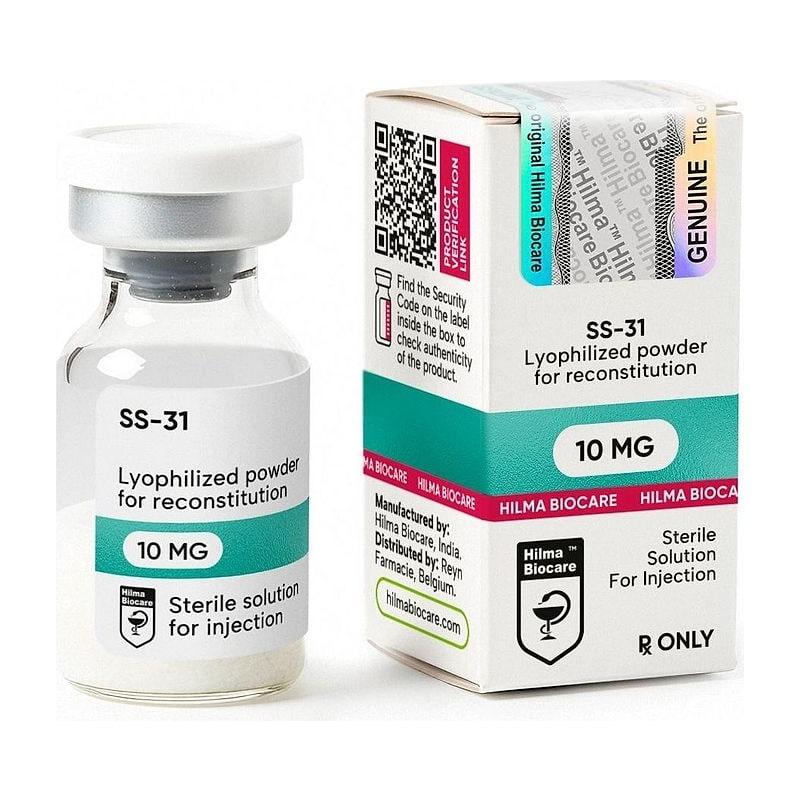
Research Disclaimer: SS-31 (Elamipretide) is sold exclusively for in-vitro and laboratory research use. Not approved for human therapeutic use except under clinical trial conditions. This content does not constitute medical advice.
SS-31 (Szeto-Schiller peptide 31, also called Elamipretide or MTP-131) is a synthetic mitochondria-targeted tetrapeptide that selectively accumulates at the inner mitochondrial membrane (IMM) and protects cardiolipin — a critical phospholipid unique to the IMM. Loss of cardiolipin integrity is a primary driver of mitochondrial dysfunction in aging, ischemia-reperfusion injury, and heart failure. SS-31 is currently in Phase 3 clinical trials for Barth syndrome and advanced cardiac disease, making it one of the most clinically validated mitochondrial peptides.
Table of Contents#
- Structure and Mitochondrial Targeting of SS-31
- Cardiolipin: The IMM Phospholipid SS-31 Protects
- Mechanism 1: Cristae Architecture Restoration
- Mechanism 2: Electron Transport Chain Efficiency
- Mechanism 3: Reducing Mitochondrial ROS
- Aging and Mitochondrial Cardiolipin Decline
- Ischemia-Reperfusion Injury Research
- Heart Failure Research and Clinical Data
- Skeletal Muscle and Aging Research
- Research Protocols
- Key References
Structure and Mitochondrial Targeting of SS-31#
SS-31 sequence: D-Arg-Dmt-Lys-Phe-NH₂ (Dmt = 2',6'-dimethyltyrosine)
Molecular weight: ~638 Da
Net charge: +3 (three positively charged residues at physiological pH)
Why does SS-31 accumulate in mitochondria?#
The mitochondrial inner membrane maintains a large electrochemical gradient (~−180 mV, negative inside). Positively charged compounds are electrostatically drawn into mitochondria and accumulate there at concentrations 100–500× higher than the cytoplasm.
However, most mitochondrial-targeting compounds use a triphenylphosphonium (TPP+) cation — a large lipophilic group — for targeting. SS-31's positive charge comes from its amino acids (the guanidinium of Arg and the ε-amino of Lys), without any lipophilic anchor. How, then, does SS-31 enter and concentrate in mitochondria?
The answer: SS-31 binds cardiolipin at the inner mitochondrial membrane. Cardiolipin has two negatively charged phosphate head groups — it acts as a "trap" that captures SS-31 via electrostatic interaction, effectively concentrating SS-31 at the exact site of action.
The Dmt (dimethyltyrosine) residue is critical: it provides the lipophilic character needed to insert the peptide into the cardiolipin-containing membrane bilayer, while the positive charges anchor it electrostatically.
Cardiolipin: The IMM Phospholipid SS-31 Protects#
What is cardiolipin?#
Cardiolipin (CL) is a unique phospholipid with four acyl chains and two phosphate groups (a "bisphosphatidylglycerol"). It is found almost exclusively in the inner mitochondrial membrane (IMM) in eukaryotes.
Cardiolipin's functions:
- Cristae stabilization: CL is highly enriched at the cristae junctions — the tight tubular connections between the cristae (shelf-like inner membrane folds) and the peripheral inner membrane. CL helps maintain the highly curved cristae architecture required for efficient oxidative phosphorylation.
- Respiratory supercomplex support: CL is required for the assembly and stability of respiratory supercomplexes (I+III+IV "respirasome"). These large assemblies channel electrons efficiently and reduce electron leak (and therefore ROS production).
- Cytochrome c anchoring: CL binds cytochrome c (the mobile electron carrier between Complex III and IV) to the IMM surface — keeping it in proximity to its redox partners.
- IMM curvature: CL has a conical shape (large head group / small tail area ratio) that promotes membrane curvature → contributes to cristae shape maintenance.
Cardiolipin oxidation#
When cardiolipin is oxidized (by ROS from a dysfunctional ETC, or by cytochrome c which can act as a CL peroxidase):
- Cristae membranes remodel from tight tubular to wide/flat lamellar morphology (loss of cristae architecture)
- Respiratory supercomplex disassembly (efficient electron channeling lost → more electron leak → more ROS → more CL oxidation — a vicious cycle)
- Cytochrome c release: oxidized CL releases bound cytochrome c → cytochrome c released to intermembrane space → can be released to cytoplasm → apoptosis signal
Mechanism 1: Cristae Architecture Restoration#
SS-31 binds to intact (reduced) cardiolipin and prevents its oxidation by:
- Sterically shielding the cardiolipin unsaturated acyl chains from radical attack
- The aromatic Dmt residue has radical-scavenging properties — it can be oxidized instead of cardiolipin, then regenerated
By maintaining cardiolipin in its reduced (functional) form, SS-31 preserves cristae architecture:
- Electron microscopy studies in aged and ischemic tissue: SS-31 treated → narrow, well-organized cristae (like young/healthy tissue). Untreated aged/ischemic → wide, disorganized cristae (the "lamellar" morphology characteristic of dysfunction).
- Cristae maintenance → respiratory supercomplexes remain assembled → ETC efficiency preserved.
Mechanism 2: Electron Transport Chain Efficiency#
Respiratory supercomplexes (I + III + IV respirasome) require cardiolipin for assembly. With cardiolipin loss/oxidation → supercomplex disassembly → individual free complexes → less efficient electron transfer → more electron "leak" to oxygen → more superoxide production.
SS-31 maintains cardiolipin → maintains supercomplexes → maintains efficient electron channeling:
- ATP synthesis rate: preserved in aged and post-ischemic mitochondria treated with SS-31
- Proton leak rate: reduced (maintained inner membrane integrity)
- Respiratory control ratio (RCR): improved in SS-31 treated mitochondria vs. untreated aged/damaged controls
Mechanism 3: Reducing Mitochondrial ROS#
Beyond supercomplex maintenance, SS-31's Dmt residue directly scavenges mitochondrial ROS:
- Dmt has a phenol group that can donate hydrogen atoms to quench hydroxyl radicals and superoxide
- After radical scavenging, Dmt is oxidized to a relatively stable radical that can be regenerated by other antioxidants
Net effect: SS-31 acts as both a structural protectant (CL oxidation prevention) and a direct antioxidant (radical scavenging) at the IMM — the two mechanisms reinforce each other.
Aging and Mitochondrial Cardiolipin Decline#
Age-related cardiolipin changes#
Aging produces multiple changes to cardiolipin in the IMM:
- Reduced cardiolipin content: total CL declines 30–40% in aged heart and skeletal muscle
- Altered acyl chain composition: more oxidized and shorter chain CLs in aged tissue
- Reduced tafazzin (TAFZ) activity: tafazzin is the enzyme responsible for CL remodeling (inserting the correct acyl chains); tafazzin activity declines with age
Consequences#
Cardiolipin loss/oxidation → cristae disorganization → supercomplex disassembly → reduced ETC efficiency → more ROS → more CL oxidation (vicious cycle). This is a primary driver of the age-related decline in mitochondrial bioenergetics.
SS-31 in aging models#
Bhaskaran et al. (2020) and Sweetwyne et al. (2017):
- Aged mice treated with SS-31 (3 mg/kg SC daily × 8 weeks)
- Restored cristae morphology in skeletal muscle to young-like appearance by electron microscopy
- Improved mitochondrial ATP production in ex vivo assays
- Improved physical function (treadmill endurance, grip strength) in aged animals
Ischemia-Reperfusion Injury Research#
The most established SS-31 application in preclinical research is ischemia-reperfusion (I-R) injury — the damage that occurs when blood flow is restored to ischemic tissue (heart, kidney, brain, muscle).
Why I-R damages mitochondria#
During ischemia: electron transport slows, NADH and FADH₂ accumulate, and Complex I becomes "reverse-mode" (pumping electrons backward, generating ROS rather than consuming them). During reperfusion: sudden oxygen supply to dysfunctional ETC → burst of superoxide → rapid CL oxidation → cytochrome c release → apoptosis.
SS-31 in I-R#
Multiple preclinical studies (Zhao et al. 2004; Kloner et al. 2012):
- SS-31 administered before or within the first minutes of reperfusion → significantly reduced infarct size
- Cardiac I-R in rodents: 40–60% reduction in infarct volume with SS-31
- Renal I-R: preserved tubular function and reduced tubular necrosis
- Mechanism: SS-31 → maintained CL integrity → prevented cytochrome c release → blocked the CL oxidation → apoptosis cascade during reperfusion burst
Heart Failure Research and Clinical Data#
Barth syndrome#
Barth syndrome (BTHS) is a rare X-linked disorder caused by tafazzin mutations → abnormal cardiolipin remodeling → severe cardiomyopathy, skeletal myopathy, neutropenia.
SS-31 (Elamipretide) is in Phase 3 trials for BTHS (TAZPOWER trial completed; Phase 3 ongoing):
- Phase 2: improved 6-minute walk test, handgrip strength, and cardiac function (LVEF) vs. placebo
- Phase 3 results pending
Heart failure with preserved ejection fraction (HFpEF)#
CHALLENGE-HF trial: Phase 2, SS-31 in HFpEF patients:
- Improved exercise capacity (6MWT) and quality of life scores
- Reduced cardiac troponin (marker of cardiomyocyte injury)
- Well-tolerated; no serious adverse events
This is among the most advanced clinical validations of a mitochondria-targeted peptide in cardiovascular disease.
Skeletal Muscle and Aging Research#
Beyond the heart, SS-31 has demonstrated benefits in aging skeletal muscle:
Sarcopenia model data#
- Aged mice (24 months): SS-31 SC daily × 8 weeks → improved treadmill endurance by 20–30% vs. age-matched controls
- Fiber cross-sectional area: maintained closer to young-adult levels
- Mechanism: preserved mitochondrial function in type I/IIa fibers → less fatigue, better contractile endurance
Muscle I-R (surgical relevance)#
Tourniquet application or limb ischemia in rodents (replicating surgical scenarios):
- SS-31 before or during ischemia → preserved mitochondrial function in post-ischemic muscle
- Reduced reperfusion injury → faster functional recovery
Research Protocols#
Standard aging protocol (SS-31)#
| Parameter | Specification |
|---|---|
| Model | Aged mice (20–24 months) or rats (18–22 months) |
| Dose | 3 mg/kg SC |
| Frequency | Once daily |
| Duration | 8–12 weeks |
| Primary endpoints | Mitochondrial respiration (Seahorse), electron microscopy (cristae morphology), physical function (treadmill, grip strength) |
| Secondary endpoints | Cardiac function (echocardiography), muscle mass/composition, ROS levels (MitoSOX in isolated mitochondria) |
I-R protection protocol#
| Parameter | Specification |
|---|---|
| Model | Cardiac MCAO or renal I-R (rodent) |
| Dose | 3 mg/kg IV bolus |
| Timing | 5–10 min before reperfusion |
| Endpoints | Infarct size, mitochondrial membrane potential, cytochrome c release, apoptosis markers |
Key References#
-
Szeto HH, Schiller PW. (2011). "Novel therapies targeting inner mitochondrial membrane — from discovery to clinical development." Pharmaceutical Research, 28(11):2669–2679.
-
Bhaskaran S, et al. (2020). "Loss of mitochondrial fission protein Drp1 causes mitochondrial dysfunction and decreases reserve respiratory capacity." Redox Biology, 29:101387.
-
Birk AV, et al. (2013). "The mitochondrial-targeted compound SS-31 re-energizes ischemic mitochondria by interacting with cardiolipin." Journal of the American Society of Nephrology, 24(8):1250–1261.
-
Sabbah HN, et al. (2016). "Chronic therapy with elamipretide (MTP-131), a novel mitochondria-targeting peptide, improves left ventricular and mitochondrial function in dogs with advanced heart failure." Circulation: Heart Failure, 9(2):e002206.
-
Zhao K, et al. (2004). "Cell-permeable peptide antioxidants targeted to inner mitochondrial membrane inhibit mitochondrial swelling, oxidative cell death, and reperfusion injury." Journal of Biological Chemistry, 279(33):34682–34690.
Research Use Only: SS-31 and all products referenced are sold exclusively for in-vitro research and laboratory use. Not for human consumption except under clinical trial conditions. JuicedPharma does not provide medical advice.
Published by JuicedPharma Research Team · September 2026 · Category: Research Protocols & Science