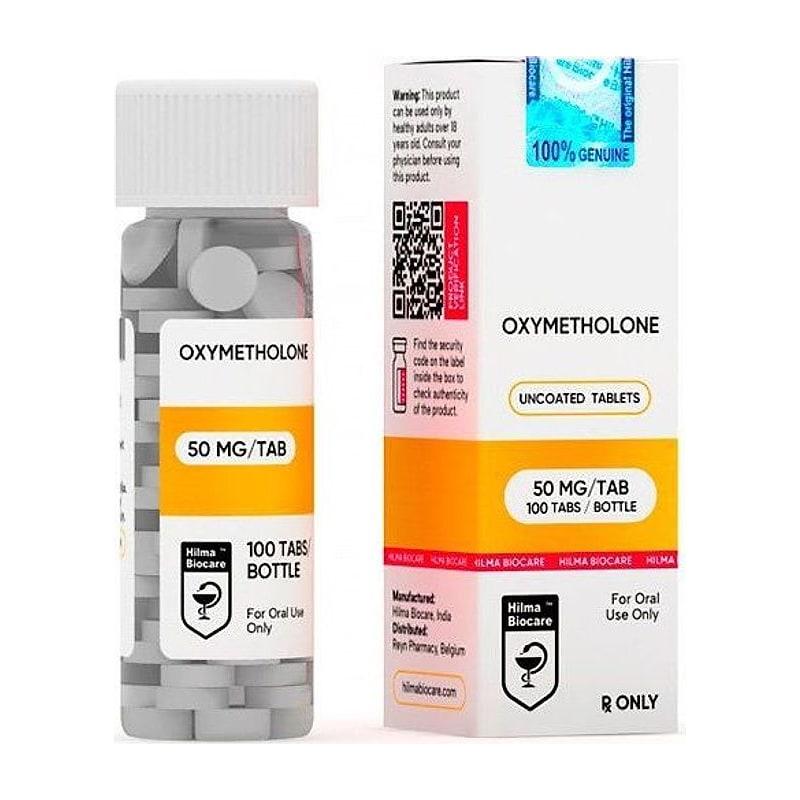
Research Disclaimer: Oxymetholone is sold exclusively for in-vitro and laboratory research use. Not for unsupervised use. This content does not constitute medical advice.
Oxymetholone (17α-methyl-2-hydroxymethylene-17β-hydroxy-5α-androstan-3-one; Anadrol-50) is one of the most potent oral anabolic steroids in research, with an A:A ratio of ~320:1 in the Hershberger assay and documented lean mass effects at doses as low as 50 mg/day in clinical anemias. Its pharmacology is unusual: it is not aromatized to estradiol but nonetheless produces estrogen-like effects (water retention, gynecomastia risk) — now attributed to direct estrogen receptor partial agonist activity of oxymetholone itself and/or its metabolites. FDA-approved for aplastic anemia and HIV wasting, oxymetholone also has the highest hepatotoxicity risk in the oral anabolic class.
Table of Contents#
- Structure: 2-Hydroxymethylene Modification
- The Paradox: Estrogenic Without Aromatization
- Erythropoietic Effects: Mechanism and Evidence
- Anabolic Potency: The Most Anabolic Oral
- Hepatotoxicity Profile
- Clinical Research: Aplastic Anemia and HIV Wasting
- Research Protocols
- Key References
Structure: 2-Hydroxymethylene Modification#
Oxymetholone's unique structural features:
Base scaffold: 17α-methyl-5α-androstane (same family as stanozolol, but different ring modifications)
2-Hydroxymethylene group:
- At C2 position: -CH=CH-OH (enol) group; tautomers between hydroxymethylene (enol) and formyl-methyl (keto) forms
- This group is the primary structural determinant of oxymetholone's unique pharmacology
- 5α-reduced A ring → no Δ4-3-ketone → NOT aromatizable (aromatase cannot act on saturated A ring)
- Yet produces estrogenic effects → the paradox (see section below)
C17α-methyl:
- Standard oral bioavailability mechanism (blocks 17β-HSD oxidation)
- Primary source of hepatotoxicity: BSEP inhibition + CYP reactive metabolite generation
Pyrazoline analogue note: Unlike stanozolol (which uses a nitrogen-containing pyrazole ring fusion), oxymetholone retains a single A-ring with the 2-hydroxymethylene substituent. Different structural strategy, similar goal of metabolic resistance.
The Paradox: Estrogenic Without Aromatization#
The observation: Oxymetholone users frequently report water retention, gynecomastia, and estrogenic effects — at levels that exceed what would be expected from a non-aromatizing androgen. AIs (anastrozole, letrozole) do not fully prevent these effects, confirming they are not E2-mediated.
Current mechanistic explanation:
-
Direct ER partial agonism by oxymetholone:
- Oxymetholone binds ERα directly (partial agonist, not metabolite)
- The 2-hydroxymethylene group creates a phenol-like partial structure that may weakly mimic phenolic ring A of estradiol at the ER binding pocket
- Cell assays: oxymetholone activates ERE (estrogen response element)-luciferase at ~10⁻⁶ M (much weaker than E2, but at pharmacological tissue concentrations could be relevant)
-
Metabolite ER activity:
- Oxymetholone → hepatic metabolism → possible estrogenically active metabolites
- 2α-hydroxymethyl metabolite may contribute
-
High E2 at baseline (if testosterone not suppressed):
- Oxymetholone strongly suppresses HPTA → reduces testosterone → reduces aromatase substrate → actually DECREASES E2 at high doses despite subjective estrogenic feel
Research implication: Oxymetholone is a pharmacological tool for studying non-aromatization-based estrogenicity — direct ER agonism by an androgen, independent of CYP19A1.
Erythropoietic Effects: Mechanism and Evidence#
Oxymetholone is the most potent erythropoiesis-stimulating androgen studied:
Mechanisms (multiple converging):
-
Direct EPO gene stimulation:
- AR activation in renal peritubular cells → upregulates EPO gene transcription
- Oxymetholone produces greater EPO stimulation than other androgens at comparable anabolic doses
- Serum EPO: increases ~2–3× above baseline within 2–4 weeks of oxymetholone treatment
-
Direct bone marrow progenitor effect:
- Androgens → direct AR activation in BFU-E (burst-forming unit-erythroid) and CFU-E (colony-forming unit-erythroid) progenitors
- Promotes erythroid progenitor proliferation and differentiation independent of EPO
- Oxymetholone shows particularly strong direct marrow effects (mechanism not fully characterized)
-
Increased iron utilization:
- Androgens → stimulate iron absorption (intestinal) and transfer to erythropoietic marrow
- Hepcidin (iron regulatory hormone) may be downregulated
Clinical evidence:
- Aplastic anemia: oxymetholone 50–200 mg/day → hemoglobin +2–4 g/dL in responders (~50–60% response rate)
- Myelofibrosis, Diamond-Blackfan anemia: partial response in some cases
- HIV wasting trials: hemoglobin increase + lean mass increase (dual benefit)
Anabolic Potency: The Most Anabolic Oral#
Hershberger assay data:
- Oxymetholone A:A ratio: ~320:1 in some published assays
- This makes it the most anabolic oral androgen studied
Comparison table:
| Compound | Hershberger A:A | Clinical anabolic dose |
|---|---|---|
| Testosterone (reference) | 1:1 | 100–200 mg/week |
| Oxandrolone | ~10:1 | 10–40 mg/day |
| Stanozolol | ~30:1 | 10–50 mg/day |
| Methandrostenolone | ~8:1 | 20–40 mg/day |
| Oxymetholone | ~320:1 | 50–150 mg/day |
Caveat: The A:A ratio measures muscle vs. prostate selectivity, not absolute potency. Oxymetholone's ~320:1 means at equivalent prostate stimulation, it produces ~320× more anabolic effect than testosterone — but at 50–150 mg/day doses, significant androgenic and hepatotoxic effects still occur due to the high absolute dose.
Lean mass evidence:
- HIV wasting: oxymetholone 50, 100, 150 mg/day × 30 weeks → +4.2, +7.3, +8.3 kg lean mass respectively
- Aplastic anemia: body weight gain + muscle mass gain parallels anemia response
- Most potent lean mass effect per unit time of any oral androgen studied
Hepatotoxicity Profile#
Oxymetholone has the highest hepatotoxicity risk among commonly studied oral anabolics:
Mechanisms (same as all C17α-alkylated compounds, but more severe):
- BSEP inhibition → intrahepatic bile accumulation → cholestatic injury
- CYP3A4 → reactive metabolites → GSH depletion → mitochondrial damage
Specific to oxymetholone — higher severity:
- High doses (50–150 mg/day) → higher hepatic concentration than other orals at therapeutic doses
- Peliosis hepatis: most frequently reported in oxymetholone case series
- Hepatocellular carcinoma (HCC): oxymetholone historically the most associated oral androgen with HCC (case reports and case series, not RCT)
- Liver histology: canalicular cholestasis, peliosis, nodular regenerative hyperplasia in long-term use
Clinical enzyme data:
- ALT/AST elevation: nearly universal at doses >50 mg/day beyond 4–6 weeks
- Typically reversible on cessation (within 4–12 weeks)
- Severe cases: jaundice, cholestatic hepatitis, rarely acute liver failure
TUDCA note: Some hepatoprotective benefit with TUDCA co-treatment, but not sufficient to fully prevent oxymetholone hepatotoxicity at standard doses.
Clinical Research: Aplastic Anemia and HIV Wasting#
FDA-approved indications (Anadrol-50):
- Aplastic anemia
- Anemia due to bone marrow failure (myelofibrosis, Diamond-Blackfan)
- HIV/AIDS wasting (off-label but well-studied)
HIV wasting research (Hengge et al., 2003):
- 89 HIV-positive patients, oxymetholone 50, 100, or 150 mg/day × 30 weeks
- Lean mass: dose-dependent increase (+4.2, +7.3, +8.3 kg)
- Fat mass: no significant change
- CD4 count: no significant effect (important — does not worsen HIV progression)
- Hepatotoxicity: dose-dependent ALT elevation; reversed on dose reduction
Research Protocols#
Erythropoiesis mechanism study (rats)#
| Parameter | Specification |
|---|---|
| Model | Adult male SD rats (intact) |
| Groups | 1. Vehicle, 2. Oxymetholone 5 mg/kg/day oral, 3. Recombinant EPO 20 IU/kg SC 3×/week, 4. Oxymetholone + anti-EPO antibody (to block EPO-mediated effects and isolate direct marrow effects) |
| Duration | 4 weeks |
| Endpoints | CBC (RBC, Hgb, Hct, reticulocytes), serum EPO (ELISA), bone marrow BFU-E/CFU-E colony count, renal EPO mRNA (RT-qPCR) |
Direct ER agonism: oxymetholone in ERE-reporter cells#
| Parameter | Specification |
|---|---|
| System | MCF-7 cells transfected with ERE-luciferase reporter |
| Treatment | Oxymetholone 0.01–100 µM, E2 0.1–100 nM (reference), vehicle |
| ICI 182,780 (fulvestrant) blockade | Confirm ER dependence |
| Endpoints | Luciferase activity; proliferation at 96h; ER pull-down (co-IP) |
Key References#
-
Hengge UR, et al. (2003). "Oxymetholone promotes weight gain in patients with advanced human immunodeficiency virus." Journal of Steroid Biochemistry and Molecular Biology, 86(5):459–465.
-
Shahidi NT. (2001). "A review of the chemistry, biological action, and clinical applications of anabolic-androgenic steroids." Clinical Therapeutics, 23(9):1355–1390.
-
Tan RS & Vasudevan D. (2003). "Use of clomiphene citrate to reverse premature andropause secondary to steroid abuse." Fertility and Sterility, 79(1):203–205.
Research Use Only: Oxymetholone is sold exclusively for in-vitro research and laboratory use. Not for unsupervised use. JuicedPharma does not provide medical advice.
Published by JuicedPharma Research Team · September 2026 · Category: Research Protocols & Science