Research Disclaimer: All compounds described are sold exclusively for in-vitro and laboratory research use. Not for unsupervised use. This content does not constitute medical advice.
Mitochondrial biogenesis — the formation of new mitochondria — is a critical adaptive response to energy demand, exercise, caloric restriction, and oxidative stress. Dysregulation of this process underlies metabolic disease, sarcopenia, neurodegeneration, and aging. The master regulator is PGC-1α (Peroxisome proliferator-activated receptor gamma coactivator 1-alpha), activated by multiple upstream sensors including AMPK, SIRT1, and NAD+. Compounds that activate this pathway are among the most researched for metabolic and longevity applications.
PGC-1α: The Master Biogenesis Regulator#
What PGC-1α does: PGC-1α is a transcriptional coactivator (not a DNA-binding transcription factor itself) that interacts with and amplifies the activity of multiple nuclear transcription factors:
- NRF1 and NRF2 (Nuclear Respiratory Factors): activate mitochondrial transcription factor A (TFAM) → mitochondrial DNA transcription and replication
- ERRα (Estrogen-Related Receptor α): drives expression of electron transport chain (ETC) genes
- PPARα: fatty acid oxidation gene program
- Yin Yang 1 (YY1): works with PGC-1α for mitochondrial gene expression
Net result of PGC-1α activation:
- ↑ TFAM → ↑ mtDNA replication → more mitochondrial genome copies
- ↑ ETC complex subunits (complexes I-V) → more OXPHOS capacity
- ↑ CPT1 (carnitine palmitoyltransferase 1) → increased fatty acid oxidation into mitochondria
- ↑ mitochondrial volume (biogenesis) → more ATP production per cell
PGC-1α regulation:
- Post-translational: SIRT1 deacetylates PGC-1α (activating); AMPK phosphorylates PGC-1α (activating)
- Transcriptional: AMPK and Ca2+/CaMKII increase PGC-1α mRNA expression
- Inhibitory: ROS activates PGC-1α short-term; chronic high ROS inhibits
The AMPK Pathway#
AMPK (AMP-activated protein kinase): AMPK is the cellular energy sensor — activated when ATP is depleted (↑ AMP:ATP ratio):
- Exercise → muscle ATP consumption → ↑ AMP → AMPK activation
- Caloric restriction → reduced glucose/energy → AMPK activation
- AMPK → multiple targets: phosphorylates and activates PGC-1α directly; inhibits mTORC1 (energy-consuming anabolic programs)
Compounds activating AMPK:
| Compound | AMPK activation mechanism | Research application |
|---|---|---|
| AICAR | AMP mimetic → direct AMPK activation | Positive control in AMPK experiments |
| Metformin (reference) | Complex I inhibition → ↑ AMP/ATP | T2DM treatment; research reference |
| MOTS-c peptide | Mitochondrial-derived; folate cycle → AMPK | Mitochondria → nucleus retrograde signaling |
| Cardarine (GW-501516) | PPARδ → PGC-1α (AMPK-independent but parallel) | Endurance/oxidative capacity research |
| Resveratrol (reference) | SIRT1 → deacetylates LKB1 → AMPK | NAD+/SIRT1 pathway research comparator |
The NAD+/SIRT1 Pathway#
NAD+ as the metabolic hub: NAD+ (Nicotinamide Adenine Dinucleotide) is the rate-limiting substrate for sirtuins (NAD+-dependent deacylases). As NAD+ declines with aging → SIRT1 activity declines → PGC-1α remains acetylated → impaired biogenesis.
SIRT1 → PGC-1α:
- SIRT1 binds PGC-1α
- SIRT1 uses NAD+ as co-substrate → removes acetyl groups from Lys residues on PGC-1α
- Deacetylated PGC-1α → activated → binds NRF1/ERRα → biogenesis program initiated
NAD+ precursor compounds in research:
| Compound | Mechanism | Published evidence |
|---|---|---|
| NMN (Nicotinamide Mononucleotide) | Direct NMN → NAD+ (NMN kinase pathway) | Animal: increased NAD+, improved muscle function in old mice |
| NR (Nicotinamide Riboside) | NR → NMN → NAD+ (NRK pathway) | Phase I: safe and raises NAD+ in humans |
| Niacin (B3) | NAMPT-dependent pathway | Older precursor; less efficient for NAD+ elevation |
| NADH (reduced NAD+) | Substrate replacement | Less studied as precursor; primarily electron carrier function |
SIRT1 activation beyond NAD+: SIRT3 (mitochondrial sirtuin) deacetylates mitochondrial proteins directly — SOD2, IDH2, acetyl-CoA synthetase — improving OXPHOS efficiency and ROS detoxification. NAD+ elevation raises both SIRT1 and SIRT3 activity.
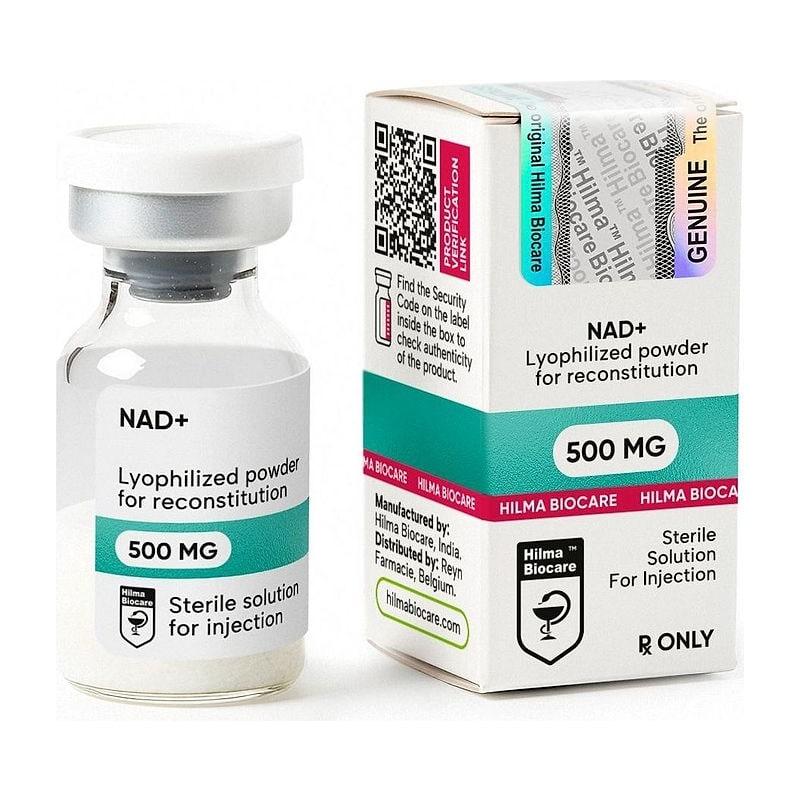
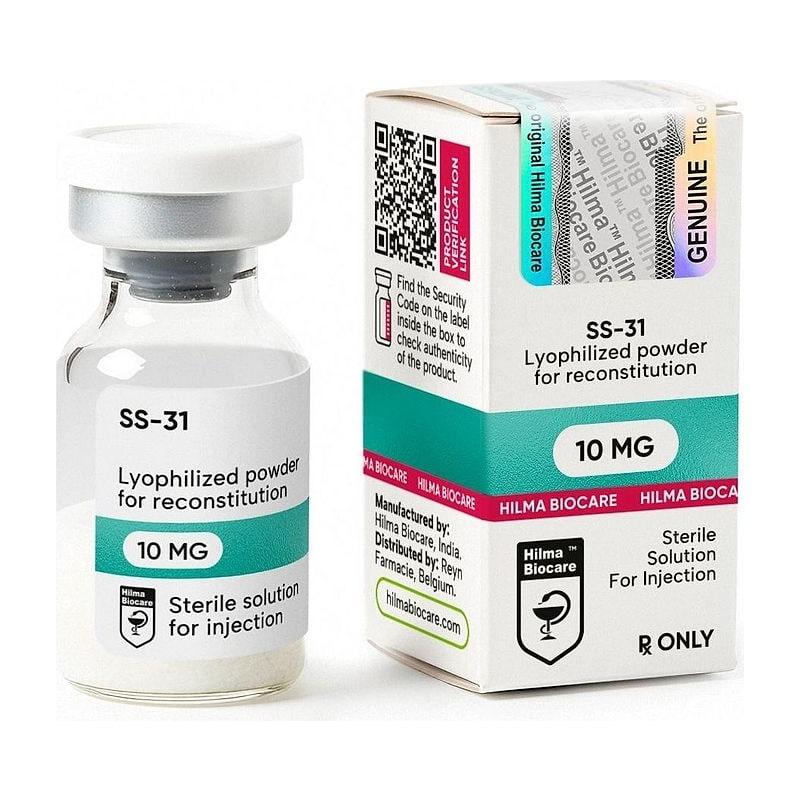
NAD+, €65 · 99.3% puritySS-31 (Elamipretide): Cardiolipin and Cristae Architecture#
A different approach to mitochondrial function:
SS-31 (D-Arg-Dmt-Lys-Phe-NH2) is a mitochondria-targeted peptide that does not activate biogenesis but directly improves the function of existing mitochondria:
Cardiolipin binding:
- Cardiolipin is a phospholipid unique to the inner mitochondrial membrane (IMM)
- It stabilizes cristae ultrastructure and is required for:
- ETC complex supercomplex assembly (I-III-IV supercomplexes)
- Cytochrome c retention in cristae
- ATP synthase dimerization → cristae curvature
- With aging/disease: cardiolipin oxidizes → cristae collapse → ETC efficiency declines
SS-31 mechanism:
- SS-31 cationic residues → electrostatic targeting to IMM (ΔΨ-dependent)
- Binds cardiolipin → protects against peroxidation
- Stabilizes ETC supercomplex assembly → increased electron transfer efficiency → less proton leak → more ATP per O2
Published research:
- SS-31 improved cardiac function in heart failure models
- Reversed age-related cristae collapse in skeletal muscle
- Reduced mitochondrial ROS without uncoupling
Experimental Models for Mitochondrial Research#
In vitro assays:
| Assay | What it measures | Notes |
|---|---|---|
| Seahorse XF assay | Oxygen consumption rate (OCR) + extracellular acidification rate (ECAR) | Gold standard for mitochondrial respiration |
| JC-1 staining | Mitochondrial membrane potential (ΔΨm) | Healthy: J-aggregates (red); depolarized: monomers (green) |
| MitoTracker staining | Mitochondrial mass/morphology | Flow cytometry or confocal |
| mtDNA:nDNA ratio | Relative mitochondrial content | qPCR on total DNA |
| TFAM western blot | PGC-1α pathway activation | Combined with NRF1/NRF2 |
In vivo models:
- Treadmill exercise + compound treatment: measure VO2max, muscle CSA, mitochondrial density (TEM)
- High-fat diet model: reduced mitochondrial function → test compound restoration
- Aged mice (24 months): impaired biogenesis baseline → good sensitivity for PGC-1α activators
Research Use Only. JuicedPharma does not provide medical advice.
Published by JuicedPharma Research Team · October 2026 · Category: Research Protocols & Science