Research Disclaimer: All compounds described are sold exclusively for in-vitro and laboratory research use. Not for unsupervised use. This content does not constitute medical advice.
Growth hormone (GH) is a potent lipolytic agent — it directly activates fat breakdown in adipose tissue while simultaneously opposing insulin's lipid-storing effects. The GH-driven lipolysis mechanism involves adipocyte GH receptor → JAK2/STAT5 → hormone-sensitive lipase (HSL) activation → triglyceride hydrolysis → fatty acid release. Understanding this pathway is essential for interpreting the fat-reducing effects of GH secretagogue peptides and the targeted lipolytic activity of HGH Fragment 176-191, which selectively retains the lipolytic domain of the full GH molecule.
GH Receptor Signaling in Adipocytes#
The GH receptor (GHR):
- GHR is a class I cytokine receptor (single transmembrane domain)
- Two GHR molecules dimerize upon GH binding → conformational change
- Dimerization → transactivation of associated JAK2 kinase molecules → JAK2-JAK2 cross-phosphorylation
JAK2/STAT5 pathway in adipocytes:
- GH → GHR dimerization → JAK2 activation
- JAK2 → phosphorylates STAT5 (Signal Transducer and Activator of Transcription 5)
- STAT5 dimerizes → translocates to nucleus → activates target gene transcription
- STAT5 target genes in adipocytes include: HSL (hormone-sensitive lipase), ATGL (adipose triglyceride lipase), and Perilipin 1 (lipid droplet protein regulating lipolysis access)
Result: Increased transcription and activation of the core lipolytic machinery.
Hormone-Sensitive Lipase (HSL) and the Lipolytic Cascade#
HSL is the rate-limiting enzyme for triglyceride hydrolysis:
In adipocytes, triglycerides are stored in lipid droplets coated by Perilipin 1. Lipolysis occurs in a coordinated sequence:
- ATGL (Adipose Triglyceride Lipase): Hydrolyzes TG → DAG (diacylglycerol) + fatty acid
- Rate-limited by CGI-58 co-activation (perilipin-regulated)
- HSL: Hydrolyzes DAG → MAG (monoacylglycerol) + fatty acid
- Rate-limited by phosphorylation state
- MGL (Monoglyceride Lipase): Hydrolyzes MAG → glycerol + fatty acid
GH activation of HSL:
- JAK2 → phosphorylates HSL at Ser660 → HSL activation (directly)
- STAT5 → increased HSL expression (long-term)
- GH → reduced perilipin-1 phosphorylation? (area of ongoing research)
Net result: GH → complete lipolytic cascade → release of free fatty acids (FFA) and glycerol into circulation
GH Opposes Insulin's Anti-Lipolytic Action#
Insulin's anti-lipolytic mechanism: Insulin → IRS-1 → PI3K → PDE3B (phosphodiesterase 3B) → cAMP hydrolysis → reduced PKA → HSL remains dephosphorylated (inactive) → lipolysis suppressed
GH-insulin antagonism: GH activates several mechanisms that impair insulin signaling in adipocytes:
- IRS-1 serine phosphorylation: JAK2 → IRS-1 Ser307 phosphorylation → IRS-1 degradation → reduced PI3K activation
- SOCS-3 induction: GH/JAK2/STAT5 → SOCS-3 expression → SOCS-3 binds IRS-1 → ubiquitin-mediated degradation
- Reduced GLUT4 translocation: Result of impaired IRS-1 → PI3K → Akt → AS160 → GLUT4 trafficking
The "diabetogenic" effect of supraphysiological GH: Chronic high GH → sustained IRS-1 degradation → insulin resistance in adipose and liver → elevated fasting glucose. This is why GH excess (acromegaly) is associated with type 2 diabetes development.
Research implication: GH secretagogue research models need glucose tolerance monitoring as a required endpoint — even at doses producing body composition benefits, insulin sensitivity may be impaired.
HGH Fragment 176-191: Selective Lipolysis#
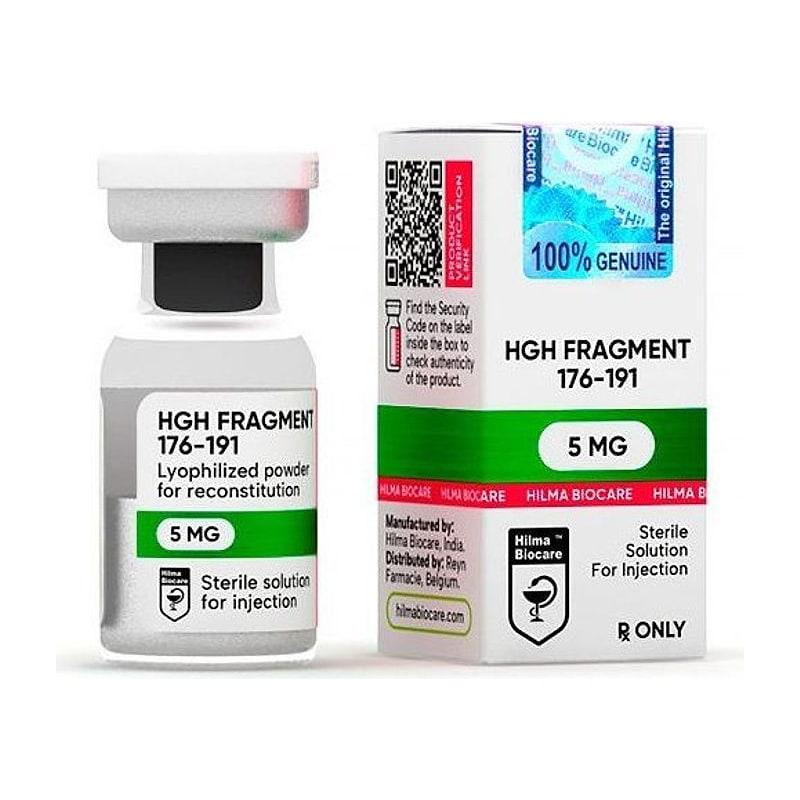
What HGH Fragment 176-191 is: HGH Fragment 176-191 is a 16-amino acid C-terminal fragment of human growth hormone (residues 176–191). This region corresponds to the portion of the GH molecule responsible for metabolic (lipolytic) effects — distinct from the growth-promoting N-terminal domain.
Selective mechanism:
- HGH Fragment binds GHR at a site that activates the lipolytic pathway
- Does NOT activate the growth/IGF-1 axis (does not stimulate significant IGF-1 production)
- Does NOT produce insulin resistance (reduced or absent IRS-1 serine phosphorylation)
In vivo evidence:
- Obese mice treated with HGH Fragment 176-191: significant reduction in body fat without growth-stimulating effects
- Fat pad weight reduction: ~25–50% in HFD mouse models vs. control
- No elevation in IGF-1 → confirms selectivity for lipolytic domain
- Reduced lipogenic gene expression in adipose tissue (reduced FAS, SREBP-1c)
Published lipolysis data: HGH Fragment 176-191 activates adipocyte lipolysis in vitro at nanomolar concentrations. β3-adrenergic agonist (isoproterenol) positive control shows similar magnitude of FFA release — confirming Fragment as a genuine lipolytic agent, not a pharmacological curiosity.
HGH Fragment 176-191, €26 · 99.2% purityResearch Models for GH-Mediated Lipolysis#
In vitro:
- Differentiated 3T3-L1 adipocytes: gold standard cell model; treat with GH or HGH Fragment → measure glycerol release (lipolysis indicator), FFA release, HSL phosphorylation
- Primary human adipocytes from fat biopsy: more physiologically relevant
Key assays:
| Assay | Readout |
|---|---|
| Glycerol release (enzymatic) | Lipolysis rate |
| NEFA (non-esterified FA) measurement | FFA release |
| HSL pSer660 western blot | Lipolytic signaling activation |
| ATGL activity assay | ATGL-specific lipolysis |
| Oil Red O staining | Lipid droplet area (pre/post treatment) |
In vivo:
- DIO mice: 8–12 weeks HFD → obese → treat with HGH Fragment or GH secretagogue → DEXA for fat mass
- Epididymal fat pad weight: simple and reproducible endpoint
- Hyperinsulinemic-euglycemic clamp: for insulin sensitivity assessment alongside lipolysis
Research Use Only. JuicedPharma does not provide medical advice.
Published by JuicedPharma Research Team · October 2026 · Category: Growth Hormone