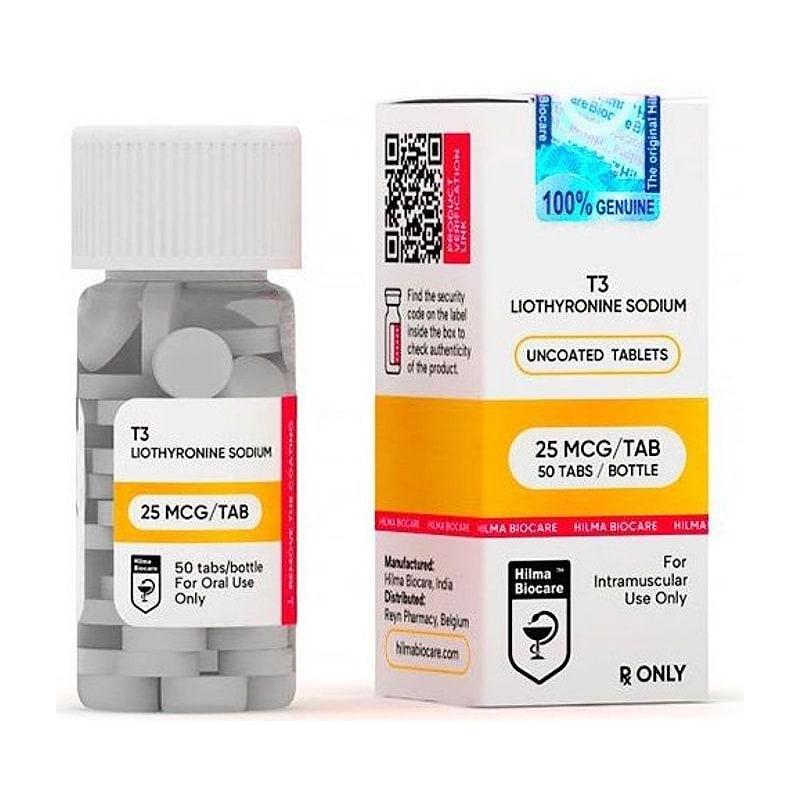
Research Disclaimer: T3 (Liothyronine) is sold exclusively for in-vitro and laboratory research use. Not for unsupervised use. This content does not constitute medical advice.
T3 (3,5,3'-triiodothyronine, liothyronine) is the biologically active form of thyroid hormone — the most potent regulator of basal metabolic rate in mammals. T3 is produced peripherally by monodeiodination of T4 (thyroxine) and acts through nuclear thyroid hormone receptors (TRα and TRβ) to regulate gene expression in nearly every tissue. In research contexts, T3 is used to study metabolic regulation, thyroid hormone receptor biology, thermogenesis mechanisms, and the molecular basis of the metabolic syndrome.
Table of Contents#
- T3 vs T4: Activation and Tissue Delivery
- Thyroid Hormone Receptors: TRα and TRβ
- Mechanism 1: Basal Metabolic Rate Elevation
- Mechanism 2: Mitochondrial Biogenesis
- Mechanism 3: Thermogenesis (BAT and Muscle)
- Mechanism 4: Lipid Metabolism
- Mechanism 5: Carbohydrate Metabolism
- Research Uses: Obesity, Hypothyroidism, and Metabolic Models
- Research Protocol Design
- Key References
T3 vs T4: Activation and Tissue Delivery#
The thyroid gland secretes primarily T4 (thyroxine, ~80% of total output) and ~20% T3. T4 is a prohormone — biologically less active and converted to active T3 in peripheral tissues.
Deiodination#
Three deiodinases regulate T3/T4 conversion:
- Deiodinase type 1 (DIO1): expressed in liver, kidney, thyroid — converts T4 → T3 (5'-deiodination); also converts T3 → T2 (inactivation)
- Deiodinase type 2 (DIO2): expressed in BAT, CNS, pituitary, heart — local T4 → T3 conversion; provides intracellular T3 near the nucleus
- Deiodinase type 3 (DIO3): inactivates T3 → T2; T4 → reverse T3 (rT3); protects certain tissues from excess T3
Key research implication: T4 supplementation in research relies on peripheral DIO1/2 activity to produce T3 intracellularly. Direct T3 (liothyronine) supplementation bypasses this conversion step — allowing precise control of T3 exposure in experimental designs where DIO activity may vary (e.g., obesity models where DIO2 is dysregulated).
Thyroid Hormone Receptors: TRα and TRβ#
T3 acts through nuclear receptors:
- TRα (thyroid receptor alpha): expressed predominantly in heart, skeletal muscle, bone — mediates cardiac effects (HR, contractility), neuromuscular effects
- TRβ (thyroid receptor beta): expressed predominantly in liver, pituitary, kidney, inner ear — mediates metabolic effects (BMR, cholesterol metabolism, liver lipid)
Mechanism of action (nuclear)#
- T3 enters cell → binds TR (in nucleus, as TR-RXR heterodimer bound to TRE — thyroid response element — in gene promoters)
- Unliganded TR-RXR → silencing (corepressor NCoR/SMRT binding → HDAC recruitment → chromatin compaction)
- T3-bound TR-RXR → conformational change → corepressor dissociation → coactivator (SRC/p300) recruitment → histone acetylation → gene activation
- Some TR target genes are negatively regulated (T3 binding → repression): TRH, TSH subunits (central feedback)
TR isoform selectivity#
Research has developed TRβ-selective agonists (e.g., eprotirome, VK2809) that separate metabolic TRβ effects from cardiac TRα effects. For metabolic research where cardiac safety is a concern, TRβ-selective agonists or low T3 doses targeting only TRβ-driven gene programs are preferred.
Mechanism 1: Basal Metabolic Rate Elevation#
T3 is the primary determinant of basal metabolic rate (BMR) in mammals. The relationship is approximately:
- Hypothyroidism → BMR -30 to -50% (major metabolic slowdown)
- Hyperthyroidism → BMR +50 to +100% (marked increase in resting energy expenditure)
Molecular basis of T3-driven BMR elevation:
-
Na⁺/K⁺-ATPase upregulation: T3 → increased transcription of Na⁺/K⁺-ATPase subunits → more sodium pump activity → more ATP consumed maintaining ionic gradients → increased heat production
-
UCP expression: T3 upregulates UCP2/3 in muscle and UCP1 in BAT → uncoupled respiration → increased O₂ consumption without proportional ATP synthesis
-
Mitochondrial biogenesis (see below): more mitochondria → more respiratory capacity
-
SERCA (sarco-endoplasmic reticulum Ca²⁺-ATPase) cycling: T3 increases SERCA1 expression → more Ca²⁺ cycling in muscle → ATP consumption → heat
Mechanism 2: Mitochondrial Biogenesis#
One of T3's most well-characterized metabolic effects:
T3 → PGC-1α transcription (TRE in PGC-1α promoter):
- PGC-1α → coactivates TFAM (mitochondrial transcription factor A) → mtDNA transcription → more respiratory chain proteins
- PGC-1α → coactivates NRF1/NRF2 → nuclear-encoded mitochondrial gene expression
- Net result: increased mitochondrial number and respiratory capacity
In hyperthyroidism research models:
- Liver mitochondria: increased number, increased respiratory rate, increased proton leak (uncoupled respiration)
- Skeletal muscle: increased oxidative fiber phenotype, increased mitochondrial enzyme activities (citrate synthase, COX)
This makes T3 a valuable tool in research studying the molecular basis of mitochondrial biogenesis — comparing T3-induced biogenesis to exercise-induced or PGC-1α overexpression-induced biogenesis.
Mechanism 3: Thermogenesis (BAT and Muscle)#
BAT thermogenesis#
T3 is required for full BAT thermogenic capacity:
- T3 → UCP-1 transcription (direct TRE in UCP-1 promoter)
- T3 → deiodinase 2 upregulation in BAT → local T3 production amplified in BAT (positive feed-forward)
- Thyroid hormone is synergistic with the sympathetic nervous system (β3-AR) for BAT activation — both are required for full UCP-1 induction
Muscle thermogenesis#
In skeletal muscle, T3 drives the SERCA-RyR Ca²⁺ futile cycle:
- SERCA pumps Ca²⁺ into SR (endoplasmic reticulum) — consuming ATP
- Ryanodine receptor (RyR1) leaks Ca²⁺ back into cytoplasm
- More T3 → more SERCA expression → more active futile cycle → more ATP consumption → heat
- This is distinct from shivering thermogenesis and represents non-shivering thermogenesis in muscle
The muscle SERCA cycle may account for a substantial portion of T3-driven BMR increase in euthermic mammals.
Mechanism 4: Lipid Metabolism#
T3 has complex effects on lipid metabolism:
Increased lipid catabolism:
- T3 → LPL (lipoprotein lipase) upregulation → clearance of VLDL triglycerides
- T3 → LDL receptor upregulation in liver → increased LDL clearance (T3-treated subjects/models have lower LDL)
- T3 → increased hepatic fatty acid β-oxidation (via PGC-1α → CPT1 upregulation)
Increased lipid synthesis (paradox):
- T3 → SREBP-1c → fatty acid synthesis enzymes (ACC, FAS) — potentially offsetting the catabolism
- Net lipid effect depends on total caloric status: in eucaloric state, increased synthesis and catabolism may be balanced; in hyperthyroidism + hyperphagia, the catabolic effects dominate
For fat loss research, T3 produces fat mobilization and increased oxidation, but the effect is non-selective (lean mass is also catabolized, unlike β2-AR agonists which preserve lean mass).
Mechanism 5: Carbohydrate Metabolism#
T3 increases glucose flux through multiple pathways:
- GLUT4 expression: T3 upregulates GLUT4 mRNA in adipocytes and muscle → enhanced insulin-stimulated glucose uptake
- Gluconeogenesis: at supraphysiological doses, T3 can increase hepatic gluconeogenesis (via PEPCK upregulation)
- Glycolysis: increased glycolytic enzyme expression (PFK, GAPDH) → faster glucose oxidation
In research models of hypothyroidism: impaired GLUT4 trafficking, insulin resistance, impaired glucose disposal. T3 replacement restores glucose metabolism — useful for metabolic syndrome models where thyroid function is compromised.
Research Uses: Obesity, Hypothyroidism, and Metabolic Models#
Hyperthyroidism/obesity research#
T3 supplementation in obese rodents → marked increase in energy expenditure → body weight reduction:
- Food intake usually increases (hyperthyroidism → hyperphagia)
- Despite increased intake, energy expenditure increase (BMR) drives net fat loss
- Lean mass: may be lost (T3 at supraphysiological doses promotes protein catabolism)
Hypothyroidism as metabolic syndrome model#
Low-dose surgical thyroidectomy or PTU (propylthiouracil) treatment → hypothyroid rodents → metabolic syndrome-like phenotype (obesity, dyslipidemia, insulin resistance). T3 replacement is the positive control for restoring metabolism.
Mitochondrial biology research#
T3 is the gold standard for inducing mitochondrial biogenesis pharmacologically in hepatocytes and cardiomyocytes — useful as a positive control for comparing novel mitochondria-targeting compounds.
Research Protocol Design#
Obesity/metabolic rate model (T3-induced hyperthyroidism)#
| Parameter | Specification |
|---|---|
| Model | C57BL/6J DIO mice or lean controls |
| T3 dose | 0.1–1 µg/g body weight IP |
| Frequency | Daily |
| Duration | 1–4 weeks |
| Endpoints | Body weight, food intake, body temperature (rectal thermometry), VO₂/VCO₂ (metabolic cage), plasma TT3, TSH suppression, body composition (DXA), plasma cholesterol/TG, cardiac weight/function (echo) |
| Cautions | Monitor HR and cardiac weight — cardiac hypertrophy and arrhythmia risk at supraphysiological doses |
In vitro T3 response (primary hepatocytes or HepG2)#
| Parameter | Specification |
|---|---|
| T3 dose | 1 nM – 1 µM |
| Duration | 24–72 hours |
| Endpoints | TRβ-target gene expression (SPOT14, ME1, SERBP-1c by RT-PCR), mitochondrial content (MitoTracker or citrate synthase activity), O₂ consumption rate (Seahorse XF) |
Key References#
-
Bianco AC, et al. (2019). "American Thyroid Association guide to investigating thyroid hormone economy and action in rodent and cell models." Thyroid, 29(2):191–259.
-
Rolfe DF, Brown GC. (1997). "Cellular energy utilization and molecular origin of standard metabolic rate in mammals." Physiological Reviews, 77(3):731–758.
-
Mentuccia D, et al. (2002). "Association between a novel variant of the human type 2 deiodinase gene Thr92Ala and insulin resistance." Diabetes, 51(3):880–883.
-
Yen PM. (2001). "Physiological and molecular basis of thyroid hormone action." Physiological Reviews, 81(3):1097–1142.
Research Use Only: T3 (Liothyronine) is sold exclusively for in-vitro research and laboratory use. Not for unsupervised use. JuicedPharma does not provide medical advice.
Published by JuicedPharma Research Team · September 2026 · Category: Research Protocols & Science